Animals of the Savanna: Africa's Grassland Wildlife
Savannas support grazing herds, big cats, and scavengers in a seasonal grassland climate. How zebra, lion, elephant, and giraffe fit the food web.
Global Animal Guide · July 16, 2026
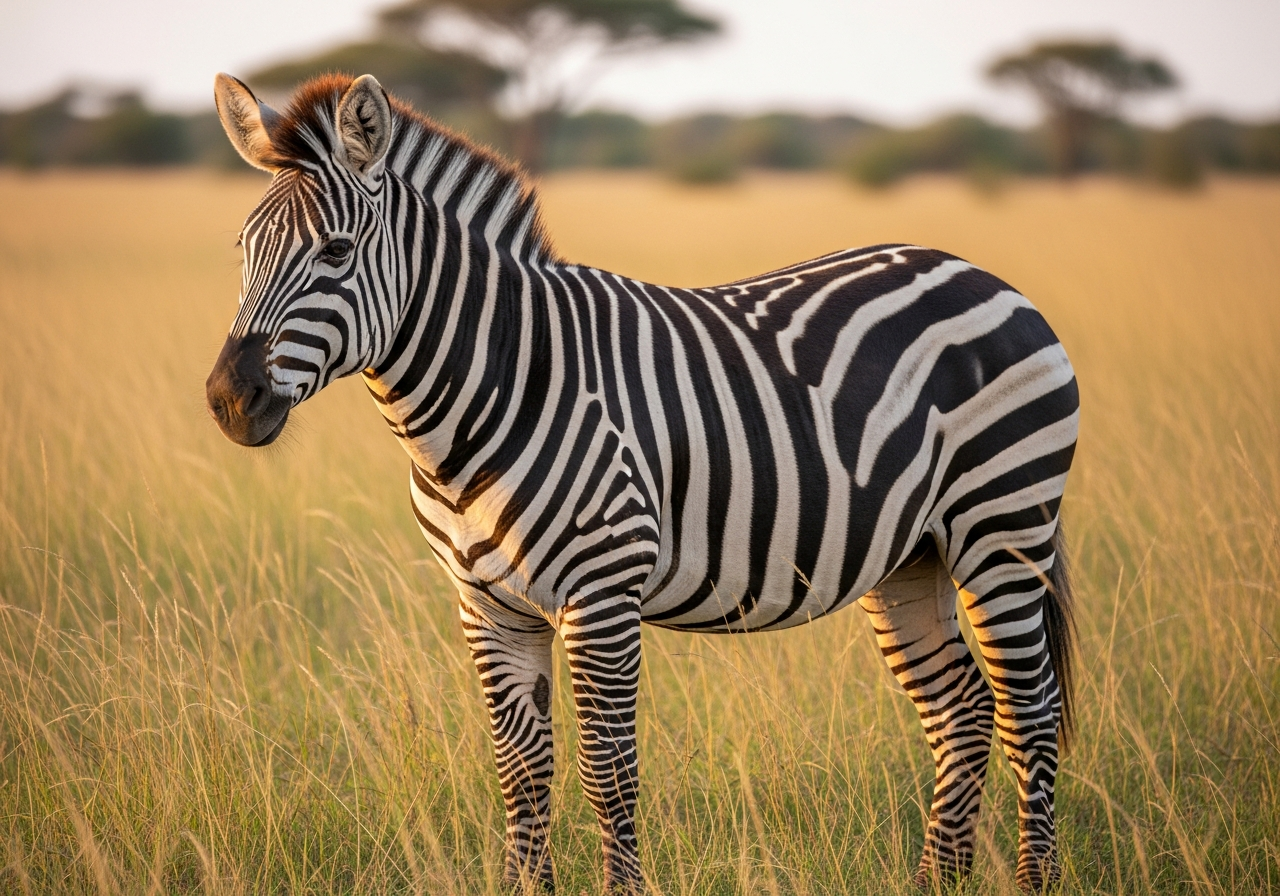
Image sourcing: see credits & licences
Quick answer
Savannas are tropical grasslands with scattered trees and strong wet/dry seasons. African savannas support dense herds of grazers (zebra, wildebeest, antelope), browsers (giraffe, elephant), and predators (lion, cheetah, hyena) that together form one of Earth’s most famous food webs.
Last updated: July 2026.
What makes a savanna a savanna
A savanna is a tropical or subtropical grassland with scattered trees and, crucially, a long dry season. That seasonality is the engine behind everything else. Rain arrives in a concentrated wet period, grass grows explosively, and then the taps shut off for months. Animals must either move to follow the water, store energy through the lean months, or specialise in extracting a living from dry, fibrous material that most herbivores cannot digest.
The scattered trees matter as much as the grass. Savanna sits in an unstable middle ground between forest and open grassland, and it stays open because of fire and large herbivores. Without periodic burning and without elephant herds pushing over saplings, much of the African savanna would thicken into woodland. This is why savanna is best understood not as a stable backdrop but as a habitat that its own animals actively maintain.
Africa hosts the most famous examples — the Serengeti, the Maasai Mara, the Kruger lowveld — but comparable grasslands exist in South America’s cerrado, northern Australia, and parts of India and Southeast Asia. The species differ; the seasonal logic does not.
Grazers: dividing one resource many ways
The savanna’s headline feature is enormous herds of grass-eaters, which raises an obvious question: how do so many similar animals coexist without competing each other out of existence? The answer is a grazing succession, and it is one of ecology’s most elegant demonstrations.
Different grazers take different parts of the same sward. Bulk feeders move through first, cropping tall coarse grass and trampling it down. Wildebeest follow, taking the shorter leafy growth that the first pass exposed. Smaller, more selective feeders such as Thomson’s gazelle come last, picking out the tender shoots and herbs now within reach. Each wave changes the grass in a way that benefits the next — facilitation rather than pure competition.
Body size drives much of this. Large animals need volume but tolerate low-quality forage, because a big gut retains food long enough to ferment it. Small animals need high-quality food but less of it. A dik-dik browsing selectively on nutritious leaves and a zebra processing coarse stems are solving the same problem from opposite ends. Zebras, unusually, ferment in the hindgut rather than a rumen — less efficient per mouthful, but faster, letting them survive on grass too poor for ruminants.
Browsers and the vertical dimension
Above the grass line, a second set of herbivores works the trees. The giraffe is the obvious specialist, reaching foliage nothing else can touch, and even within a species males and females tend to feed at different heights — a partitioning of the same trees.
Acacias do not accept this passively. Many respond to browsing by increasing tannins in their leaves within minutes, making them less palatable, and some release volatile compounds that prime neighbouring trees to do the same. Others house aggressive ants in swollen thorns that swarm any browser. Giraffes counter with a long prehensile tongue, tough lips, and a habit of feeding on one tree only briefly before moving on — often upwind, staying ahead of the chemical alarm.
Elephants operate on a different scale entirely, stripping bark and pushing over whole trees. Destructive as this looks, it is the process that keeps the savanna open, creates deadwood habitat, and brings canopy browse down to ground level for smaller animals such as impala.
Predators: dividing the prey, not just chasing it
Savanna carnivores partition their world as thoroughly as the herbivores do. The lion is a cooperative ambush hunter, using group tactics and sheer mass to take large prey — a strategy that works because a pride can defend a big carcass. The cheetah is a solitary sprint specialist built for a short explosive chase, and its light frame forces a trade-off: it can catch almost anything over a short distance but cannot defend the kill, so it eats fast and often loses meals to larger competitors. The leopard solves that problem by hauling carcasses into trees. The african wild dog takes yet another route — endurance pursuit by a coordinated pack, running prey to exhaustion rather than out-accelerating it.
Timing separates them further. Cheetahs hunt largely in daylight, partly to avoid the nocturnal lions and hyena clans that would otherwise steal their kills. The common picture of the hyena as a mere scavenger is simply wrong: spotted hyenas are capable hunters that kill a large share of their own food, and lions scavenge from them at least as often as the reverse.
Smaller predators fill the gaps — the serval pouncing on rodents in tall grass, the caracal taking birds, the secretary bird striding through grassland stamping on snakes.
Migration and the chase after rain
The Serengeti–Mara migration — well over a million wildebeest, plus zebra and gazelle, moving in a rough annual circuit — exists because savanna rainfall is patchy in both space and time. Grass quality peaks briefly after rain, and the herds are effectively chasing that peak around the ecosystem. Zebras often lead, cropping the tall grass; wildebeest follow onto the shorter growth; gazelle bring up the rear.
Migration is also an anti-predator strategy. Predators are territorial and cannot follow indefinitely, so a moving herd outruns its own predation pressure. The concentration of births into a short calving window works the same way: predators can only eat so many calves in a few weeks, so most survive simply by arriving at once. This is why fencing is so damaging — a barrier that blocks a migration route does not merely inconvenience a herd, it removes the mechanism the population depends on.
The small animals that build the habitat
The savanna’s most consequential engineers are often the least visible. Termite mounds concentrate nutrients and alter drainage, creating fertile patches where distinct plant communities grow and grazers preferentially feed; from the air, savanna productivity often maps onto termite mound spacing. Dung beetle species bury enormous quantities of herbivore dung, returning nitrogen to the soil and suppressing parasites and flies that would otherwise multiply in it.
The aardvark digs burrows that it largely abandons, and those holes become shelter for warthogs, meerkat-like mongooses, snakes, and birds — an entire secondary housing market built by one nocturnal insect-eater. Remove any of these unglamorous species and the visible megafauna suffers within a few seasons.
Quick comparison
| Role | Examples |
|---|---|
| Grazers | Zebra, antelope |
| Browsers | Giraffe, elephant |
| Ambush / pursuit predators | Lion, cheetah |
| Ecosystem engineers | Elephants opening woodland; aardvark burrows |
Explore more
Related reading
Sources
Frequently asked questions
Where are savannas found?
Large savannas occur in Africa, plus similar grasslands in South America, Australia, and parts of India and Southeast Asia.
What's the difference between savanna and grassland?
Savannas are tropical/subtropical grasslands with a long dry season and scattered trees; temperate grasslands (prairie, steppe) are usually cooler with fewer trees.
Why do so many animals migrate on the savanna?
Herds follow rain-driven grass growth — the Serengeti–Mara migration is the best-known example.
Are savannas endangered habitats?
Many face conversion to farmland, fencing that blocks migration, poaching, and climate stress.