Food Chains and Food Webs Explained
Food chains show who eats whom in a line; food webs show the real network. Producers, consumers, decomposers, and why removing one species can cascade.
Global Animal Guide · July 16, 2026
Quick answer
A food chain is a simple line of who eats whom (grass → zebra → lion). A food web is the realistic network of overlapping chains in an ecosystem. Energy usually starts with plants or phytoplankton (producers) and moves through herbivores, carnivores, and decomposers.
Last updated: July 2026.
A simple savanna chain
In reality zebras also eat herbs, lions also take wildebeest, and scavengers such as hyenas and vultures join after the kill — that mesh is the food web.
A food chain, then, is a teaching tool rather than a description of nature. It isolates one thread so you can see how energy moves. The moment you add a second predator, a seasonal diet change, or a scavenger, the line becomes a network — and the network behaves in ways the line cannot predict.
Trophic levels (schoolroom map)
- Producers — plants, algae, phytoplankton
- Primary consumers — herbivores (elephant, zooplankton)
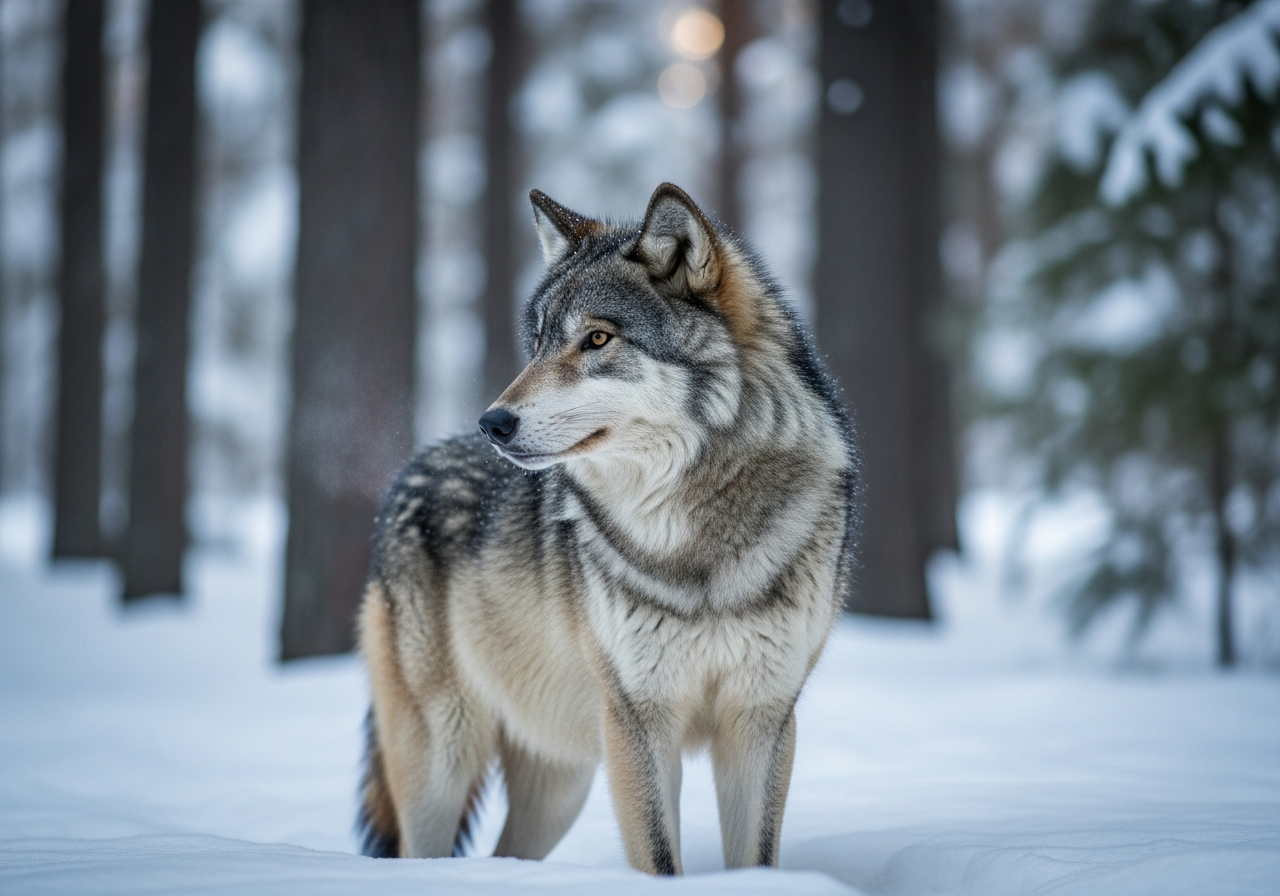
- Secondary / tertiary consumers — predators (gray wolf, sharks)
- Decomposers — fungi, bacteria, many invertebrates
Where the energy actually goes
The central fact behind every food web is that energy leaks. When a zebra eats grass, only a modest fraction of the energy in that grass ends up as zebra. The rest is spent on breathing, walking, staying warm, and digesting, or is simply never absorbed and leaves as dung. The rough teaching figure is that around a tenth of the energy at one level makes it into the next, though real ecosystems vary considerably around that number.
This leakage explains one of ecology’s most reliable patterns: there is always far more plant matter than herbivore, and far more herbivore than predator. It is not a coincidence or a matter of temperament. A savanna simply cannot fund many lion prides, because by the time energy has passed through grass and then through wildebeest, most of it is gone. The same arithmetic caps food chains at four or five links in most systems — there is rarely enough left to support a predator that eats predators that eat predators.
It also explains why big predators are so vulnerable. An animal at the top of a web depends on the entire structure beneath it staying intact. Remove some of the base and the top disappears first, because it has the least margin.
Producers: where it all starts
Almost every food web on Earth begins with something that turns sunlight into sugar. On land that means plants; in the ocean it means phytoplankton — microscopic drifting algae that collectively fix an enormous share of the planet’s carbon and feed everything from zooplankton to the blue-whale that strains them out by the tonne.
There are exceptions, and they are instructive. Around deep-sea hydrothermal vents, where no sunlight reaches, bacteria draw energy from chemicals in the vent fluid instead. Whole communities of tube worms, crabs, and molluscs live on that chemosynthetic base. Cave systems run on a similar principle, or on the imported energy of bat droppings. The rule is not “webs start with sunlight” but “webs start with something that converts an outside energy source into biological tissue”.
Consumers are messier than the diagram admits
The tidy ladder of primary, secondary, and tertiary consumers breaks down almost immediately in real ecosystems. Most animals feed at several levels at once. A brown-bear eats berries, roots, insects, and salmon within a single season — it is simultaneously a primary and a tertiary consumer, and its trophic level is best described as a fraction rather than a whole number.
Diets shift with age, too. Many fish and amphibians begin life eating algae or plankton and end it eating other animals, moving up the web as they grow. Others switch by season: a red-fox leans on fruit and insects when they are abundant and on rodents when they are not. Omnivores are not a curiosity at the edge of the diagram; they are much of the diagram.
Then there are the specialists whose role is easy to overlook. Parasites take energy without killing, and by biomass they are a substantial part of many webs. Scavengers such as the vulture intercept energy that would otherwise go straight to decomposers, and they do it fast enough to limit the spread of disease.
Decomposers close the loop
Without decomposers, a food web would run down. Nutrients would be locked inside dead bodies and fallen leaves, and producers would starve for want of nitrogen and phosphorus. Fungi and bacteria do most of this work, but they are helped enormously by animals that break material down physically first.
The earthworm drags leaf litter underground and shreds it, exposing far more surface for microbes to attack. The dung-beetle buries herbivore waste, returning nutrients to soil and denying flies a breeding site. The termite digests wood using microbes in its gut, unlocking cellulose that almost nothing else can process. These animals rarely appear in a schoolroom food chain, yet remove them and the system silts up.
Decomposers are also the reason the web is a cycle rather than a ladder. Energy flows in one direction and dissipates as heat; matter, by contrast, goes round and round indefinitely.
Why webs matter more than chains
Remove a keystone species or add an invasive predator and effects fan out sideways, not just “up” one chain. That is why conservation looks at habitats and communities, not only single species.
The classic demonstration is the sea-otter. Otters eat sea-urchin; urchins eat kelp. Where otters were hunted out, urchin numbers exploded and grazed kelp forests down to bare rock — taking with them the fish, invertebrates, and birds that depended on the kelp. Nothing ate kelp except urchins, and nothing meaningfully ate urchins except otters, so a single removal two links away collapsed the habitat. That is a trophic cascade: an effect at one level rippling down through the others.
Webs also carry things nobody intended. Persistent pollutants concentrate as they move upward, so a contaminant that is harmless in plankton can reach damaging levels in a polar-bear or an orca at the top. Biomagnification is a direct consequence of web structure: the predator eats the accumulated exposure of everything below it.
The encouraging side of this is redundancy. A web with many overlapping links can usually absorb a loss, because something else takes up the role. A web that has been simplified — by habitat loss, by fishing down the large species, by monoculture — has fewer spare threads, and each further removal does more damage than the last. Complexity is not decoration. It is the safety margin.
Related reading
- What is an apex predator?
- Carnivore vs herbivore vs omnivore
- Keystone species explained
- Food chains educator pack
Sources
Frequently asked questions
What is the difference between a food chain and a food web?
A chain is one pathway; a web shows many linked pathways. Real ecosystems are webs.
What are producers and consumers?
Producers make food from sunlight (plants, algae). Consumers eat other organisms — herbivores, carnivores, or omnivores.
Where do decomposers fit?
Fungi, bacteria, and detritivores break down dead matter and recycle nutrients back to producers.
What is a trophic cascade?
When a change at one level (often predators) ripples through the web — for example wolves affecting deer and then vegetation.