Leopard
Panthera pardus
Image sourcing: see credits & licences
Quick answer
The leopard is a powerful, secretive big cat found across Africa and parts of Asia, recognized by its golden coat covered in rosette spots. Leopards are exceptional climbers that often haul prey heavier than themselves into trees to keep it from lions and hyenas. They are highly adaptable, can run up to 58 km/h (36 mph), and typically live 12 to 17 years in the wild.
Also available in Español (Leopardo)
Leopard facts at a glance
| Scientific name | Panthera pardus |
|---|---|
| Diet | Carnivore |
| Habitat | Forest, savanna, mountains, and scrub |
| Lifespan | 12–17 years in the wild |
| Weight | 30–90 kg (66–200 lb) |
| Top speed | 58 km/h (36 mph) |
| Conservation status | Vulnerable (IUCN) |
| Kingdom | Animalia |
|---|---|
| Phylum | Chordata |
| Class | Mammalia |
| Order | Carnivora |
| Family | Felidae |
| Genus | Panthera |
What is a group of leopards called?
Group name (collective noun)
A group of Leopards is called a leap. It is also known as a prowl.
Baby name
A baby Leopard is called a cub.
Explore more animal collective nouns and baby animal names .
The ultimate generalist
Leopards are the most adaptable of all the big cats, living everywhere from rainforest and savanna to deserts and snowy mountains, and from deep wilderness to the edges of cities. They will eat almost anything they can catch, from insects and birds to antelope, which is a big reason they survive where other big cats vanish.
Climbing and caching
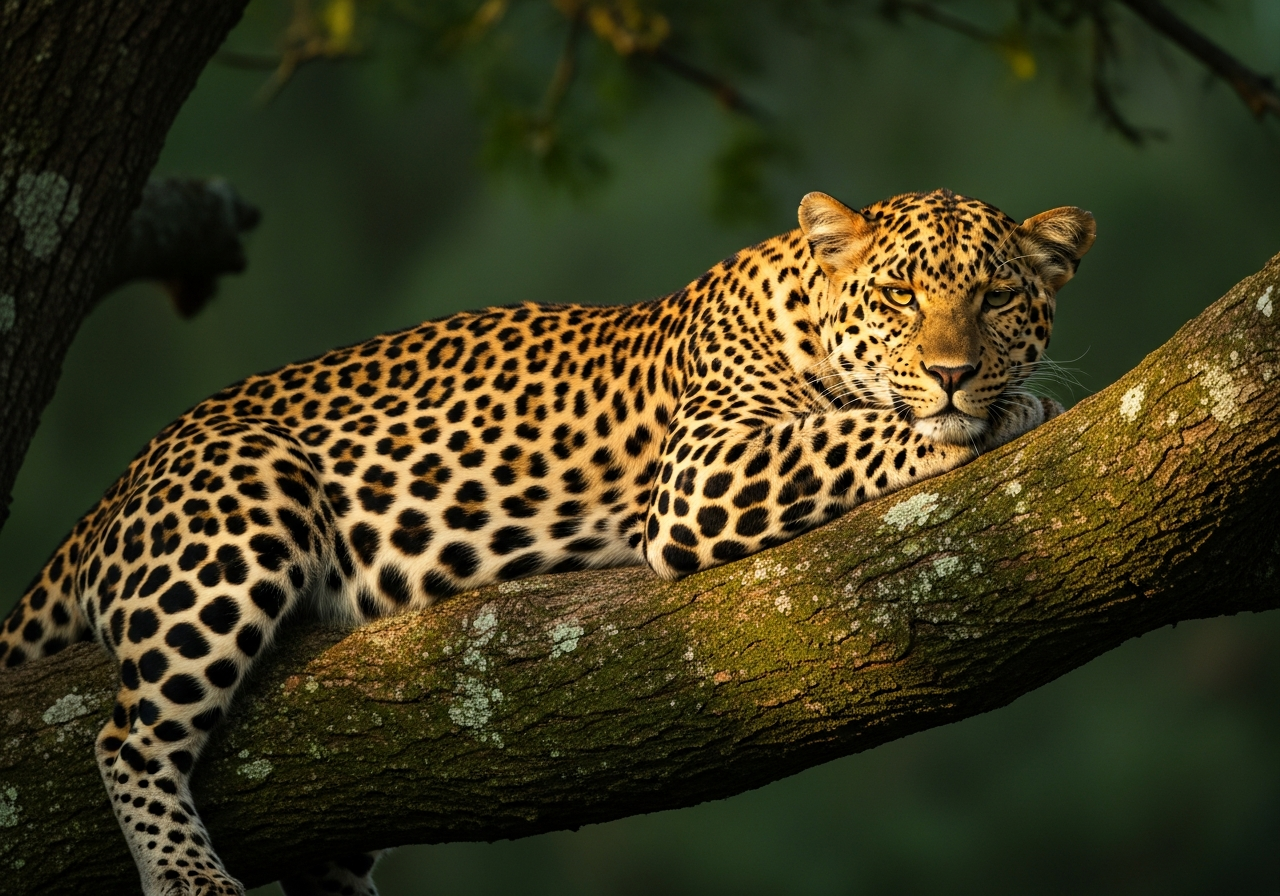
Immensely strong for their size, leopards routinely drag carcasses up into trees, sometimes lifting prey heavier than themselves. Storing a kill in the branches keeps it safe from scavenging lions and hyenas and lets the leopard feed in peace over several days.
Solitary hunters
Leopards are solitary and largely nocturnal, relying on stealth rather than speed. They stalk to within a few meters of prey before a final explosive rush, then dispatch it with a precise bite. Each leopard's rosette pattern is unique, helping it stay camouflaged in dappled light.
Conservation
Leopards are listed as Vulnerable, with several subspecies far more endangered, such as the critically endangered Amur leopard of the Russian Far East. Habitat loss, prey decline, poaching for skins and bones, and conflict with farmers are the main threats across their wide range.
Adaptability
Leopards are the most widespread big cat, living across Africa and Asia in habitats ranging from rainforest and savanna to mountains and even the edges of cities. This adaptability, combined with a broad diet, has helped them survive in places where other big cats have disappeared.
Strength and tree-caching
Leopards are extraordinarily strong for their size and often haul kills heavier than themselves into trees to keep them safe from lions and hyenas. They are solitary, mostly nocturnal hunters that rely on stealth to get very close before striking.
Dig deeper into the Leopard
- Are Leopard Endangered
Dig deeper into leopard — are leopard endangered.
- How Fast Is A Leopard
Dig deeper into leopard — how fast is a leopard.
- How Long do Leopard Live?
Dig deeper into leopard — how long do leopard live.
- What do Leopard Eat
Dig deeper into leopard — what do leopard eat.
- Where do Leopard Live?
Dig deeper into leopard — where do leopard live.
Explore the Leopard
Collections
Range & geography
Did you know? Leopard facts
- Leopards are the most widespread big cat, ranging across Africa and much of Asia.
- They routinely haul prey heavier than themselves up into trees to avoid scavengers.
- Black panthers are simply leopards (or jaguars) with a melanistic, all-dark coat.
- Leopards are highly adaptable and can live close to cities, often unseen.
- A leopard's rosette pattern differs by region and helps conceal it in dappled light.
- They are powerful, stealthy ambush hunters active mainly at night.
Diet & feeding
Leopards take an unusually broad diet — antelope, deer, primates, rodents, birds, and even insects — favouring medium-sized prey they can ambush and, where needed, hoist into trees.
Adaptations
- Rosette-patterned fur provides camouflage across forest, savanna, and rocky terrain. (Estes 1991)
- Exceptional climbing strength lets leopards cache kills in trees, away from lions and hyenas.
- A compact, muscular build supports both stealth and the power to drag heavy prey.
- Acute night vision and hearing make the leopard an efficient nocturnal predator.
Behaviour & ecology
- Leopards are solitary and territorial, marking ranges with scent and claw marks. (Estes 1991)
- They are dietary generalists, which underpins their success across many habitats.
- Mothers raise cubs alone, hiding them in dense cover for the first weeks.
- Caching kills in trees is a signature behaviour that reduces competition.
Communication
- A rasping, saw-like call advertises territory and helps individuals locate one another.
- Scent-marking and scrapes map out and defend territory.
- Tail and body postures, plus the white tail-tip, signal to cubs and rivals.
Habitat & range
Leopards occupy an exceptional range of habitats — rainforest, savanna, mountains, scrub, and semi-desert — from sub-Saharan Africa through the Middle East to Southeast Asia, often persisting near human settlement.
Ecological role
As an adaptable mesopredator-to-apex predator, the leopard controls populations of medium-sized herbivores and primates and helps maintain balance across diverse ecosystems.
Conservation status of the Leopard
Vulnerable (VU) means a species faces a high risk of extinction in the medium-term future. It is the lowest-risk of the three 'threatened' IUCN categories — one step below Endangered, which is itself below Critically Endangered — and is often an early warning that a population is in trouble.
Main threats to the leopard
- Habitat loss and fragmentation
- Poaching for the illegal wildlife trade
- Prey depletion
- Human–wildlife conflict
Leopard (Panthera pardus) was most recently assessed for the IUCN Red List in 2023. View the full IUCN assessment .
Frequently asked questions about the Leopard
What is the difference between a leopard and a jaguar?
Leopards live in Africa and Asia and have smaller rosettes without central spots, while jaguars live in the Americas, are bulkier, and have rosettes with spots inside them.
Can leopards climb trees?
Yes. Leopards are excellent climbers and frequently rest and store their prey in trees, hauling carcasses high off the ground.
Can leopards really climb trees with their prey?
Yes. Leopards are powerful climbers and often haul carcasses, sometimes heavier than themselves, high into trees to protect their kills from lions and hyenas.
How fast can a leopard run?
Leopards can sprint up to about 58 km/h (36 mph), but they rely far more on stealth, stalking close to prey before a short, explosive charge.
What is a black panther?
A black panther is not a separate species. It is usually a leopard (in Africa or Asia) or a jaguar (in the Americas) with a genetic condition called melanism that makes its coat very dark, though the rosettes are still faintly visible.
Are leopards endangered?
Leopards are listed as Vulnerable overall, and some subspecies, such as the Amur leopard, are Critically Endangered. Habitat loss, poaching, and prey decline threaten them across Africa and Asia.
What is a group of leopards called?
A group of Leopards is called a leap. It is also known as a prowl.
What is a baby leopard called?
A baby Leopard is called a cub.
Sources & references
This guide is compiled and reviewed against established zoological and conservation references. Key sources for the Leopard:
-
IUCN Red List of Threatened Species
Conservation status (Vulnerable) reflects the IUCN Red List category for Panthera pardus, most recently assessed in 2023.
- Stein, A. B. et al. (2020). Panthera pardus. IUCN Red List of Threatened Species.
Status (Vulnerable) and range.
- Estes, R. D. (1991). The Behavior Guide to African Mammals. University of California Press.
Behaviour and ecology.
- Animal Diversity Web — Panthera pardus. University of Michigan Museum of Zoology.
Life history, morphology, and range.
-
Global Animal Guide editorial standards
How we research, source, review, and update every guide for accuracy.