African Elephant
Loxodonta africana
Photo: Muhammad Mahdi Karim Facebook The making of this document was supported by Wikimedia CH. (Submit your project!) For all the files concerned, please see the category Supported by Wikimedia CH. العربية ∙ বাংলা ∙ čeština ∙ Deutsch ∙ English ∙ Esperanto ∙ español ∙ français ∙ galego ∙ हिन्दी ∙ magyar ∙ italiano ∙ 日本語 ∙ македонски ∙ Nederlands ∙ português do Brasil ∙ rumantsch ∙ русский ∙ sicilianu ∙ slovenščina ∙ தமிழ் ∙ українська ∙ 中文 ∙ +/− · GFDL 1.2 · source · credits
Quick answer
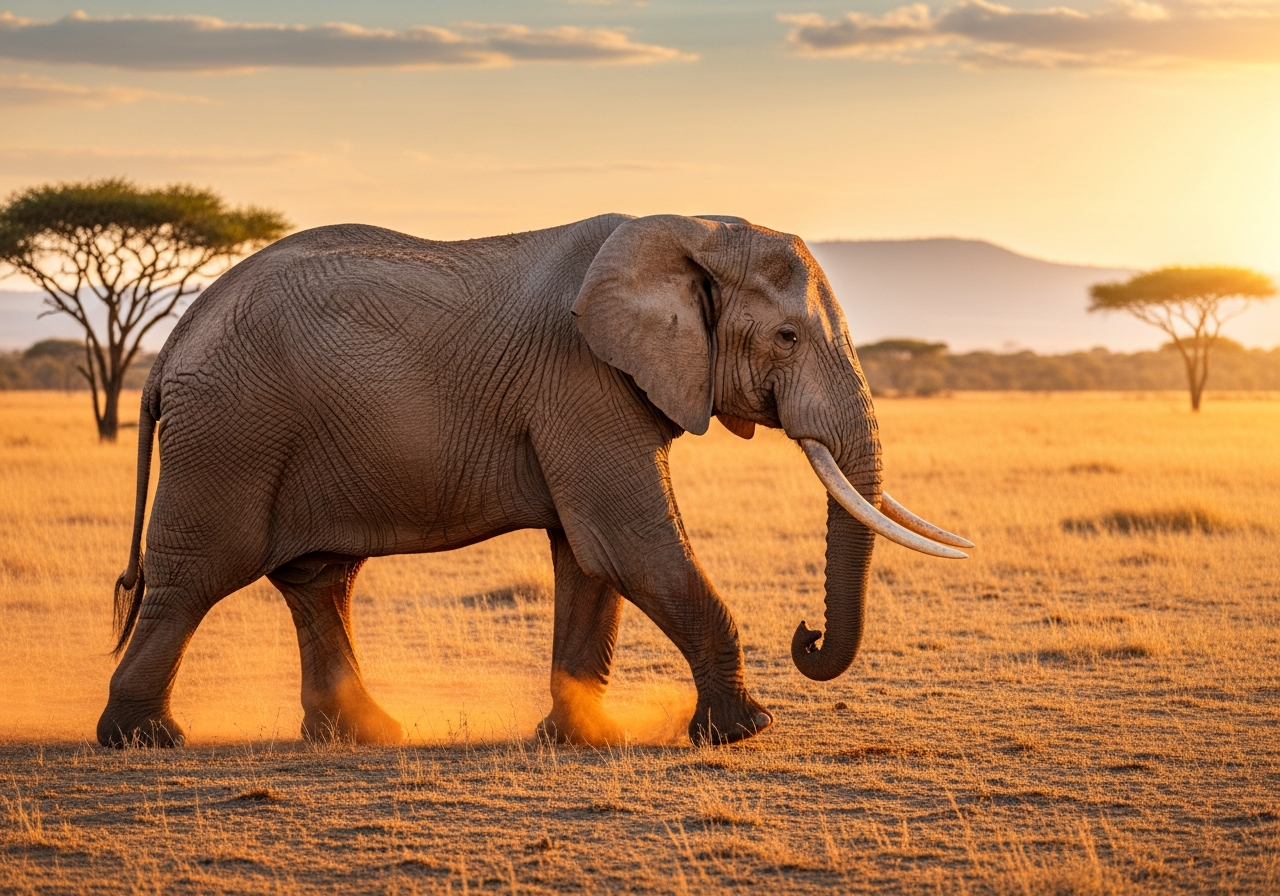
The African elephant is the largest living land animal, weighing up to 6,000 kg (13,200 lb) and standing up to 4 m (13 ft) at the shoulder. They are highly intelligent, deeply social, and use their trunks for breathing, drinking, grasping, and communication. Wild elephants can live 60 to 70 years.
Also available in Español (Elefante africano)
African Elephant facts at a glance
| Scientific name | Loxodonta africana |
|---|---|
| Diet | Herbivore |
| Habitat | Savanna, forest, desert edge |
| Lifespan | 60–70 years in the wild |
| Weight | 2,700–6,000 kg (6,000–13,200 lb) |
| Height | Up to 4 m (13 ft) at the shoulder |
| Conservation status | Endangered (IUCN) |
| Kingdom | Animalia |
|---|---|
| Phylum | Chordata |
| Class | Mammalia |
| Order | Proboscidea |
| Family | Elephantidae |
| Genus | Loxodonta |
Where it lives
The savannas, forests, and desert edges of sub-Saharan Africa.
What is a group of african elephants called?
Group name (collective noun)
A group of African Elephants is called a herd. It is also known as a parade.
Baby name
A baby African Elephant is called a calf.
Explore more animal collective nouns and baby animal names .
Diet
Elephants are herbivores that eat grasses, leaves, bark, roots, and fruit. An adult can consume up to 150 kg (330 lb) of vegetation and drink up to 190 liters (50 gallons) of water in a single day, spending up to 16 hours feeding.
The trunk and tusks
An elephant's trunk contains around 40,000 muscles and is used for breathing, smelling, drinking, grasping food, and social touch. Tusks are elongated incisor teeth used for digging, stripping bark, and defense, but they also make elephants a target for the ivory trade.
Conservation
African savanna elephants are Endangered and forest elephants are Critically Endangered, largely because of poaching for ivory and habitat fragmentation. As a keystone species, elephants shape entire ecosystems by clearing trees, spreading seeds, and digging waterholes.
Intelligence and memory
Elephants have the largest brain of any land animal and show remarkable intelligence, including problem-solving, tool use, and self-recognition in mirrors. They display apparent grief, returning to and touching the bones of dead herd members, and can remember distant water sources and individual animals over many years.
Herd structure
Elephant herds are matriarchal, led by the oldest and most experienced female, who guides the group to food and water. Adult males usually leave the herd as they mature and live alone or in loose bachelor groups, rejoining females mainly to breed.
Dig deeper into the African Elephant
- African Vs Asian Elephant
Dig deeper into african elephant — african vs asian elephant.
- Are Elephant Endangered
Dig deeper into african elephant — are elephant endangered.
- How Fast Is A Elephant
Dig deeper into african elephant — how fast is a elephant.
- How Long do Elephant Live?
Dig deeper into african elephant — how long do elephant live.
- How Much Does An Elephant Weigh
Dig deeper into african elephant — how much does an elephant weigh.
- What do Elephant Eat
Dig deeper into african elephant — what do elephant eat.
- Where do Elephant Live?
Dig deeper into african elephant — where do elephant live.
Explore the African Elephant
Compare
Collections
Range & geography
Did you know? African Elephant facts
- The African bush elephant is the largest land animal, with big bulls reaching around 6,000 kg (6 tonnes).
- An elephant's trunk has no bone yet contains tens of thousands of muscle units, giving extraordinary dexterity.
- Elephants are among the few animals to show apparent recognition of themselves in a mirror.
- Herds are led by a matriarch — usually the oldest female — whose memory of resources can be vital in droughts.
- Elephants communicate over kilometres using low-frequency 'rumbles', much of it below human hearing.
- A newborn calf already weighs around 100 kg and can stand within hours of birth.
- Elephants eat up to ~150 kg of vegetation a day and act as ecosystem engineers across their range.
Diet & feeding
As bulk herbivores, elephants browse and graze on grasses, leaves, bark, roots, and fruit, consuming roughly 150 kg of vegetation and up to 100+ litres of water daily, with diet shifting seasonally between grazing and browsing.
Adaptations
- The prehensile trunk works as nose, hand, snorkel, and tool — manipulating objects and drawing up water. (Sukumar 2003)
- Large ears radiate heat and are fanned to cool blood in hot climates (especially in African species).
- Pillar-like legs positioned under the body bear immense weight efficiently.
- Ever-growing molars are replaced in sequence up to six times across a lifetime as they wear down. (Nowak 1999)
- Sensitive foot pads detect seismic vibrations, aiding long-distance communication.
Behaviour & ecology
- Females live in stable matriarchal family groups; males disperse and may enter periodic 'musth'. (Moss 1988)
- Elephants show strong social bonds, cooperative calf care, and apparent interest in dead herd-mates.
- Matriarchs draw on long memories of distant water and food sources during droughts. (McComb et al. 2001)
- Mud- and dust-bathing protect the skin from sun and parasites.
Communication
- Low-frequency infrasonic rumbles travel several kilometres and coordinate herd movement. (Payne et al. 1986)
- Seismic signals through the ground supplement airborne calls.
- Rich tactile signalling with the trunk reinforces bonds and reassures calves.
- Visual postures of ears, head, and trunk convey threat, greeting, and mood.
Habitat & range
African elephants range across savanna, forest, and semi-arid scrub south of the Sahara (two species: bush and forest), while Asian elephants inhabit forests and grasslands from India to Southeast Asia. All need large, connected areas to meet their huge food and water demands.
Ecological role
Elephants are keystone ecosystem engineers: they disperse seeds over long distances, fell trees and open up woodland to grassland, dig waterholes used by other species, and create paths that shape the landscape.
Conservation status of the African Elephant
Endangered (EN) means a species faces a very high risk of extinction in the wild. Populations are usually declining sharply due to habitat loss, hunting, disease, or climate pressure. It sits one level below Critically Endangered on the IUCN Red List.
Main threats to the african elephant
- Poaching for ivory
- Habitat loss and fragmentation
- Human–elephant conflict
African Elephant (Loxodonta africana) was most recently assessed for the IUCN Red List in 2021. View the full IUCN assessment .
Frequently asked questions about the African Elephant
How much does an elephant eat?
Elephants are herbivores that can eat up to 150 kg (330 lb) of vegetation and drink up to 190 liters of water in a single day.
What is the difference between African and Asian elephants?
African elephants are larger, with bigger ears, and both sexes usually have tusks. Asian elephants are smaller with smaller ears, and many individuals lack visible tusks.
What is the largest land animal?
The African elephant is the largest land animal on Earth. Large males can weigh up to 6,000 kg (13,200 lb) and stand up to 4 m (13 ft) tall at the shoulder.
What do elephants eat?
Elephants are herbivores that eat grasses, leaves, bark, roots, and fruit. An adult may eat up to 150 kg of plant matter and drink up to 190 liters of water each day.
How long do elephants live?
Wild elephants typically live 60 to 70 years, making them one of the longest-lived land mammals. Lifespan in captivity is often shorter.
Why are elephants endangered?
Elephants are endangered mainly because of poaching for ivory and the loss and fragmentation of their habitat. African forest elephants are now classified as Critically Endangered.
How many muscles are in an elephant's trunk?
An elephant's trunk contains an estimated 40,000 muscles, giving it the dexterity to pick up a single blade of grass or carry hundreds of kilograms.
Do elephants really have good memories?
Yes. Elephants have excellent long-term memory, which helps matriarchs remember distant water sources during droughts and recognize individuals after years apart.
What is a group of african elephants called?
A group of African Elephants is called a herd. It is also known as a parade.
What is a baby african elephant called?
A baby African Elephant is called a calf.
Sources & references
This guide is compiled and reviewed against established zoological and conservation references. Key sources for the African Elephant:
-
IUCN Red List of Threatened Species
Conservation status (Endangered) reflects the IUCN Red List category for Loxodonta africana, most recently assessed in 2021.
- Gobush, K. S. et al. (2021). Loxodonta africana. The IUCN Red List of Threatened Species.
Conservation status and threats (African savanna elephant).
- Sukumar, R. (2003). The Living Elephants: Evolutionary Ecology, Behavior, and Conservation. Oxford University Press.
Biology and ecology across species.
- Moss, C. (1988). Elephant Memories: Thirteen Years in the Life of an Elephant Family. William Morrow.
Long-term social behaviour.
- Payne, K. B. et al. (1986). Infrasonic calls of the Asian elephant. Behavioral Ecology and Sociobiology.
Low-frequency communication.
-
Global Animal Guide editorial standards
How we research, source, review, and update every guide for accuracy.
Want to help directly? Learn how to symbolically adopt a african elephant and support its conservation.