Quick answer
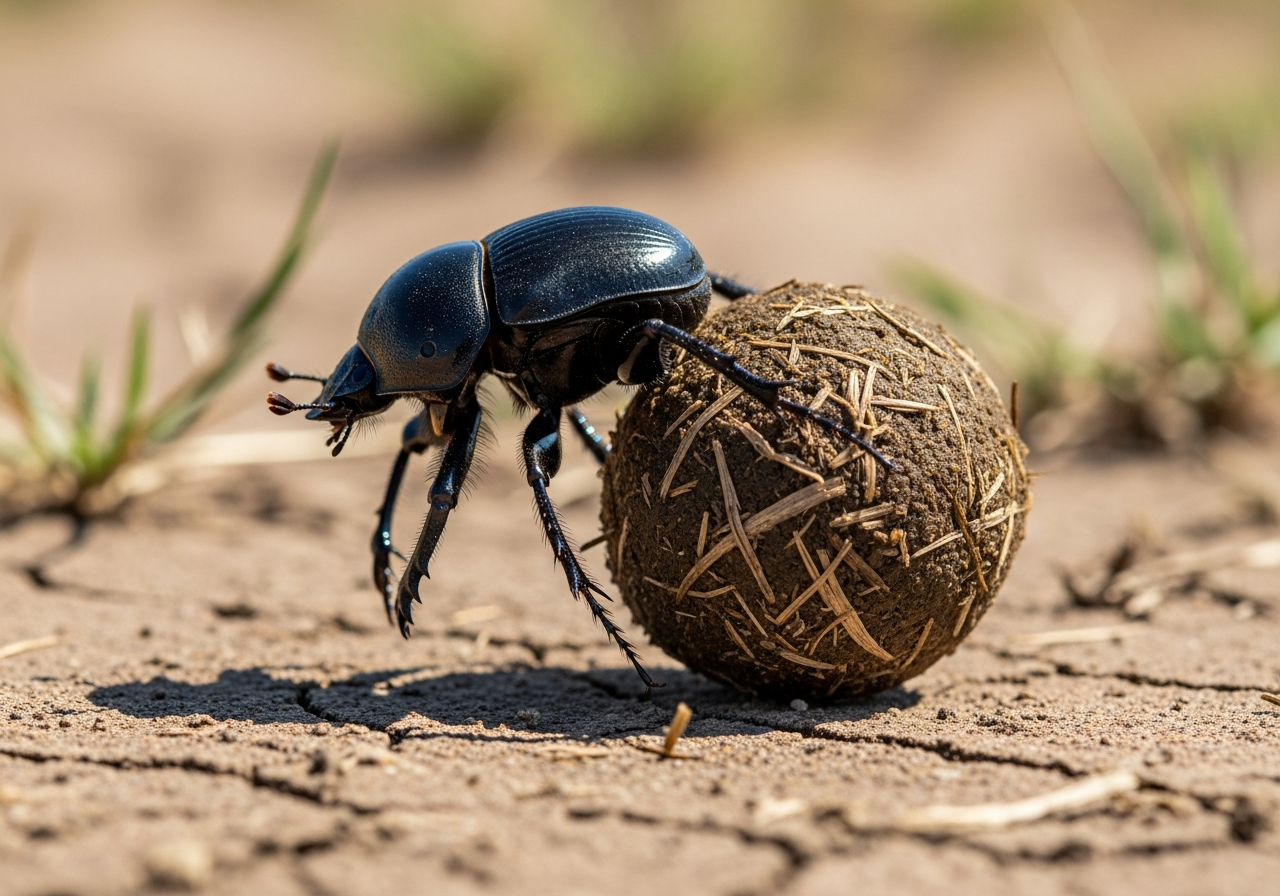
Dung beetles are beetles that feed on animal droppings, and many are famous for rolling dung into balls and pushing them away to bury as food or a brood chamber. They are remarkably strong for their size and play a vital role in recycling waste, improving soil, and reducing pests. Found on every continent except Antarctica, dung beetles include species that roll, tunnel, or simply dwell in dung.
Top questions about the Dung Beetle
Dung Beetle facts at a glance
- Weight 3 g
- Length 3 cm
- Top speed 1 km/h
- Lifespan 1 years
| Scientific name | Scarabaeus sacer |
|---|---|
| Diet | Coprophagous (animal dung) |
| Habitat | Grasslands, farmland, forests, and deserts |
| Lifespan | Around 1 to 3 years |
| Length | 0.5–3 cm depending on species |
| Strength | Can move many times its own body weight |
| Conservation status | Least Concern (IUCN) |
| Kingdom | Animalia |
|---|---|
| Phylum | Arthropoda |
| Class | Insecta |
| Order | Coleoptera |
| Family | Scarabaeidae |
| Genus | Scarabaeus |
Where it lives
The dung beetle (Scarabaeus sacer) is native to Grasslands, farmland, and deserts worldwide; famous for rolling balls of dung. — recorded across Africa, Europe, Asia in this guide’s range summary.
For occurrence records, see GBIF species search and sources below.
How big is a dung beetle?
An adult dung beetle measures 3 cm long — about 1% of the height of an average adult person (1.73 m) — and weighs around 3 g, a small fraction of an average adult’s body weight (70 kg).
Length vs an average adult’s height (to scale)
What is a group of dung beetles called?
Group name (collective noun)
A group of Dung Beetles is called a colony.
Baby name
A baby Dung Beetle is called a grub. It may also be called a larva.
Explore more animal collective nouns and baby animal names .
Rollers, tunnelers, and dwellers
Dung beetles use dung in different ways depending on the species. Rollers shape dung into balls and push them away to bury, tunnelers dig down beneath a dung pat to store it, and dwellers simply live within the dung itself. The rolling species are the most famous, navigating in straight lines sometimes using the sun, the moon, or even the band of the Milky Way.
Remarkable strength
Dung beetles are among the strongest animals for their size. Some species can pull loads many hundreds of times their own body weight, the equivalent of a person hauling several loaded trucks. This strength helps them move dung balls far larger and heavier than themselves across uneven ground.
Diet and reproduction
Both adults and larvae feed on dung, which provides nutrients and moisture. Many species form a brood ball in which the female lays an egg, so the hatching larva has a ready food supply. By burying dung, the beetles also plant it underground where it nourishes the soil.
Ecological importance
By burying and consuming dung, dung beetles recycle nutrients, improve soil structure, and reduce the breeding grounds of pest flies and parasites that thrive in droppings. They also help disperse seeds contained in dung. These services make them valuable to farmers and to natural grassland ecosystems worldwide.
Dig deeper into the Dung Beetle
- Dung Beetle: Key Facts
Dung beetles are beetles that feed on animal droppings, and many are famous for rolling dung into balls and pushing them away to bury as food or a brood…
- What Do Dung Beetles Eat?
What dung beetles eat: Coprophagous (animal dung), foraging style, and seasonal shifts in Grasslands, farmland, forests, and deserts.
- Where Do Dung Beetles Live?
Where dung beetles live: Grasslands, farmland, forests, and deserts, native range cues, and human overlap. Status Least Concern.
Explore the Dung Beetle
Related Insects
Range & geography
Did you know? Dung Beetle facts
- Dung beetles are beetles that feed on animal droppings, and many are famous for rolling dung into balls and pushing them away to bury as food or a brood chamber.
- Rolling species shape dung into balls and push them away to bury as a food store or as a brood chamber for their eggs. Moving the dung away reduces competition from other beetles at the original pile.
- Dung beetles are among the strongest animals relative to their size, with some species able to pull many hundreds of times their own body weight. This lets them move dung balls far heavier than themselves.
- Dung beetles feed on animal droppings, which provide both nutrients and moisture. Both the adults and their larvae rely on dung as their main food source.
- Yes. By burying dung they recycle nutrients, improve soil, disperse seeds, and reduce pest flies and parasites. These services make them valuable to farming and natural ecosystems.
- Conservation: Least Concern (IUCN).
Diet & feeding
Dung Beetle feeds primarily as a coprophagous (animal dung). Dung beetles use dung in different ways depending on the species. Rollers shape dung into balls and push them away to bury, tunnelers dig down beneath a dung pat to store it, and dwellers simply live within the dung itself. The rolling species are the most fa
Adaptations
- Dung beetles use dung in different ways depending on the species. Rollers shape dung into balls and push them away to bury, tunnelers dig down beneath a dung pat to store it, and dwellers simply live within the dung itself. The rolling species are the most famous, navigating in straight lines sometimes using the sun, the moon, or even the band of the Milky Way.
- Dung beetles are among the strongest animals for their size. Some species can pull loads many hundreds of times their own body weight, the equivalent of a person hauling several loaded trucks. This strength helps them move dung balls far larger and heavier than themselves across uneven ground.
Behaviour & ecology
- Dung beetles use dung in different ways depending on the species. Rollers shape dung into balls and push them away to bury, tunnelers dig down beneath a dung pat to store it, and dwellers simply live within the dung itself. The rolling species are the most famous, navigating in straight lines sometimes using the sun, the moon, or even the band of the Milky Way.
- Dung beetles are among the strongest animals for their size. Some species can pull loads many hundreds of times their own body weight, the equivalent of a person hauling several loaded trucks. This strength helps them move dung balls far larger and heavier than themselves across uneven ground.
- Both adults and larvae feed on dung, which provides nutrients and moisture. Many species form a brood ball in which the female lays an egg, so the hatching larva has a ready food supply. By burying dung, the beetles also plant it underground where it nourishes the soil.
Communication
- Dung Beetle uses scent, posture, and vocal signals to mark territory and coordinate social behaviour.
- Communication intensity often peaks during breeding seasons and territorial disputes.
Habitat & range
Grasslands, farmland, forests, and deserts
Ecological role
Dung Beetle participates in pollination, decomposition, or prey-base support for birds and other insectivores.
Conservation status of the Dung Beetle
The dung beetle (Scarabaeus sacer) is listed as Least Concern on the IUCN Red List. Least Concern (LC) is the IUCN's lowest-risk category, assigned to widespread, abundant species that have been evaluated and found not to be threatened. It does not mean a species faces no pressures — only that it is not currently at risk of extinction.
The dung beetle (Scarabaeus sacer) is assessed on the IUCN Red List. Look up on the IUCN Red List .
Frequently asked questions about the Dung Beetle
Why do dung beetles roll dung?
Rolling species shape dung into balls and push them away to bury as a food store or as a brood chamber for their eggs. Moving the dung away reduces competition from other beetles at the original pile.
How strong are dung beetles?
Dung beetles are among the strongest animals relative to their size, with some species able to pull many hundreds of times their own body weight. This lets them move dung balls far heavier than themselves.
What do dung beetles eat?
Dung beetles feed on animal droppings, which provide both nutrients and moisture. Both the adults and their larvae rely on dung as their main food source.
Are dung beetles useful?
Yes. By burying dung they recycle nutrients, improve soil, disperse seeds, and reduce pest flies and parasites. These services make them valuable to farming and natural ecosystems.
How do dung beetles navigate?
Rolling dung beetles move in straight lines using cues such as the position of the sun or moon, and some can even orient by the band of the Milky Way. This keeps them from circling back to the dung pile.
Where do dung beetles live?
Dung beetles are found on every continent except Antarctica, in habitats ranging from grasslands and farmland to forests and deserts. They live wherever grazing animals leave droppings to feed on.
What is a group of dung beetles called?
A group of Dung Beetles is called a colony.
What is a baby dung beetle called?
A baby Dung Beetle is called a grub. It may also be called a larva.
Sources & references
This guide is compiled and reviewed against established zoological and conservation references. Key sources for the Dung Beetle:
-
IUCN Red List of Threatened Species
Conservation status (Least Concern) reflects the IUCN Red List category for Scarabaeus sacer.
-
iNaturalist — observations & photos
Search citizen-science observations and community IDs for Scarabaeus sacer. Useful for range checks and recent sightings — not a substitute for formal Red List status.
-
GBIF — occurrence data
Global Biodiversity Information Facility species search for Scarabaeus sacer. Explore published occurrence records used in range research.
- IUCN Red List — Scarabaeus sacer.
Conservation status (Least Concern) and population trends.
- Animal Diversity Web — Scarabaeus sacer. University of Michigan Museum of Zoology.
Life history, morphology, and range.
- Wikipedia — Dung Beetle.
General taxonomy and overview (cross-check primary sources).
-
Global Animal Guide editorial standards
How we research, source, review, and update every guide for accuracy.