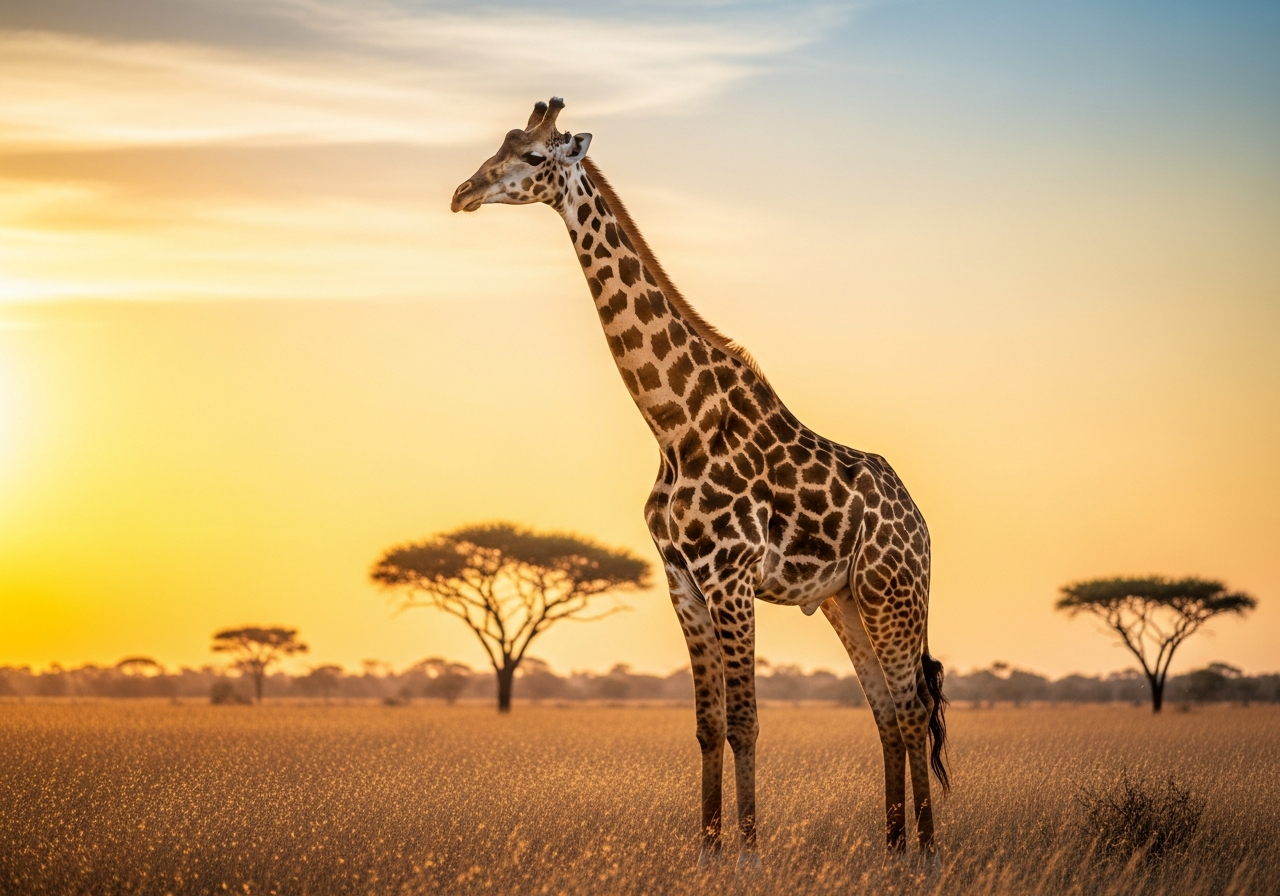
Giraffe
Giraffa camelopardalis
Photo: Muhammad Mahdi Karim Facebook The making of this document was supported by Wikimedia CH. (Submit your project!) For all the files concerned, please see the category Supported by Wikimedia CH. العربية ∙ বাংলা ∙ čeština ∙ Deutsch ∙ English ∙ Esperanto ∙ español ∙ français ∙ galego ∙ हिन्दी ∙ magyar ∙ italiano ∙ 日本語 ∙ македонски ∙ Nederlands ∙ português do Brasil ∙ rumantsch ∙ русский ∙ sicilianu ∙ slovenščina ∙ தமிழ் ∙ українська ∙ 中文 ∙ +/− · GFDL 1.2 · source · credits
Quick answer
The giraffe is the tallest living animal, with adult males reaching up to 5.5 m (18 ft). Native to the savannas of Africa, giraffes use their long necks and 45 cm (18 in) tongues to browse leaves high in acacia trees. Despite the neck's length, a giraffe has just seven neck bones, the same number as humans, and typically lives around 25 years.
Also available in Español (Jirafa)
Giraffe facts at a glance
| Scientific name | Giraffa camelopardalis |
|---|---|
| Diet | Herbivore |
| Habitat | Savanna, grassland, and open woodland |
| Lifespan | 20–25 years in the wild |
| Height | 4.3–5.5 m (14–18 ft) |
| Top speed | 60 km/h (37 mph) |
| Conservation status | Vulnerable (IUCN) |
| Kingdom | Animalia |
|---|---|
| Phylum | Chordata |
| Class | Mammalia |
| Order | Artiodactyla |
| Family | Giraffidae |
| Genus | Giraffa |
Where it lives
Savannas and open woodlands of sub-Saharan Africa, from the Sahel to South Africa.
What is a group of girafves called?
Group name (collective noun)
A group of Girafves is called a tower.
Baby name
A baby Giraffe is called a calf.
Explore more animal collective nouns and baby animal names .
Built tall
A giraffe's neck alone can be over 2 m (6 ft) long, yet it contains only seven vertebrae like almost all mammals. To pump blood up to the brain, the giraffe has an oversized heart and the highest blood pressure of any animal, with special vessels in the neck that stop it blacking out when it lowers its head to drink.
Diet and feeding
Giraffes are browsers that feed mainly on the leaves, shoots, and flowers of acacia and other trees, using a long prehensile tongue and tough lips to strip foliage past the thorns. They eat for many hours a day and get most of their water from their food, so they can go long stretches without drinking.
Conservation
Giraffe numbers have fallen sharply in recent decades, a decline some call a 'silent extinction'. Habitat loss, poaching, and civil unrest across their range have driven the species to Vulnerable, with some subspecies critically threatened. Protected reserves and anti-poaching work are central to their recovery.
Adaptations for height
The giraffe is the tallest land animal, reaching up to 5.5 m (18 ft). Despite its length, its neck contains the same seven vertebrae found in most mammals. A powerful heart and specialized blood vessels manage the enormous blood pressure needed to pump blood all the way up to the brain.
Behavior and feeding
Giraffes browse mainly on acacia leaves, using a prehensile tongue up to 45 cm long to strip foliage past the thorns. Males establish dominance by necking, swinging their heads and necks against rivals. Giraffes need very little sleep, sometimes only a few minutes at a time.
Dig deeper into the Giraffe
- Are Giraffe Endangered
Dig deeper into giraffe — are giraffe endangered.
- How Fast Is A Giraffe
Dig deeper into giraffe — how fast is a giraffe.
- How Long do Giraffe Live?
Dig deeper into giraffe — how long do giraffe live.
- What do Giraffe Eat
Dig deeper into giraffe — what do giraffe eat.
- Where do Giraffe Live?
Dig deeper into giraffe — where do giraffe live.
Explore the Giraffe
Collections
Range & geography
Did you know? Giraffe facts
- The giraffe is the tallest living animal, with males reaching up to 5.5 m.
- A giraffe's neck has just seven vertebrae — the same number as a human.
- Special blood-pressure control stops a giraffe fainting when it raises its head.
- Giraffes sleep very little, sometimes only around 30 minutes a day.
- Each giraffe's coat pattern is unique, like a fingerprint.
- Males fight by swinging their necks and heads in bouts called 'necking'.
Diet & feeding
Giraffes are browsers feeding mainly on the leaves, shoots, and flowers of acacia and other trees, using a long tongue and lips to handle thorns; they can go long periods without drinking.
Adaptations
- A powerful heart and tight leg skin manage the extreme blood pressure of a long neck. (Estes 1991)
- A 45-cm prehensile tongue strips leaves from thorny acacia branches.
- Long legs and neck give access to high foliage other browsers cannot reach.
- Patterned coat breaks up the outline among dappled trees.
Behaviour & ecology
- Giraffes live in loose, fluid herds without strong long-term bonds. (Estes 1991)
- Males establish dominance through 'necking' contests.
- They spend much of the day browsing high foliage, beyond competitors' reach.
- Calves are vulnerable early on and gather in informal nursery groups.
Communication
- Giraffes use infrasonic sounds, plus snorts and grunts, alongside vision.
- Their height gives excellent long-distance visual awareness of threats.
- Posture and 'necking' displays settle dominance between males.
Habitat & range
Giraffes range across savannas, grasslands, and open woodlands of sub-Saharan Africa, favouring areas with scattered acacia and other browse trees.
Ecological role
As the tallest browser, the giraffe shapes the structure of acacia woodland, disperses seeds, and opens feeding niches unavailable to shorter herbivores.
Conservation status of the Giraffe
Vulnerable (VU) means a species faces a high risk of extinction in the medium-term future. It is the lowest-risk of the three 'threatened' IUCN categories — one step below Endangered, which is itself below Critically Endangered — and is often an early warning that a population is in trouble.
The giraffe (Giraffa camelopardalis) is assessed on the IUCN Red List. Look up on the IUCN Red List .
Frequently asked questions about the Giraffe
How tall is a giraffe?
Adult giraffes stand 4.5 to 5.5 m (15 to 18 ft) tall, with males taller than females. Newborn calves are already about 1.8 m tall.
Are giraffes endangered?
Giraffe numbers have declined significantly, and the species is listed as Vulnerable by the IUCN, with some subspecies considered Critically Endangered.
How many bones are in a giraffe's neck?
A giraffe has just seven neck vertebrae, the same number as a human. Each bone is simply very long, which is what gives the giraffe its towering neck.
What do giraffes eat?
Giraffes are herbivores that browse mostly on acacia leaves and other tree foliage, using their long tongue to reach past thorns. They feed for many hours each day.
How fast can a giraffe run?
Giraffes can gallop at up to about 60 km/h (37 mph) over short distances, fast enough to outrun most predators despite their ungainly appearance.
Why are giraffes endangered?
Giraffes are listed as Vulnerable due to habitat loss, poaching, and human conflict across Africa. Populations have dropped significantly, prompting concern about a quiet, overlooked decline.
What is a group of girafves called?
A group of Girafves is called a tower.
What is a baby giraffe called?
A baby Giraffe is called a calf.
Sources & references
This guide is compiled and reviewed against established zoological and conservation references. Key sources for the Giraffe:
-
IUCN Red List of Threatened Species
Conservation status (Vulnerable) reflects the IUCN Red List category for Giraffa camelopardalis.
- Muller, Z. et al. (2018). Giraffa camelopardalis. IUCN Red List of Threatened Species.
Status (Vulnerable) and decline.
- Estes, R. D. (1991). The Behavior Guide to African Mammals. University of California Press.
Behaviour and ecology.
- Animal Diversity Web — Giraffa camelopardalis. University of Michigan Museum of Zoology.
Life history, morphology, and range.
-
Global Animal Guide editorial standards
How we research, source, review, and update every guide for accuracy.

Social life and defense
Giraffes live in loose, ever-changing herds. Males settle dominance by 'necking', swinging their heads at each other like clubs. Their main defense is a powerful kick that can injure or kill a lion, and their height gives them an excellent early view of approaching predators.