What Is the Fastest Land Animal?
The cheetah is the fastest land animal, sprinting up to about 120 km/h in short bursts. Pronghorn antelope hold speed longer over distance.
Global Animal Guide · June 28, 2026
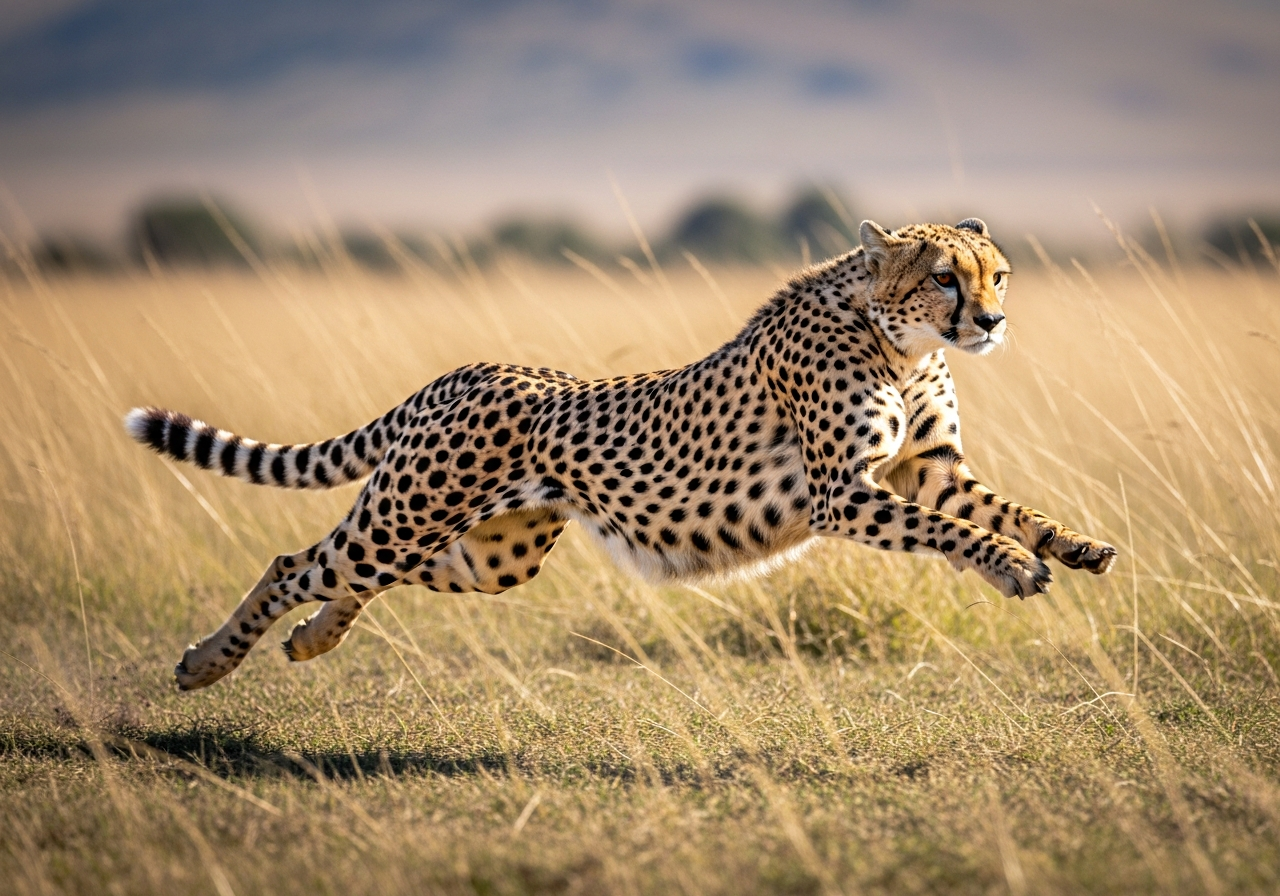
Quick answer
The cheetah is the fastest land animal, reaching roughly 100–120 km/h (62–75 mph) in short sprints — but only for a few hundred metres before overheating.
Last updated: June 2026 — figures reflect widely cited scientific estimates.
The answer, with the fine print attached
The cheetah is the fastest land animal over a short sprint, and no serious contender comes close. Widely cited figures put its top speed at roughly 100–120 km/h (62–75 mph), reached in a burst lasting perhaps twenty seconds. The fine print matters, though: the cheetah wins the sprint and loses almost everything else. It cannot hold that pace, it cannot turn the record on when tired, and it pays for the effort with a body that overheats within a few hundred metres.
If the question were instead “which land animal is fastest over several kilometres?”, the answer would change. The pronghorn of North America cruises at speeds a cheetah can only touch briefly, and holds them long enough to cover distance. Both animals are champions; they are simply champions of different events. Most disagreements about this record are really disagreements about which event is being run.
What makes the cheetah’s body a sprinting machine
Cheetah anatomy departs from the standard cat blueprint in nearly every direction that favours acceleration. The spine is unusually flexible and acts like a spring, folding and extending with each stride so that the animal’s reach far exceeds its skeletal length. At full gallop, a cheetah spends much of each stride cycle with no feet touching the ground at all.
The limbs are long and lightly built, with reduced muscle mass low down where extra weight costs the most energy to swing. Unlike other cats, cheetahs have claws that only partially retract, giving them permanent studs for traction — closer to a sprinter’s spikes than to the retractable hooks a lion or leopard uses for grappling. The tail is long and heavy, working as a counterweight that lets the animal swing through tight turns at speed without tumbling.
Internally, the picture is just as specialised: enlarged nostrils and airways, a large heart, and adrenal chemistry tuned for explosive output. All of it serves acceleration. A cheetah can reach highway speed in roughly the time it takes to read this sentence, and that acceleration — not the peak number — is what actually catches prey.
Why the cheetah has to stop
The same specialisation that produces the record enforces its limit. Sprinting generates enormous heat, and a cheetah’s muscles produce it faster than its body can shed it. Body temperature climbs steeply during a chase, and the animal must stop before it does itself harm. After a successful hunt a cheetah typically spends several minutes panting hard, unable to eat or defend itself.
That recovery window is a genuine ecological cost. Cheetahs are relatively lightly built for a big cat, and a winded cheetah beside a fresh kill is vulnerable to hyena clans, lion prides, and even vultures arriving in numbers. Losing kills to stronger competitors is a routine part of cheetah life, and it is a direct consequence of the trade-off: a body optimised for speed is not a body optimised for holding ground.
Hunt success also depends on getting close before the sprint begins. Cheetahs stalk to within a short distance of a gazelle or impala before committing, because the sprint is a finite resource that must be spent well. A chase that starts too far out simply fails.
The endurance champion nobody expects
The pronghorn is the more remarkable animal by some measures. It is not a true antelope, and it can sustain speeds over kilometres that would leave a cheetah collapsed after the first few hundred metres. Its lungs, heart, and windpipe are outsized for its body, and its blood carries oxygen to muscle at a rate far above what similar-sized mammals manage.
The strange part is that nothing in modern North America can catch a pronghorn. It is widely thought to be running from predators that no longer exist — a case of adaptations outliving the pressure that shaped them. The pronghorn’s speed is, in effect, a fossil written in living muscle.
How these records are actually measured
Good speed data is harder to collect than headline numbers suggest. Early records often came from stopwatches, chased vehicles, or captive animals lured along a straight line — none of which reflect what an animal does while hunting. Modern work uses GPS collars with motion sensors, radar, and high-speed video, which measure real animals making real turns on real ground.
Those better methods have produced an interesting correction. Wild cheetahs, when tracked properly, rarely hit their theoretical maximum. Actual hunts are decided by acceleration and by the ability to decelerate and turn sharply as prey jinks — not by holding a top speed in a straight line. The record number is real, but it describes a laboratory-like best case rather than a typical day.
Runners-up, and where the myths come from
Below the cheetah and pronghorn sits a crowded field. The springbok, blackbuck, and various gazelles are all genuinely fast, and the ostrich is the fastest animal on two legs — outrunning most mammals despite having no need for flight. The horse is quick over distance, and the red-kangaroo achieves respectable speed through a hopping gait so efficient that it costs less energy the faster it goes.
Most myths in this area trace to one of three confusions: mixing peak burst speed with sustained speed, quoting captive figures as if they were wild ones, or comparing across media — the peregrine-falcon is often called the fastest animal, but it achieves that in a vertical dive, not level travel. A useful habit when reading any speed claim is to ask what was measured, over what distance, and on what animal.
Conservation note
Cheetahs occupy a fraction of their historical range and exist in relatively small numbers, pressured by habitat loss, prey decline, and conflict with livestock farmers. Their need for open ground on which to sprint makes them unusually sensitive to fragmentation: a landscape cut into small pieces by fences and roads is a landscape where the cheetah’s single great advantage stops working. Protecting large connected habitats preserves not only the record holder but the zebra, wildebeest, and antelope populations that make the record worth having.
Sources
Related reading: Animal profiles · Fastest animals on Earth · Support wildlife protection
Frequently asked questions
What Is the Fastest Land Animal
The cheetah is the fastest land animal, reaching roughly 100–120 km/h (62–75 mph) in short sprints — but only for a few hundred metres before overheating.
How do scientists measure this record?
Records come from peer-reviewed studies, GPS tracking, high-speed video, toxicology assays, and acoustic meters — field conditions always add variation.
Can the record holder change?
Yes — new measurements, species reclassification, or better technology can update rankings. Always check whether speed, venom, or size is measured differently.