Cheetah
Acinonyx jubatus
Quick answer
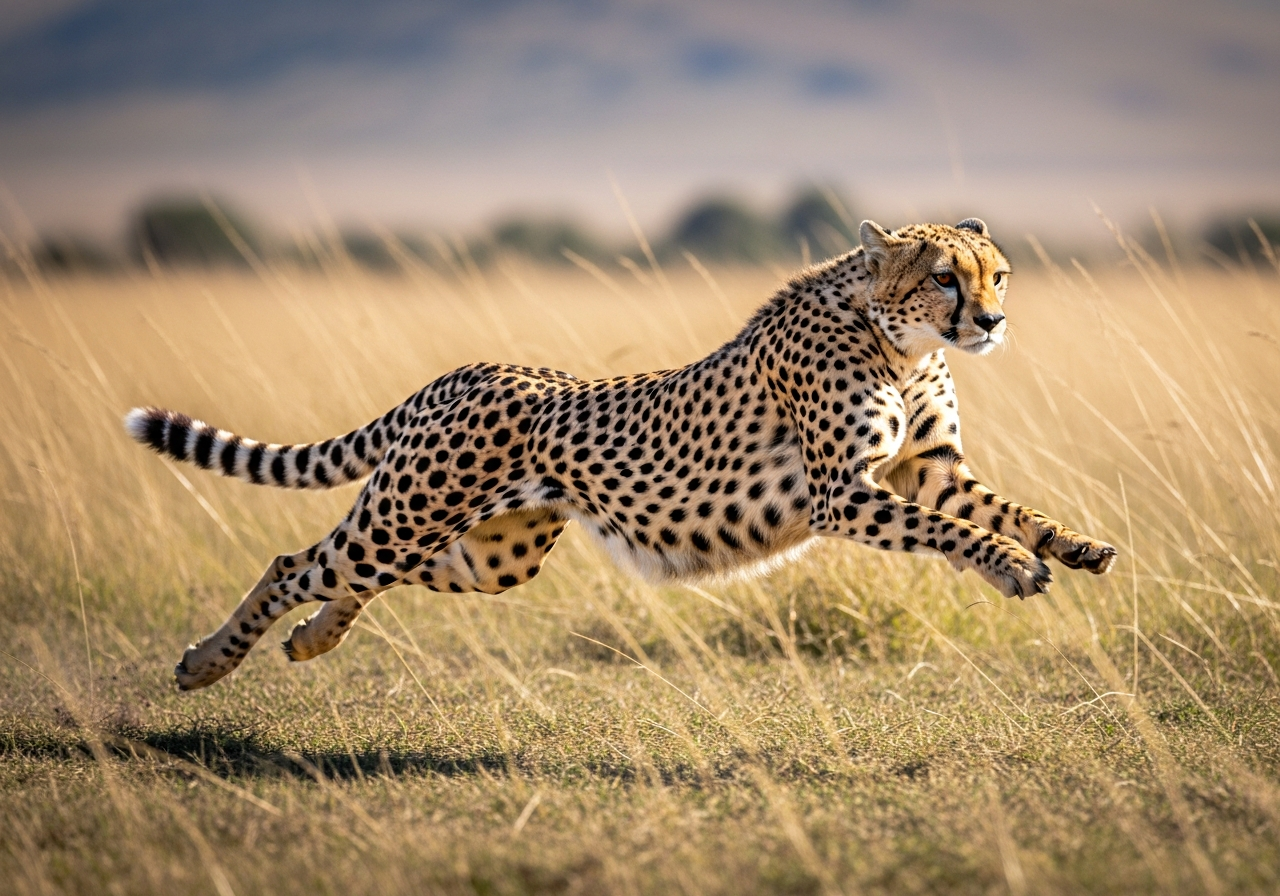
The cheetah is the fastest land animal, capable of reaching 112 km/h (70 mph) in short bursts. Built for speed with a slender body, long legs, and a flexible spine, it relies on quick daytime chases rather than ambush. Cheetahs are found mainly in Africa and live around 10 to 12 years in the wild.
Also available in Español (Guepardo)
Cheetah facts at a glance
| Scientific name | Acinonyx jubatus |
|---|---|
| Diet | Carnivore |
| Habitat | Grassland, savanna, semi-desert |
| Lifespan | 10–12 years in the wild |
| Weight | 21–72 kg (46–159 lb) |
| Top speed | Up to 112 km/h (70 mph) |
| Conservation status | Vulnerable (IUCN) |
| Kingdom | Animalia |
|---|---|
| Phylum | Chordata |
| Class | Mammalia |
| Order | Carnivora |
| Family | Felidae |
| Genus | Acinonyx |
What is a group of cheetahs called?
Group name (collective noun)
A group of Cheetahs is called a coalition.
Baby name
A baby Cheetah is called a cub.
Explore more animal collective nouns and baby animal names .
Built for speed
Everything about the cheetah is designed for acceleration. A lightweight frame, long legs, enlarged heart and lungs, and a flexible spine let it reach 112 km/h and go from 0 to 100 km/h in just a few seconds. Its semi-retractable claws act like running spikes for grip.
Hunting strategy
Unlike most big cats, cheetahs hunt during the day to avoid competition from lions and hyenas. They rely on a short, explosive chase, and because sprinting overheats their bodies, they can only run for around 20 to 30 seconds before needing to rest.
Behavior
Cheetahs are more lightly built and less aggressive than other big cats. Females are usually solitary, raising cubs alone, while males sometimes form small coalitions, often brothers, to hold territory together.
Conservation
Cheetahs are Vulnerable, with fewer than an estimated 7,000 left in the wild. They face habitat loss, conflict with farmers, low genetic diversity, and high cub mortality, making them one of Africa's most threatened big cats.
Hunting and challenges
Cheetahs hunt by day, using sharp eyesight to spot prey and acceleration to run it down, then must rest to recover from the effort. Because they are relatively light, they often lose kills to lions and hyenas, and high cub mortality makes the species especially vulnerable.
Dig deeper into the Cheetah
- Are Cheetah Endangered
Dig deeper into cheetah — are cheetah endangered.
- Cheetah Acceleration
Dig deeper into cheetah — cheetah acceleration.
- Cheetah Cubs Survival
Dig deeper into cheetah — cheetah cubs survival.
- Cheetah Habitat
Dig deeper into cheetah — cheetah habitat.
- Cheetah Pets Myth
Dig deeper into cheetah — cheetah pets myth.
- Cheetah Vs Leopard Speed
Dig deeper into cheetah — cheetah vs leopard speed.
- How Cheetahs Hunt
Dig deeper into cheetah — how cheetahs hunt.
- How Fast Is A Cheetah
Dig deeper into cheetah — how fast is a cheetah.
- How Long do Cheetah Live?
Dig deeper into cheetah — how long do cheetah live.
- King Cheetah
Dig deeper into cheetah — king cheetah.
- What do Cheetah Eat
Dig deeper into cheetah — what do cheetah eat.
- Where do Cheetah Live?
Dig deeper into cheetah — where do cheetah live.
- Why Are Cheetahs Endangered
Dig deeper into cheetah — why are cheetahs endangered.
Explore the Cheetah
Collections
Range & geography
Did you know? Cheetah facts
- The cheetah is the fastest land animal, reaching about 100–120 km/h in short bursts.
- It can accelerate from 0 to 100 km/h in roughly three seconds — quicker than most sports cars.
- A full sprint lasts only 20–30 seconds before overheating forces the cheetah to stop.
- Unlike other big cats, the cheetah cannot fully retract its claws, giving sprinter's grip.
- Cheetahs rely on stealth to get close before the chase, since the sprint is so costly.
- The species has unusually low genetic diversity, a legacy of an ancient population bottleneck.
- Cheetahs succeed in roughly half their hunts — a high rate among large cats.
Diet & feeding
Cheetahs hunt small-to-medium ungulates such as Thomson's gazelle, impala, and springbok, plus hares and young of larger species, typically eating quickly before larger predators can steal the kill.
Adaptations
- A long, flexible spine extends the stride and works like a spring at full speed. (Caro 1994)
- An enlarged heart, lungs, and nasal passages supply oxygen for explosive sprints.
- Semi-retractable claws and ridged pads provide traction like an athlete's spikes.
- A long, muscular tail acts as a rudder for sharp turns while tracking jinking prey.
- Black 'tear marks' may reduce glare and help fix the gaze on prey during a chase.
Behaviour & ecology
- Cheetahs hunt mostly by day, avoiding competition with nocturnal lions and hyenas. (Caro 1994)
- Hunting begins with a careful stalk to minimise the energetically costly sprint.
- Males may form lifelong 'coalitions' (often brothers) that hold territory together.
- After a kill, a cheetah must rest and pant to cool down before it can eat.
Communication
- Cheetahs cannot roar; instead they chirp, purr, yelp, and growl.
- A distinctive bird-like chirp helps mothers and cubs, or coalition males, relocate one another.
- Scent-marking on prominent landmarks advertises territory and reproductive state.
Habitat & range
Cheetahs favour open and semi-open country — savanna, grassland, and scrub — across parts of Africa, with a tiny, critically endangered population in Iran, where clear lines of sight suit high-speed pursuit.
Ecological role
As a diurnal mesopredator, the cheetah helps regulate populations of small-to-medium antelope and occupies a hunting niche separated in time and prey size from larger carnivores.
Conservation status of the Cheetah
Vulnerable (VU) means a species faces a high risk of extinction in the medium-term future. It is the lowest-risk of the three 'threatened' IUCN categories — one step below Endangered, which is itself below Critically Endangered — and is often an early warning that a population is in trouble.
Main threats to the cheetah
- Habitat loss and fragmentation
- Human–wildlife conflict
- Prey depletion
- Illegal wildlife trade, including the cub trade
Cheetah (Acinonyx jubatus) was most recently assessed for the IUCN Red List in 2021. View the full IUCN assessment .
Frequently asked questions about the Cheetah
How fast is a cheetah?
A cheetah can reach about 110 km/h (68 mph) in short bursts, accelerating from a standstill to 100 km/h in around three seconds.
Are cheetahs endangered?
Yes. Cheetahs are listed as Vulnerable, with fewer than about 7,000 left in the wild due to habitat loss, conflict with farmers, and loss of prey.
How fast can a cheetah run?
Cheetahs are the fastest land animals, reaching speeds of up to 112 km/h (70 mph) in short bursts and accelerating from 0 to 100 km/h in just a few seconds.
Why can't cheetahs run for long?
Sprinting at top speed rapidly overheats a cheetah's body, so it can only chase prey for about 20 to 30 seconds before it must stop and recover.
What do cheetahs eat?
Cheetahs are carnivores that hunt small to medium antelope such as gazelles, as well as hares and young wildebeest. They hunt mostly during the day.
What is the difference between a cheetah and a leopard?
Cheetahs have solid round spots and distinctive black 'tear marks' running from the eyes to the mouth, while leopards have rosette-shaped spots. Cheetahs are also slimmer and faster, while leopards are stockier and climb trees.
How long do cheetahs live?
Wild cheetahs typically live 10 to 12 years. Cub mortality is high, but cheetahs in captivity can live to around 17 years.
What is a group of cheetahs called?
A group of Cheetahs is called a coalition.
What is a baby cheetah called?
A baby Cheetah is called a cub.
Sources & references
This guide is compiled and reviewed against established zoological and conservation references. Key sources for the Cheetah:
-
IUCN Red List of Threatened Species
Conservation status (Vulnerable) reflects the IUCN Red List category for Acinonyx jubatus, most recently assessed in 2021.
- Durant, S. et al. (2022). Acinonyx jubatus. The IUCN Red List of Threatened Species.
Status (Vulnerable) and range decline.
- Caro, T. M. (1994). Cheetahs of the Serengeti Plains: Group Living in an Asocial Species. University of Chicago Press.
Behaviour and hunting ecology.
- Nowak, R. M. (1999). Walker's Mammals of the World (6th ed.). Johns Hopkins University Press.
Morphology and speed.
- Animal Diversity Web — Acinonyx jubatus. University of Michigan Museum of Zoology.
Life history and diet.
-
Global Animal Guide editorial standards
How we research, source, review, and update every guide for accuracy.