Desert Animals Explained: How Wildlife Survives Extreme Heat
Desert animals survive heat and drought with nocturnal habits, water-saving kidneys, burrows, and specialised diets. Iconic species from camels to fennec foxes.
Global Animal Guide · July 16, 2026
Quick answer
Desert animals survive scarce water and extreme heat with behaviours (nocturnal activity, burrowing) and body adaptations (efficient kidneys, reflective coats, fat storage). Camels, fennec foxes, and many reptiles are classic desert specialists.
Last updated: July 2026.
Deserts are defined by shortage rather than by heat: less than about 250 millimetres of rain a year, and often far less. Heat is simply what happens when there is no cloud, no moisture, and nothing much to shade the ground. Everything that lives there is solving the same two problems — how to shed heat without spending water, and how to find water in food when there is none to drink.
Behaviour is the first line of defence
The cheapest adaptation is to not be there when it is hot. A desert surface can exceed 60°C in the afternoon while the air a metre above it is dramatically cooler and the soil half a metre down is cooler still. So the majority of desert mammals simply invert the day. The fennec fox sleeps out the heat in a sand burrow and hunts insects and rodents at night. The gila monster spends the overwhelming majority of its life underground, surfacing for only a few weeks a year. Burrows are not just shelter; they are humidity traps, where an animal’s own exhaled moisture raises the local air’s water content and slows its losses.
Where burrowing is impossible, animals use posture and shade. The xerus, an African ground squirrel, holds its bushy tail over its back as a parasol and forages in its own moving patch of shade. The red kangaroo licks saliva onto a network of superficial blood vessels in its forearms, cooling the blood by evaporation from a surface it can afford to wet. The meerkat times its foraging around the day’s edges and retreats to a burrow system when the sand becomes intolerable.
Reptiles get a structural discount here. Because they are ectothermic, they do not burn fuel to maintain a body temperature, which means they need far less food and produce far less metabolic heat to dump. A chuckwalla can bask until it reaches its preferred temperature, then simply stop — and when threatened it wedges into a rock crevice and inflates its lungs until it cannot be pulled out.
Water economy: kidneys, dung, and urine
Losing heat is easy if you have water to evaporate. Almost no desert animal does, so the real adaptations are in the plumbing. Desert mammals run kidneys with exceptionally long loops of Henle, the structure that concentrates urine — the longer the loop, the more water is reclaimed and the saltier the urine that leaves. Many desert rodents produce urine several times more concentrated than a human’s. Faeces come out dry and pelleted, water having been stripped in the large intestine.
Birds and reptiles skip the problem differently. Instead of excreting nitrogen as urea, which must be dissolved in water, they excrete it as uric acid — the white paste in bird droppings — which needs almost no water to carry it out. This is one reason reptiles and birds dominate desert species lists so thoroughly, from the sidewinder to the ostrich.
Then there is water you never drink. Metabolising food releases water as a chemical by-product, and for some seed-eating desert rodents this metabolic water plus the trace moisture in dry seeds is genuinely enough to live on indefinitely. Others harvest condensation. The thorny devil of Australia is grooved between its scales with a network of capillary channels; dew or damp sand touching any part of its body is wicked along these channels to the corners of its mouth, so the lizard effectively drinks through its feet.
Radiators, insulation, and the camel problem
Large ears are the classic desert billboard, and the mechanism is real: the fennec fox’s outsized ears are thin, richly supplied with blood vessels, and act as radiators dumping heat to the air without evaporating a drop. The bat-eared fox uses the same trick in the drier parts of Africa, doubling the ears as insect detectors.
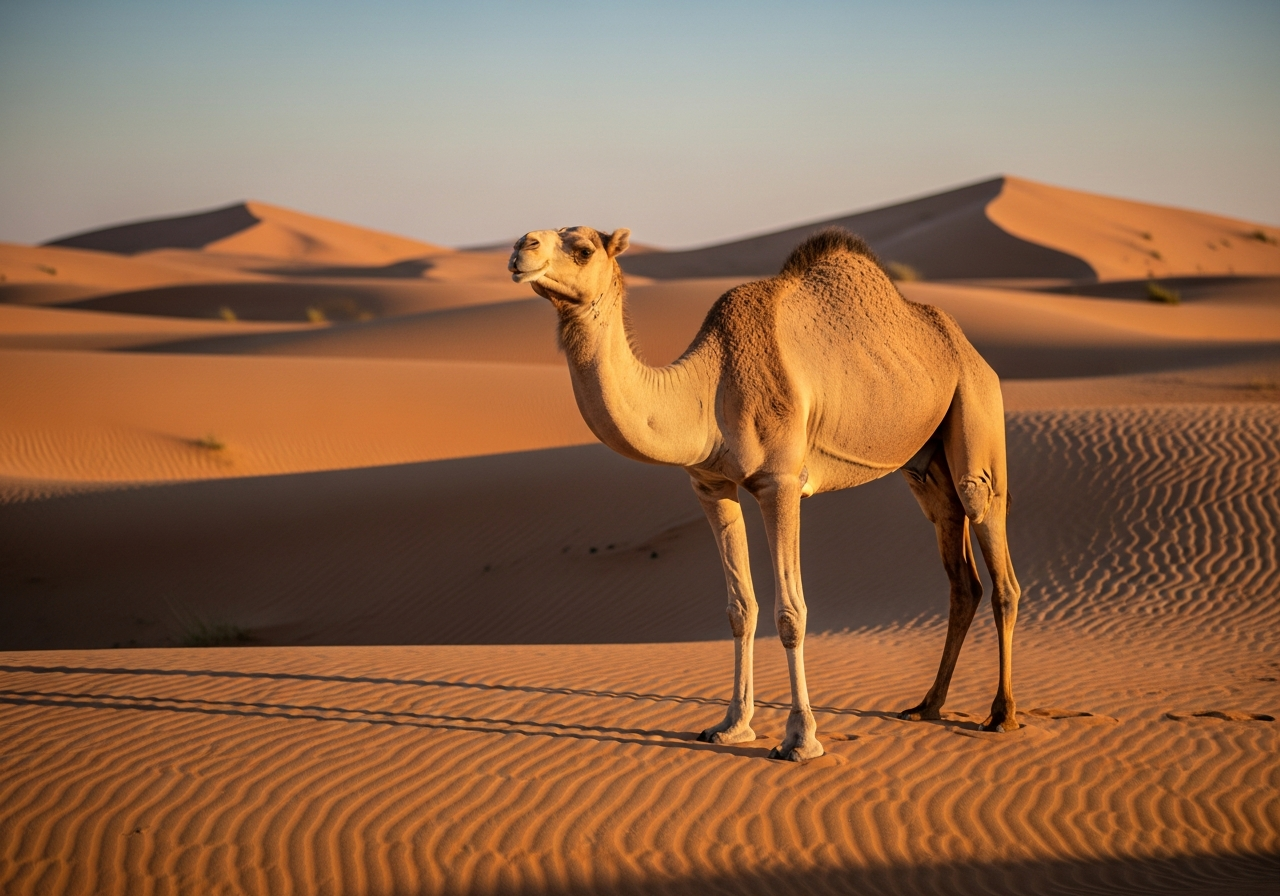
The camel is the most misunderstood desert animal alive. Its humps store fat, not water. What makes it formidable is a suite of subtler tricks. It lets its body temperature drift by several degrees across the day, storing heat in the morning rather than sweating it away and radiating it back out at night — an enormous water saving. Its coat insulates against incoming solar heat rather than trapping body heat. Its nasal passages recapture moisture from exhaled air. Its red blood cells are oval and unusually tough, so they survive both severe dehydration and the sudden flood of a hundred-plus litres of water drunk in minutes, which would burst the cells of most mammals.
Antelope solve it with size and nose. The tiny dik-dik never needs to drink, taking its water from browse and using nasal panting — rapid airflow across a moist nasal chamber that cools the blood heading to the brain. The springbok does much the same across the Kalahari.
Deserts are not just hot and not just sand
Deserts are defined by aridity, not temperature, and many are savagely cold at night or in winter. The high Andes support the vicuña and guanaco in cold, thin, dry air where the challenge is heat retention as much as loss. Australia’s arid interior holds the bilby, the dingo, the emu and the echidna. North American deserts run to rock and scrub rather than dune, home to the rattlesnake and the scorpion, whose thick waxy cuticle makes it almost watertight.
Boom and bust: living on rainfall
Desert productivity arrives in pulses. Rain, when it comes, can be years apart and then torrential, and desert life is built to exploit the window. Plants flower within days; insects emerge; the dung beetle works the flush of large-herbivore droppings that follows the grazing that follows the grass.
Amphibians take this furthest. Several desert frogs and toads spend the dry years sealed in a cocoon of shed skin a foot underground, metabolism throttled almost to nothing, waiting. The vibration of heavy rain wakes them; they surface, breed explosively in a temporary pool over a single night, and their tadpoles race to metamorphose before the puddle evaporates — sometimes in under two weeks. It is the same logic as the camel’s, on a different clock: endure the drought, and spend everything the moment water arrives.
Species to explore
- Camel
- Fennec fox
- Desert habitat hub — full species list
Related reading
Sources
Frequently asked questions
How do camels store water?
Camels do not store water in their humps — humps store fat. They save water with efficient kidneys, dry dung, and the ability to tolerate temporary dehydration.
Why are many desert animals nocturnal?
Nights are cooler, so animals hunt and travel with less water loss and heat stress.
Can amphibians live in deserts?
A few species wait out dry seasons underground and breed explosively when rains come.
What do desert animals drink?
Some drink rarely; many get moisture from food (seeds, insects, succulent plants) or metabolic water.