Why Do Zebras Have Stripes? The Science Behind the Pattern
Zebras are famous for their bold black-and-white stripes — but why did evolution paint them that way? From fly defence to heat regulation, here's what research says.
Global Animal Guide · June 24, 2026
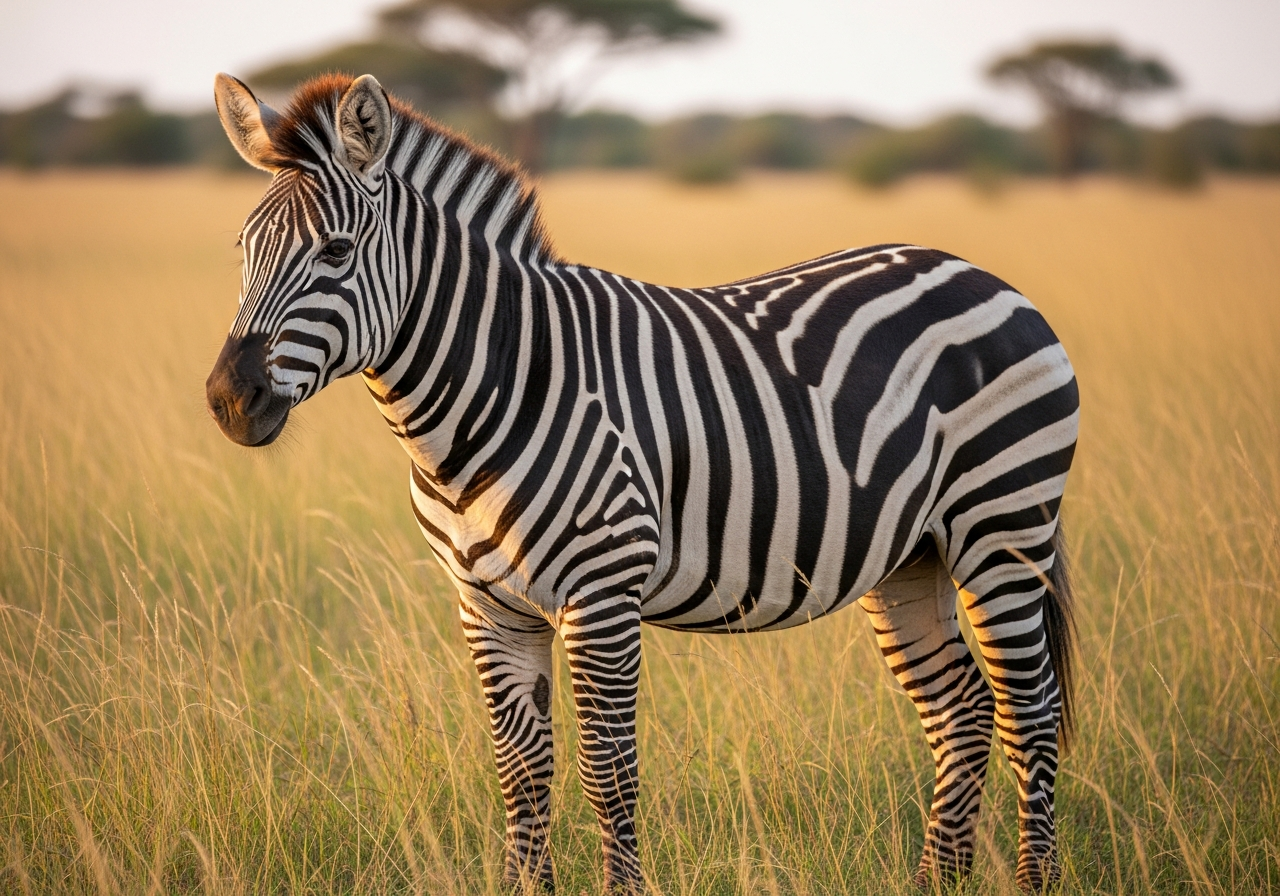
Image sourcing: see credits & licences
Quick answer
Zebras likely evolved stripes mainly to deter biting flies — striped patterns confuse tsetse flies and horseflies and may make zebras harder to land on. Stripes may also help with social recognition, temperature regulation through air movement at stripe edges, and confusing predators when herds move together. No single theory explains everything; several benefits probably work together.
The best-supported answer is biting flies. Striped coats are strikingly bad landing surfaces for tsetse flies and horseflies, and the zebra lives exactly where those flies are worst. Older explanations — camouflage from lions, cooling, social signalling — have not vanished, but they have been demoted from headline answer to possible side benefit.
A pattern that puzzled Darwin
For more than a century, biologists have debated why zebras wear such striking black-and-white stripes. Early ideas ranged from camouflage in tall grass to social signalling. Modern experiments have narrowed the field — and the answer is probably several benefits at once, not one magic reason.
Part of what makes the question sharp is that the zebra is the odd one out. Its closest relatives — the horse and the donkey — are plain, as are the other large grazers sharing its range. The wildebeest, the impala, and the gazelle all face the same lions on the same plains without a stripe between them. So whatever stripes do, it must be something zebras need and their neighbours do not, or something zebras can afford and others cannot.
That constraint is what killed the simplest theories. Camouflage should benefit an impala as much as a zebra. Fly defence, by contrast, tracks something genuinely zebra-specific: the overlap between zebra range and the distribution of the biting flies that carry African horse sickness and trypanosomiasis, diseases to which equids are particularly vulnerable. Where the flies are worst, the striping is boldest.
Biting flies: the strongest evidence
The most robust experimental support points to parasitic flies. Tsetse flies and horseflies spread disease and drain blood from grazing mammals. Researchers found that:
- Striped surfaces attract fewer landings from biting flies in controlled tests
- Zebras swish their tails less than solid-coloured horses in similar habitats — suggesting fewer bites
- Striped coats painted on cattle reduced fly harassment in field trials
Stripes may disrupt the polarised light patterns flies use to identify a landing surface, or simply make the outline harder to resolve.
The most revealing observations come from filming flies as they approach. They find striped and plain animals equally well from a distance — stripes do not hide the zebra. What fails is the final approach. Flies that would normally decelerate smoothly into a controlled landing instead overshoot, bounce off, or veer away at the last moment. The pattern seems to disrupt the visual cues an insect uses to judge how fast a surface is rushing towards it.
This also explains why the stripes are fine and high-contrast rather than broad and muted. The effect depends on the pattern remaining unresolved at close range from an insect’s low-resolution eye, while a lion at fifty metres sees an obvious zebra. A defence tuned to a fly’s eye need not fool a mammal’s.
Predator confusion and motion dazzle
When a zebra herd runs, overlapping stripes can create a motion dazzle effect — making it harder for a predator to pick one individual to chase. Lions do hunt zebras successfully, so stripes are not foolproof armour, but they may slightly improve survival at the moment of attack.
The theory is plausible but awkward. Zebras are hunted by ambush and endurance predators alike — the lion, the hyena, and the african wild dog — and there is little evidence that striped prey survive attacks at higher rates than plain prey nearby. Human observers also pick individual zebras out of a running herd without much trouble, and a lion’s visual system is built for exactly this task.
The honest position is that motion dazzle may contribute a small margin without being the reason stripes exist. Evolution keeps traits that pay for themselves overall; it does not require every proposed benefit to be real.
Social stripes: every zebra is unique
Each zebra’s stripe pattern is individual, like a human fingerprint. Foals learn their mother’s pattern, and adults may use stripes to recognise allies in large herds. In species like Grevy’s zebra, where males hold territories, visual identity matters.
The difficulty with treating this as the origin of stripes is that plenty of highly social mammals manage individual recognition without any such pattern. Plain-coated grazers, and social carnivores from the meerkat to the wild dog, recognise one another by voice, scent, and subtler visual detail. Recognition is more convincingly a use zebras have found for the pattern than a reason it arose.
Temperature and the stripe debate
Some thermoregulation studies propose that black stripes heat faster than white ones, creating micro air currents along stripe borders that cool the skin. Other researchers argue the effect is small. Climate, species, and habitat likely determine how much this matters.
The mechanism is not unreasonable — adjacent surfaces at different temperatures do generate small convective flows — but the measured differences are modest, and other large grazers solve heat without stripes. The elephant radiates through its ears, the giraffe through patterned skin vasculature, and most antelope simply seek shade. Stripes as an air-conditioning system remain unproven rather than refuted.
What we still do not know
Stripes may have evolved for one reason and been co-opted for others — a common story in evolution. Plains zebras, mountain zebras, and Grevy’s zebras differ in stripe boldness and belly coverage, hinting that local pressures shape the pattern too.
The unresolved question is not really whether flies matter but how the disruption works at the level of insect vision, and whether that same mechanism could be borrowed. The painted-cattle trials point at a practical answer: if a pattern can reduce fly harassment on livestock, it offers an alternative to insecticide in regions where fly-borne disease is a serious agricultural burden. A century-old puzzle about an animal’s coat turns out to have a use.
Sources
Related reading: Animal camouflage explained · Fastest animals on Earth · Lion guide
Frequently asked questions
Do zebra stripes camouflage them from lions?
Stripes may confuse predators at a distance or in motion, but the strongest evidence supports fly deterrence rather than classic camouflage in open savanna.
Are all zebra stripe patterns the same?
No — each zebra has a unique stripe pattern, like a fingerprint. Species differ too: plains, mountain, and Grevy's zebras have distinct stripe widths and belly patterns.
Can zebras see each other's stripes?
Yes — zebras have colour vision and can distinguish fine stripe details, which may help mothers recognise foals and groups stay cohesive.
Do stripes help zebras stay cool?
Some studies suggest black stripes heat slightly faster than white ones, creating small air currents that may help dissipate heat — though this remains debated.