Quick answer
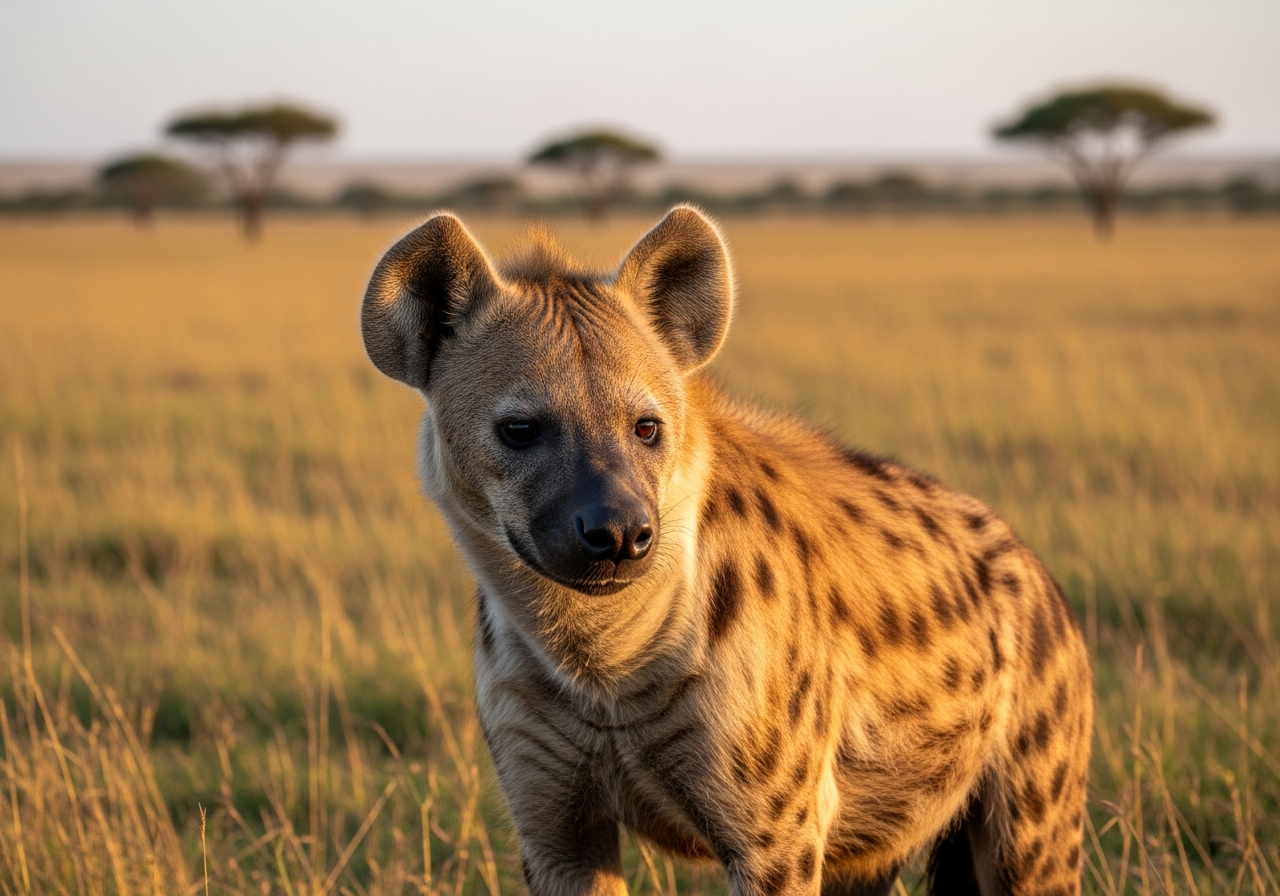
The spotted hyena is a powerful, highly social carnivore of sub-Saharan Africa, known for its bone-crushing jaws and eerie, laugh-like calls. It lives in large matriarchal groups called clans, led by dominant females, and is both a skilled cooperative hunter and an opportunistic scavenger. Despite its dog-like look, the hyena is more closely related to cats and mongooses. Wild spotted hyenas typically live around 12 years.
Top questions about the Spotted Hyena
Spotted Hyena facts at a glance
- Weight 60 kg
- Length 1.5 m
- Top speed 60 km/h
- Lifespan 12 years
| Scientific name | Crocuta crocuta |
|---|---|
| Diet | Carnivore |
| Habitat | Savanna, grassland, and semi-desert |
| Lifespan | About 12 years in the wild |
| Weight | 40–86 kg (88–190 lb) |
| Top speed | Up to 60 km/h (37 mph) |
| Conservation status | Least Concern (IUCN) |
| Kingdom | Animalia |
|---|---|
| Phylum | Chordata |
| Class | Mammalia |
| Order | Carnivora |
| Family | Hyaenidae |
| Genus | Crocuta |
Where it lives
The spotted hyena (Crocuta crocuta) is native to Savannas, grasslands, and semi-deserts across sub-Saharan Africa. — recorded across Africa in this guide’s range summary.
For occurrence records, see GBIF species search and sources below.
How big is a spotted hyena?
An adult spotted hyena measures 1.5 m long — about 87% of the height of an average adult person (1.73 m) — and weighs around 60 kg, about 86% of an average adult’s body weight (70 kg).
Length vs an average adult’s height (to scale)
What is a group of spotted hyenas called?
Group name (collective noun)
A group of Spotted Hyenas is called a clan. It is also known as a cackle.
Baby name
A baby Spotted Hyena is called a cub.
Explore more animal collective nouns and baby animal names .
Diet and hunting
Spotted hyenas are formidable carnivores that hunt the majority of their own food, working together to chase down prey such as wildebeest, zebra, and antelope. They are also expert scavengers and have the strongest jaws relative to size of any mammal, able to crush and digest bone. Their digestive system extracts nutrients from parts other predators leave behind, wasting almost nothing of a carcass. A clan will defend its kills against lions, with which it has a fierce rivalry.
Habitat and range
The spotted hyena is widespread across sub-Saharan Africa, inhabiting savannas, grasslands, open woodlands, and semi-deserts. It avoids only dense rainforest and the most extreme deserts. Clans hold and defend territories, marking boundaries with scent and communal latrines. Their adaptability and varied diet have helped them remain common across much of the continent.
Reproduction and conservation
Female spotted hyenas usually give birth to one or two cubs in a communal den, and cubs nurse for an unusually long time. Social rank strongly affects survival, as cubs of high-ranking females get better access to food. The species is listed as Least Concern, but it faces persecution, habitat loss, and conflict with herders in some areas. Healthy hyena populations play an important role in keeping ecosystems clean and balanced.
Dig deeper into the Spotted Hyena
- Are Spotted Hyenas Dangerous?
Are spotted hyenas dangerous? Realistic risk, when incidents rise, and safety basics.
- How Long Do Spotted Hyenas Live?
Spotted Hyena lifespan is typically About 12 years in the wild. What shortens or extends life, life stages, and status (Least Concern).
- Spotted Hyena: Key Facts
The spotted hyena is a powerful, highly social carnivore of sub-Saharan Africa, known for its bone-crushing jaws and eerie, laugh-like calls.
- What Do Spotted Hyenas Eat?
What spotted hyenas eat: Carnivore, foraging style, and seasonal shifts in Savanna, grassland, and semi-desert.
- Where Do Spotted Hyenas Live?
Where spotted hyenas live: Savanna, grassland, and semi-desert, native range cues, and human overlap. Status Least Concern.
Explore the Spotted Hyena
Compare
Range & geography
Did you know? Spotted Hyena facts
- Spotted hyenas are skilled hunters, not just scavengers — they kill most of what they eat.
- They live in large female-dominated clans, where females outrank all males.
- A hyena's bite force is among the strongest of any mammal, crushing bone with ease.
- Their 'laugh' is a real vocalisation that signals excitement or stress.
- Hyenas digest bone, hide, and teeth, leaving little waste.
- Despite looking dog-like, hyenas are more closely related to cats and mongooses.
Diet & feeding
Spotted hyenas hunt medium-to-large ungulates such as wildebeest and zebra and scavenge widely; their bone-crushing ability lets them use carcasses other predators leave behind.
Adaptations
- Massive jaws and bone-crushing teeth let hyenas consume entire carcasses, bones included. (Kruuk 1972)
- A powerful digestive system extracts nutrition from bone, hide, and even teeth.
- Strong forequarters and stamina support long, persistent hunts.
- Acute senses of smell and hearing locate carcasses and prey at great distance.
Behaviour & ecology
- Spotted hyenas live in large clans with a strict, female-dominated hierarchy. (Kruuk 1972)
- Clans hunt cooperatively, taking prey as large as wildebeest and zebra.
- They defend territory communally and clash with lions over kills.
- Cubs are raised in communal dens, with rank inherited from the mother.
Communication
- A famous 'laugh', whoops, and groans coordinate the clan and signal status.
- Scent from anal glands ('pasting') marks territory boundaries.
- Greeting ceremonies and postures reinforce the social hierarchy.
Habitat & range
Spotted hyenas range widely across sub-Saharan Africa in savanna, grassland, semi-desert, and woodland, wherever sufficient prey and carrion are available.
Ecological role
As both apex predator and efficient scavenger, the hyena regulates herbivore numbers and recycles carcasses, performing a vital clean-up role in savanna ecosystems.
Conservation status of the Spotted Hyena
The spotted hyena (Crocuta crocuta) is listed as Least Concern on the IUCN Red List. Least Concern (LC) is the IUCN's lowest-risk category, assigned to widespread, abundant species that have been evaluated and found not to be threatened. It does not mean a species faces no pressures — only that it is not currently at risk of extinction.
Main threats to the spotted hyena
- Persecution and poisoning
- Habitat loss
- Decline of wild prey
- Road mortality
Spotted Hyena (Crocuta crocuta) was most recently assessed for the IUCN Red List in 2015. View the full IUCN assessment .
Frequently asked questions about the Spotted Hyena
Are hyenas dogs or cats?
Neither exactly. Hyenas have their own family, Hyaenidae, but they are more closely related to cats, mongooses, and civets than to dogs despite their dog-like appearance.
Do hyenas only scavenge?
No. Spotted hyenas are skilled hunters that kill most of their own prey in cooperative groups, in addition to scavenging. The idea that they only steal kills is a myth.
Why do hyenas laugh?
The hyena's "laugh" is a vocalization that signals excitement, nervousness, or social tension, often during feeding or conflict. It is communication, not a sign of amusement.
How strong is a hyena's bite?
Spotted hyenas have exceptionally powerful jaws, among the strongest of any mammal for their size, allowing them to crush and eat bones that other predators cannot.
Are female hyenas dominant?
Yes. Spotted hyena clans are matriarchal. Females are larger than males and outrank them, and social status is inherited through the female line.
Are hyenas endangered?
The spotted hyena is listed as Least Concern and remains widespread in sub-Saharan Africa, though local populations are threatened by habitat loss and persecution by people.
What is a group of spotted hyenas called?
A group of Spotted Hyenas is called a clan. It is also known as a cackle.
What is a baby spotted hyena called?
A baby Spotted Hyena is called a cub.
Sources & references
This guide is compiled and reviewed against established zoological and conservation references. Key sources for the Spotted Hyena:
-
IUCN Red List of Threatened Species
Conservation status (Least Concern) reflects the IUCN Red List category for Crocuta crocuta, most recently assessed in 2015.
-
iNaturalist — observations & photos
Search citizen-science observations and community IDs for Crocuta crocuta. Useful for range checks and recent sightings — not a substitute for formal Red List status.
-
GBIF — occurrence data
Global Biodiversity Information Facility species search for Crocuta crocuta. Explore published occurrence records used in range research.
- Bohm, T. & Höner, O. (2015). Crocuta crocuta. IUCN Red List of Threatened Species.
Status (Least Concern) and range.
- Kruuk, H. (1972). The Spotted Hyena: A Study of Predation and Social Behavior. University of Chicago Press.
Definitive field study.
- Estes, R. D. (1991). The Behavior Guide to African Mammals. University of California Press.
Behaviour and ecology.
-
Global Animal Guide editorial standards
How we research, source, review, and update every guide for accuracy.