Image sourcing: see credits & licences
Quick answer
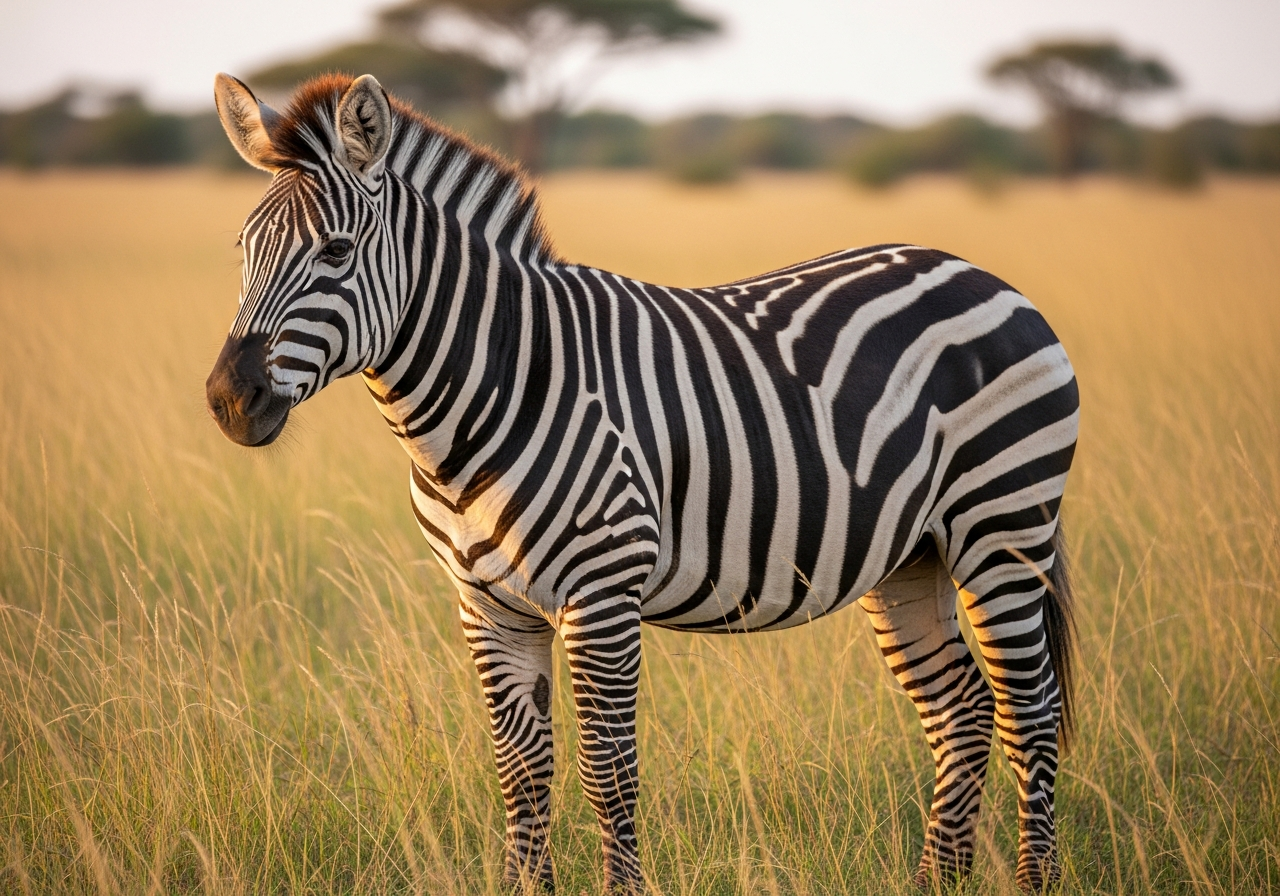
The zebra is a wild member of the horse family native to Africa, instantly recognizable by its bold black-and-white stripes, which are as unique to each animal as a fingerprint. Plains zebras live in social herds, can run up to 65 km/h (40 mph), and typically live around 25 years in the wild. The stripes are thought to deter biting flies and confuse predators.
Top questions about the Zebra
Also available in Español (Cebra)
Zebra facts at a glance
- Weight 350 kg
- Length 2.3 m
- Top speed 65 km/h
- Lifespan 25 years
| Scientific name | Equus quagga |
|---|---|
| Diet | Herbivore |
| Habitat | Savanna, grassland, and open plains |
| Lifespan | 20–25 years in the wild |
| Weight | 200–450 kg (440–990 lb) |
| Top speed | 65 km/h (40 mph) |
| Conservation status | Near Threatened (IUCN) |
| Kingdom | Animalia |
|---|---|
| Phylum | Chordata |
| Class | Mammalia |
| Order | Perissodactyla |
| Family | Equidae |
| Genus | Equus |
Where it lives
The zebra (Equus quagga) is native to Grasslands and savannas of eastern and southern Africa. — recorded across Africa in this guide’s range summary.
For occurrence records, see GBIF species search and sources below.
How big is a zebra?
An adult zebra measures 2.3 m long — about 1.3× the height of an average adult person (1.73 m) — and weighs around 350 kg, about 5.0× an average adult’s body weight (70 kg).
Length vs an average adult’s height (to scale)
What is a group of zebras called?
Group name (collective noun)
A group of Zebras is called a dazzle. It is also known as a zeal.
Baby name
A baby Zebra is called a foal.
Explore more animal collective nouns and baby animal names .
Why the stripes?
No two zebras have the same stripe pattern. Scientists believe the stripes help in several ways: they deter biting flies that struggle to land on striped surfaces, they make it harder for predators to single out one animal in a moving herd, and they may help with temperature regulation.
Herd life
Plains zebras live in family groups of a stallion, several mares, and their foals, which often gather into much larger herds, sometimes alongside wildebeest. There is safety in numbers, and the herd's combined senses help detect lions and hyenas. Zebras groom one another to strengthen social bonds.
On the move
Zebras are grazers that follow the rains in search of fresh grass, joining some of Africa's great migrations. They can run at up to 65 km/h (40 mph) and deliver a powerful kick strong enough to break a predator's jaw, their main defense alongside flight.
Conservation
The plains zebra is the most common zebra but is now listed as Near Threatened due to hunting and habitat loss. Other species fare worse: the Grevy's zebra is Endangered. Protecting migration routes and reserves is key to keeping zebra populations healthy.
Dig deeper into the Zebra
- How Fast Is A Zebra?
Zebra top speed is about 65 km/h (40 mph). Sprint vs endurance and what limits pace.
- How Long Do Zebras Live?
Zebra lifespan is typically 20–25 years in the wild. What shortens or extends life, life stages, and status (Near Threatened).
- What Do Zebras Eat?
What zebras eat: Herbivore, foraging style, and seasonal shifts in Savanna, grassland, and open plains.
- Where Do Zebras Live?
Where zebras live: Savanna, grassland, and open plains, native range cues, and human overlap. Status Near Threatened.
- Zebra: Key Facts
The zebra is a wild member of the horse family native to Africa, instantly recognizable by its bold black-and-white stripes, which are as unique to each…
Explore the Zebra
Range & geography
Did you know? Zebra facts
- Every zebra's stripe pattern is unique, like a fingerprint.
- Stripes may deter biting flies and help confuse predators in a moving herd.
- Zebras are wild horses and have never been successfully domesticated at scale.
- Plains zebras undertake one of Africa's great migrations alongside wildebeest.
- A zebra's kick is powerful enough to injure or kill an attacking predator.
- Foals can stand and run within an hour of birth.
Diet & feeding
Zebras are grazers that feed predominantly on grasses, able to use coarser vegetation than many co-occurring herbivores, and must drink regularly.
Adaptations
- Bold striping may reduce biting-fly attacks and dazzle predators in a herd. (Estes 1991)
- Powerful legs and a strong kick provide defence against lions and hyenas.
- Strong teeth and an efficient gut process tough, fibrous grasses.
- Excellent eyesight and hearing give early warning of predators on open plains.
Behaviour & ecology
- Plains zebras live in family harems led by a stallion, often within larger herds. (Estes 1991)
- Herds migrate seasonally in search of fresh grazing and water.
- Members groom one another and watch collectively for predators.
- Stallions defend their harem against rivals and predators.
Communication
- Zebras bark, bray, and snort to signal alarm and maintain contact.
- Ear, head, and tail positions convey mood and intent.
- Mutual grooming reinforces bonds within the family group.
Habitat & range
Plains zebras inhabit savannas, grasslands, and open woodlands of eastern and southern Africa, depending on grazing and regular access to water.
Ecological role
As bulk grazers, zebras crop coarse grasses ahead of other herbivores, shaping grassland structure and supporting the great migrations that sustain predators.
Conservation status of the Zebra
The zebra (Equus quagga) is listed as Near Threatened on the IUCN Red List. Near Threatened (NT) means a species does not yet qualify as threatened but is close to it, or likely to become so in the near future without ongoing conservation. It is a watch-list category just below Vulnerable.
Main threats to the zebra
- Habitat loss and fencing that blocks migration
- Hunting for meat and skins in some areas
- Drought and competition with livestock
- Civil unrest affecting protected areas
Zebra (Equus quagga) was most recently assessed for the IUCN Red List in 2016. View the full IUCN assessment .
Frequently asked questions about the Zebra
Are zebras black with white stripes or white with black stripes?
Zebras are black with white stripes. Their underlying skin is black, and the white stripes are areas where pigment is absent, so the black is considered the base color.
Why do zebras have stripes?
Stripes likely deter biting flies, confuse predators by making it hard to target one animal in a herd, and may help regulate body temperature. Each zebra's pattern is unique.
How fast can a zebra run?
Zebras can run up to about 65 km/h (40 mph) and use sharp, zigzagging turns plus a powerful kick to escape predators such as lions and hyenas.
Can zebras be tamed or ridden like horses?
Not reliably. Although zebras are related to horses, they are skittish, aggressive, and difficult to handle, so they have never been domesticated for riding or work the way horses have.
Where do zebras live?
Zebras live in the savannas, grasslands, and open plains of eastern and southern Africa, where they graze and migrate in search of fresh grass and water.
What is a group of zebras called?
A group of Zebras is called a dazzle. It is also known as a zeal.
What is a baby zebra called?
A baby Zebra is called a foal.
Sources & references
This guide is compiled and reviewed against established zoological and conservation references. Key sources for the Zebra:
-
IUCN Red List of Threatened Species
Conservation status (Near Threatened) reflects the IUCN Red List category for Equus quagga, most recently assessed in 2016.
-
iNaturalist — observations & photos
Search citizen-science observations and community IDs for Equus quagga. Useful for range checks and recent sightings — not a substitute for formal Red List status.
-
GBIF — occurrence data
Global Biodiversity Information Facility species search for Equus quagga. Explore published occurrence records used in range research.
- King, S. R. B. & Moehlman, P. D. (2016). Equus quagga. IUCN Red List of Threatened Species.
Status (Near Threatened) and range.
- Estes, R. D. (1991). The Behavior Guide to African Mammals. University of California Press.
Behaviour and social structure.
- Animal Diversity Web — Equus quagga. University of Michigan Museum of Zoology.
Life history, morphology, and range.
-
Global Animal Guide editorial standards
How we research, source, review, and update every guide for accuracy.