Sea Otter
Enhydra lutris
Image sourcing: see credits & licences
Quick answer
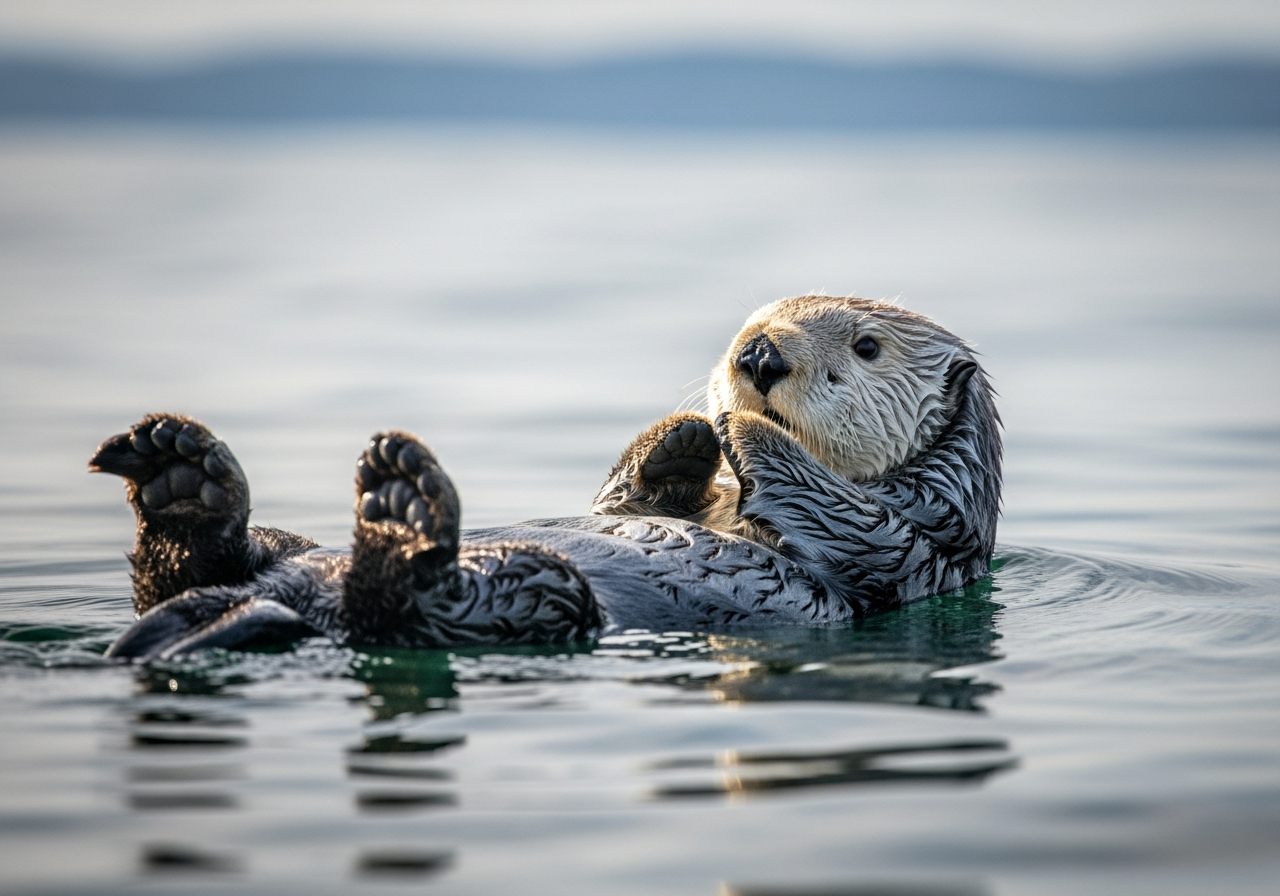
The sea otter is a marine mammal of the North Pacific coast and the smallest marine mammal, famous for floating on its back, using rocks as tools to crack open shellfish, and holding hands while resting. It has the densest fur of any animal, with up to a million hairs per square inch, and is a keystone species that keeps kelp forests healthy. Sea otters typically live 10 to 20 years.
Sea Otter facts at a glance
| Scientific name | Enhydra lutris |
|---|---|
| Diet | Carnivore |
| Habitat | Coastal North Pacific and kelp forests |
| Lifespan | 10–20 years |
| Weight | 14–45 kg (31–99 lb) |
| Top speed | About 9 km/h (5.5 mph) swimming |
| Conservation status | Endangered (IUCN) |
| Kingdom | Animalia |
|---|---|
| Phylum | Chordata |
| Class | Mammalia |
| Order | Carnivora |
| Family | Mustelidae |
| Genus | Enhydra |
Where it lives
Coastal waters of the North Pacific, from California and Alaska to Russia and Japan.
What is a group of sea otters called?
Group name (collective noun)
A group of Sea Otters is called a raft.
Baby name
A baby Sea Otter is called a pup.
Explore more animal collective nouns and baby animal names .
The warmest coat in nature
Unlike whales and seals, sea otters have no insulating blubber. Instead they rely on the densest fur of any animal, with up to a million hairs per square inch, trapping a layer of air to stay warm in cold seas. They spend hours grooming to keep this fur clean and waterproof.
Tool users
Sea otters are one of the few animals that use tools. They often carry a favorite rock in a loose pouch of skin under the forearm and use it to smash open hard-shelled prey such as clams, mussels, and sea urchins while floating on their backs.
Keystone of the kelp forest
By eating sea urchins, otters stop the urchins from overgrazing and destroying kelp forests. Healthy kelp forests shelter countless other species and absorb carbon, which makes the sea otter a keystone species whose presence shapes the whole ecosystem. Otters also hold hands or wrap themselves in kelp to avoid drifting apart while they sleep.
Conservation
Hunted almost to extinction for their fur in the 1700s and 1800s, sea otters have made a partial recovery but remain Endangered. Oil spills, entanglement in fishing gear, and pollution still threaten them, and their loss can trigger the collapse of entire kelp ecosystems.
Dig deeper into the Sea Otter
- Are Sea Otter Endangered
Dig deeper into sea otter — are sea otter endangered.
- How Long do Sea Otter Live?
Dig deeper into sea otter — how long do sea otter live.
- Sea Otter Guide 5
Dig deeper into sea otter — sea otter guide 5.
- What do Sea Otter Eat
Dig deeper into sea otter — what do sea otter eat.
- Where do Sea Otter Live?
Dig deeper into sea otter — where do sea otter live.
Explore the Sea Otter
Collections
Range & geography
Did you know? Sea Otter facts
- Sea otters have the densest fur of any animal — up to a million hairs per square inch.
- They use rocks as tools to crack open shellfish on their chest.
- Otters often hold hands while resting so they don't drift apart.
- They eat around a quarter of their body weight daily to stay warm.
- Sea otters are a keystone species that protect kelp forests by eating urchins.
- Unlike most marine mammals, they rely on fur, not blubber, for warmth.
Diet & feeding
Sea otters are carnivores feeding on sea urchins, crabs, clams, mussels, and snails, often using rocks as tools and eating a quarter of their body weight daily to fuel their metabolism.
Adaptations
- The densest fur of any mammal traps air and insulates without blubber. (Nowak 1999)
- Tool use — cracking shellfish on a chest rock — opens hard-shelled prey.
- A high metabolism generates the heat needed in cold coastal water.
- Loose chest skin forms a 'pocket' for storing food and a favoured rock.
Behaviour & ecology
- Sea otters float at the surface to rest, groom, and feed, often in groups called rafts.
- They dive to the seabed to collect urchins, crabs, clams, and other prey.
- Constant grooming maintains the insulating air layer in their fur.
- Mothers carry and care for a single pup on their chest.
Communication
- Otters use coos, whines, and screams to communicate, especially mother and pup.
- Grooming and rafting together reinforce social proximity.
- Scent and touch feature in close-range interactions.
Habitat & range
Sea otters live in cold coastal waters of the North Pacific, in and around kelp forests and rocky shores where shellfish are abundant.
Ecological role
Sea otters are a classic keystone species: by preying on sea urchins they protect kelp forests, which in turn support diverse marine life and store carbon.
Conservation status of the Sea Otter
Endangered (EN) means a species faces a very high risk of extinction in the wild. Populations are usually declining sharply due to habitat loss, hunting, disease, or climate pressure. It sits one level below Critically Endangered on the IUCN Red List.
Main threats to the sea otter
- Oil spills and pollution
- Predation by killer whales
- Fisheries bycatch and entanglement
- Disease and human–otter conflict
Sea Otter (Enhydra lutris) was most recently assessed for the IUCN Red List in 2020. View the full IUCN assessment .
Frequently asked questions about the Sea Otter
Why do sea otters hold hands?
Sea otters hold hands, or wrap themselves in kelp, while resting so they do not drift apart from one another on the moving water. A group of resting otters is called a raft.
How do sea otters stay warm without blubber?
Sea otters have the densest fur of any animal, up to a million hairs per square inch, which traps a layer of air against the skin for insulation. They groom constantly to keep it working.
Do sea otters really use tools?
Yes. Sea otters use rocks as tools to crack open hard-shelled prey like clams and urchins, often keeping a favorite stone in a skin pouch under the arm.
Why are sea otters important to the ecosystem?
Sea otters are a keystone species. By eating sea urchins, they prevent urchins from destroying kelp forests, which shelter many species and store carbon, so otters keep the whole ecosystem in balance.
Are sea otters endangered?
Yes. After being hunted almost to extinction for their fur, sea otters are listed as Endangered. Oil spills, fishing-gear entanglement, and pollution remain serious threats.
What is a group of sea otters called?
A group of Sea Otters is called a raft.
What is a baby sea otter called?
A baby Sea Otter is called a pup.
Sources & references
This guide is compiled and reviewed against established zoological and conservation references. Key sources for the Sea Otter:
-
IUCN Red List of Threatened Species
Conservation status (Endangered) reflects the IUCN Red List category for Enhydra lutris, most recently assessed in 2020.
- Doroff, A. & Burdin, A. (2015). Enhydra lutris. IUCN Red List of Threatened Species.
Status (Endangered) and recovery.
- Animal Diversity Web — Enhydra lutris. University of Michigan Museum of Zoology.
Life history, morphology, and range.
- Nowak, R. M. (1999). Walker's Mammals of the World (6th ed.). Johns Hopkins University Press.
Fur, tool use, and ecology.
-
Global Animal Guide editorial standards
How we research, source, review, and update every guide for accuracy.