Quick answer
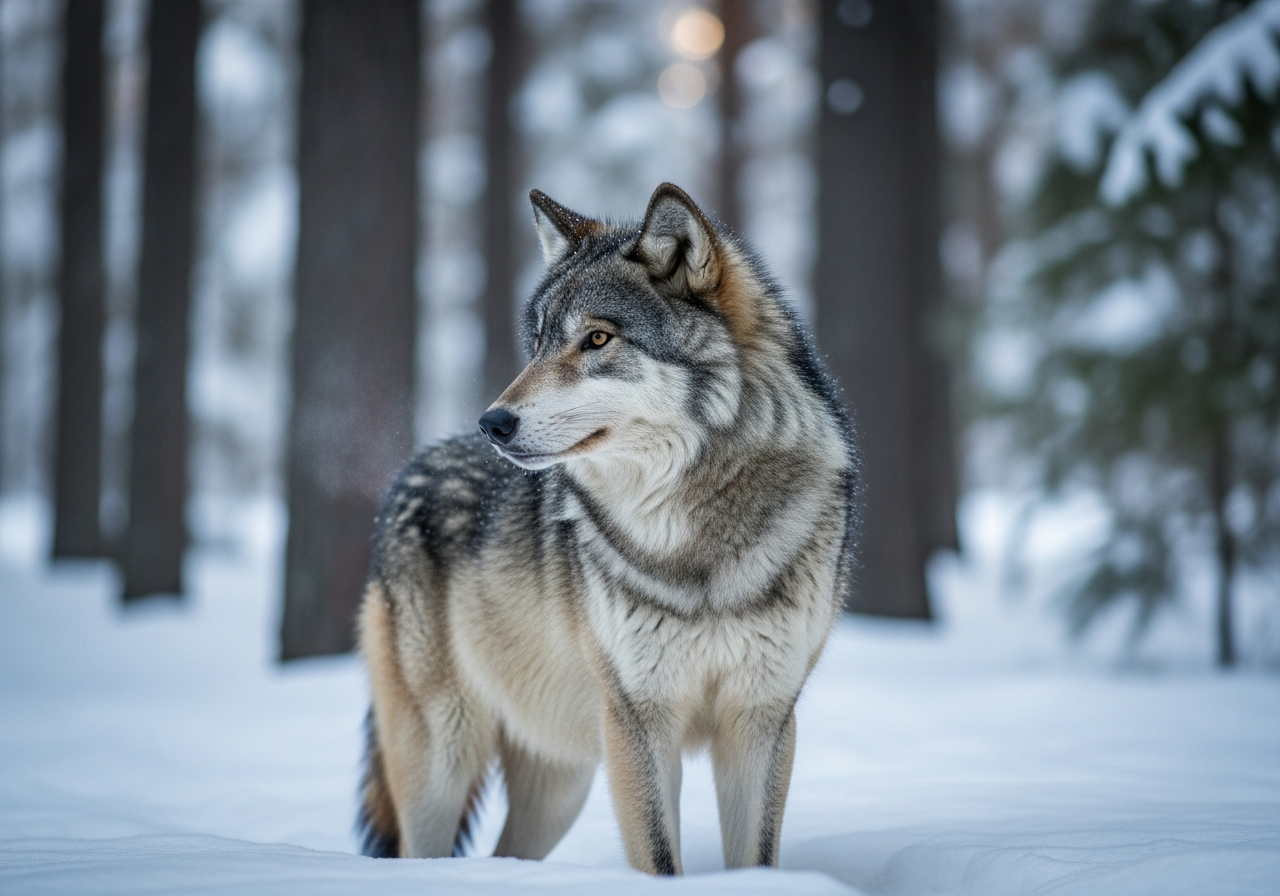
The gray wolf is the largest wild member of the dog family and the ancestor of the domestic dog. Wolves live and hunt in family groups called packs, communicate through howls, and range across forests, tundra, and mountains of the Northern Hemisphere. Wild wolves live around 6 to 8 years.
Top questions about the Gray Wolf
Also available in Español (Lobo gris)
Gray Wolf facts at a glance
- Weight 60 kg
- Length 1.6 m
- Top speed 60 km/h
- Lifespan 13 years
| Scientific name | Canis lupus |
|---|---|
| Diet | Carnivore |
| Habitat | Forest, tundra, grassland, mountains |
| Lifespan | 6–8 years in the wild |
| Weight | 23–80 kg (50–175 lb) |
| Top speed | Up to 60 km/h (37 mph) |
| Conservation status | Least Concern (IUCN) |
| Kingdom | Animalia |
|---|---|
| Phylum | Chordata |
| Class | Mammalia |
| Order | Carnivora |
| Family | Canidae |
| Genus | Canis |
Where it lives
The gray wolf (Canis lupus) is native to Forests, tundra, and mountains across the Northern Hemisphere. — recorded across North America, Europe, Asia in this guide’s range summary.
For occurrence records, see GBIF species search and sources below.
How big is a gray wolf?
An adult gray wolf measures 1.6 m long — about 92% of the height of an average adult person (1.73 m) — and weighs around 60 kg, about 86% of an average adult’s body weight (70 kg).
Length vs an average adult’s height (to scale)
What is a group of gray wolves called?
Group name (collective noun)
A group of Gray Wolves is called a pack.
Baby name
A baby Gray Wolf is called a pup.
Explore more animal collective nouns and baby animal names .
Pack life
Wolves live in packs that are essentially family units, usually a breeding pair and their offspring. The pack cooperates to hunt, raise pups, and defend territory. Far from the rigid 'alpha' myth, wild packs are led naturally by the breeding parents.
Communication
Wolves communicate through howls, body language, scent marking, and facial expressions. Howling helps reunite separated pack members, advertise territory, and reinforce social bonds, and can be heard several kilometers away.
Diet and hunting
Gray wolves are carnivores that hunt large hoofed animals such as deer, elk, moose, and bison, along with smaller prey. By hunting in coordinated groups, they can take down animals far larger than a single wolf.
Ecological role
Wolves are a keystone species. Their return to ecosystems such as Yellowstone National Park changed the behavior of prey animals and helped restore vegetation and river systems in a chain reaction known as a trophic cascade.
Pack structure
Gray wolves live in family packs usually led by a breeding pair and their offspring of different ages. The pack cooperates to hunt large prey such as deer, elk, and moose, and defends a territory that can span hundreds of square kilometers.
Dig deeper into the Gray Wolf
- Are Gray Wolfs Dangerous?
Are gray wolfs dangerous? Realistic risk, when incidents rise, and safety basics.
- Are Gray Wolfs Dangerous?
Are gray wolfs dangerous? Realistic risk, when incidents rise, and safety basics.
- How Fast Is A Gray Wolf?
Gray Wolf top speed is up to about 60 km/h (37 mph). Sprint vs endurance and what limits pace.
- How Long Do Gray Wolfs Live?
Gray Wolf lifespan is typically 6–8 years in the wild. What shortens or extends life, life stages, and status (Least Concern).
- What Do Gray Wolfs Eat?
What gray wolfs eat: Carnivore, foraging style, and seasonal shifts in Forest, tundra, grassland, mountains.
- Where Do Gray Wolfs Live?
Where gray wolfs live: Forest, tundra, grassland, mountains, native range cues, and human overlap. Status Least Concern.
- Gray Wolf: Key Facts
The gray wolf is the largest wild member of the dog family and the ancestor of the domestic dog.
Explore the Gray Wolf
Collections
Range & geography
Did you know? Gray Wolf facts
- Every domestic dog descends from the gray wolf and shares more than 98% of its DNA.
- Wolves live in family packs, typically a breeding pair and their offspring of several years.
- A wolf can travel 50 km or more in a day and may have a territory spanning hundreds of square kilometres.
- Their reintroduction to Yellowstone is a classic example of a top predator reshaping an ecosystem.
- Wolves rarely bark; they communicate over distance mainly by howling.
- A wolf's bite force (~400 PSI) and stamina are built for hunting large hoofed prey as a team.
- Healthy wild wolves very rarely attack people — historically, most attacks were linked to rabies.
Diet & feeding
Wolves are carnivores specialising in wild ungulates — elk, deer, moose, caribou, and bison — supplemented by beaver, hares, and carrion; a pack may gorge after a kill, then go days between meals.
Adaptations
- Long legs and large feet give the endurance and snow-travel ability to cover huge territories. (Mech & Boitani 2003)
- A powerful skull and jaws crack bone and bring down prey far larger than themselves.
- Dense double-layered fur insulates against extreme cold across the Northern Hemisphere.
- Acute hearing and smell detect prey and pack-mates across long distances.
Behaviour & ecology
- Packs are cooperative family units; the breeding pair leads hunting and pup-rearing. (Mech 1999)
- Cooperative hunting allows wolves to take large ungulates such as elk, deer, and moose.
- Territories are advertised and defended through scent-marking and howling.
- Pups are raised communally, with all pack members helping to feed and guard them.
Communication
- Howling coordinates the pack, reunites separated members, and advertises territory. (Harrington & Mech 1979)
- Scent-marking with urine and scat maps territorial boundaries.
- A detailed repertoire of body postures, facial expressions, and tail positions signals rank and intent.
- Growls, whimpers, and barks function at close range during social and alarm contexts.
Habitat & range
Gray wolves are habitat generalists, occupying forest, tundra, mountains, grassland, and desert across the Northern Hemisphere wherever there is sufficient large prey and tolerance from humans.
Ecological role
As a top predator, the wolf regulates herbivore numbers and behaviour; in Yellowstone, returning wolves are credited with trophic cascades that altered elk movement, vegetation, and even riverbanks.
Conservation status of the Gray Wolf
The gray wolf (Canis lupus) is listed as Least Concern on the IUCN Red List. Least Concern (LC) is the IUCN's lowest-risk category, assigned to widespread, abundant species that have been evaluated and found not to be threatened. It does not mean a species faces no pressures — only that it is not currently at risk of extinction.
Main threats to the gray wolf
- Persecution and killing over livestock conflict
- Habitat loss and fragmentation
- Prey (wild ungulate) depletion
- Hybridization with domestic dogs
Gray Wolf (Canis lupus) was most recently assessed for the IUCN Red List in 2025. View the full IUCN assessment .
Frequently asked questions about the Gray Wolf
Are wolves dangerous to humans?
Wild wolves generally avoid people, and attacks on humans are very rare. A wolf is far more likely to flee than to approach.
How far can a wolf travel?
Wolves are tireless travelers that can cover 50 km or more in a day, trotting for hours at around 8 km/h while hunting or patrolling their territory.
Are wolves the ancestors of dogs?
Yes. Domestic dogs descend from gray wolves, which were domesticated by humans tens of thousands of years ago. Dogs and wolves remain closely related and can interbreed.
What do wolves eat?
Gray wolves are carnivores that primarily hunt large hoofed mammals such as deer, elk, and moose. Hunting in packs lets them take down prey much larger than themselves.
Why do wolves howl?
Wolves howl to locate pack members, mark and defend territory, and strengthen social bonds. A howl can travel several kilometers across open terrain.
How long do wolves live?
Wild gray wolves usually live 6 to 8 years, though some reach their teens. Wolves in captivity can live up to 16 years.
Are gray wolves dangerous to humans?
Wolves generally avoid people, and verified attacks on humans are very rare. They are far more likely to flee from human contact than to approach it.
Is the alpha wolf theory true?
The rigid 'alpha' hierarchy is largely a myth based on captive wolves. Wild packs are family groups led naturally by the breeding parents, not by dominance fights.
What is a group of gray wolves called?
A group of Gray Wolves is called a pack.
What is a baby gray wolf called?
A baby Gray Wolf is called a pup.
Sources & references
This guide is compiled and reviewed against established zoological and conservation references. Key sources for the Gray Wolf:
-
IUCN Red List of Threatened Species
Conservation status (Least Concern) reflects the IUCN Red List category for Canis lupus, most recently assessed in 2025.
-
iNaturalist — observations & photos
Search citizen-science observations and community IDs for Canis lupus. Useful for range checks and recent sightings — not a substitute for formal Red List status.
-
GBIF — occurrence data
Global Biodiversity Information Facility species search for Canis lupus. Explore published occurrence records used in range research.
- Boitani, L. et al. (2018). Canis lupus. The IUCN Red List of Threatened Species.
Status (Least Concern globally) and range.
- Mech, L. D. & Boitani, L. (eds.) (2003). Wolves: Behavior, Ecology, and Conservation. University of Chicago Press.
Definitive reference on wolf biology.
- Mech, L. D. (1970). The Wolf: The Ecology and Behavior of an Endangered Species. Natural History Press.
Classic field study.
- Harrington, F. H. & Mech, L. D. (1979). Wolf howling and its role in territory maintenance. Behaviour.
Vocal communication.
-
Global Animal Guide editorial standards
How we research, source, review, and update every guide for accuracy.
Want to help directly? Learn how to symbolically adopt a gray wolf and support its conservation.