Polar Bear
Ursus maritimus
Quick answer
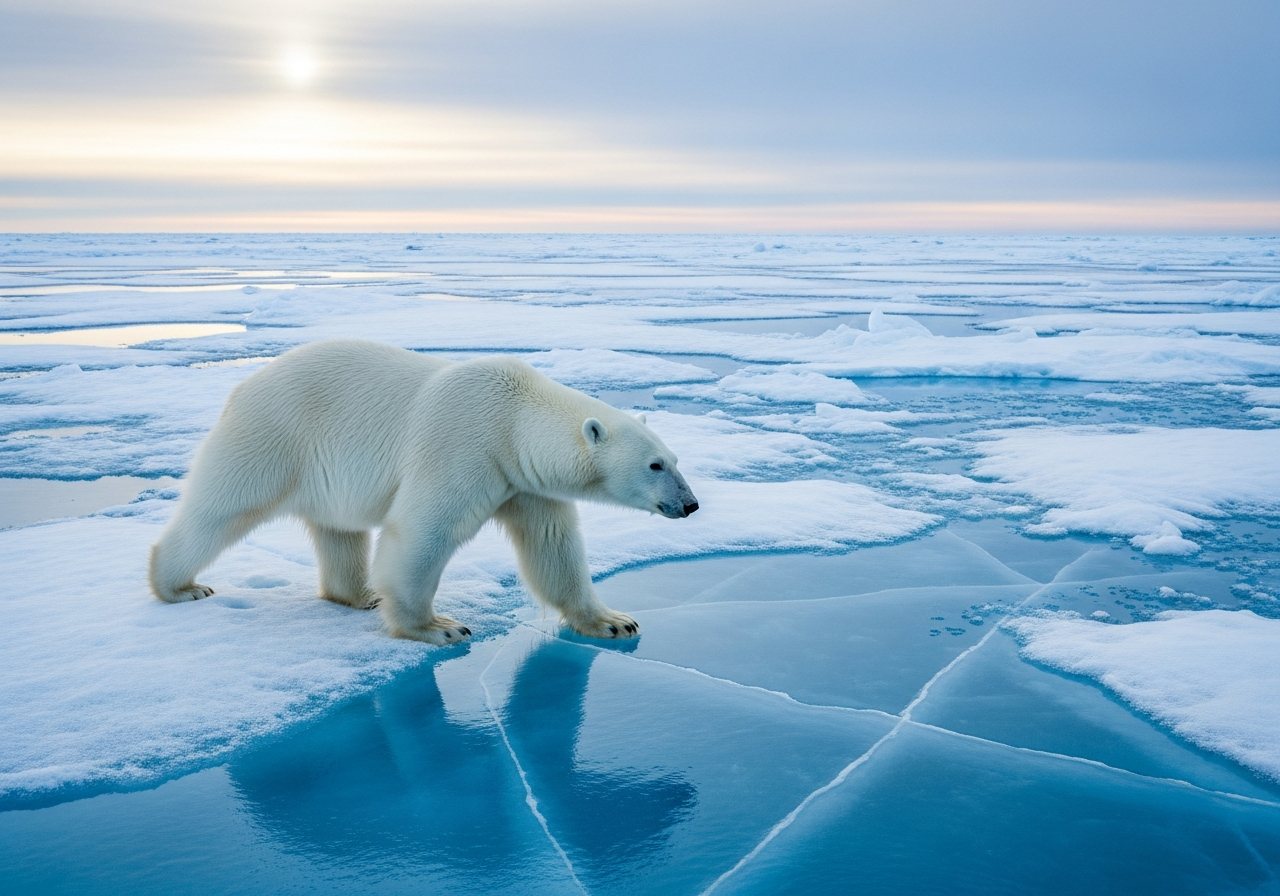
The polar bear is the largest land carnivore, perfectly adapted to life on Arctic sea ice. It hunts seals from the ice, has black skin under white-looking translucent fur, and is classified as a marine mammal because it depends on the ocean. Polar bears live around 25 years and are threatened by melting sea ice.
Also available in Español (Oso polar)
Polar Bear facts at a glance
| Scientific name | Ursus maritimus |
|---|---|
| Diet | Carnivore (mainly seals) |
| Habitat | Arctic sea ice and coasts |
| Lifespan | ~25 years in the wild |
| Weight | 300–700 kg (660–1,540 lb) |
| Top speed | 40 km/h (25 mph) on land |
| Conservation status | Vulnerable (IUCN) |
| Kingdom | Animalia |
|---|---|
| Phylum | Chordata |
| Class | Mammalia |
| Order | Carnivora |
| Family | Ursidae |
| Genus | Ursus |
Where it lives
Across the Arctic — Canada, Alaska, Greenland, Norway (Svalbard), and Russia.
What is a group of polar bears called?
Group name (collective noun)
A group of Polar Bears is called a sleuth. It is also known as a sloth.
Baby name
A baby Polar Bear is called a cub.
Explore more animal collective nouns and baby animal names .
Built for the Arctic
Polar bears are superbly adapted to extreme cold, with a thick layer of fat, dense insulating fur, and large paws that spread their weight on thin ice and act as paddles when swimming. Their fur appears white but is actually translucent, and their skin underneath is black.
Hunting on the ice
Polar bears mainly hunt ringed and bearded seals, waiting patiently beside breathing holes in the sea ice. The fat-rich seal blubber provides the energy they need to survive, which is why access to sea ice is essential to their survival.
Marine mammals
Although they live and travel on land and ice, polar bears are classified as marine mammals because they depend on the ocean for food. They are powerful long-distance swimmers, capable of crossing many kilometers of open water.
Conservation
Polar bears are Vulnerable and have become a global symbol of climate change. As the Arctic warms and sea ice forms later and melts earlier, bears have less time to hunt seals, leading to poorer body condition and lower cub survival.
Dig deeper into the Polar Bear
- Are Polar Bear Endangered
Dig deeper into polar bear — are polar bear endangered.
- Are Polar Bears Dangerous
Dig deeper into polar bear — are polar bears dangerous.
- How Fast Is A Polar Bear
Dig deeper into polar bear — how fast is a polar bear.
- How Long do Polar Bear Live?
Dig deeper into polar bear — how long do polar bear live.
- What do Polar Bear Eat
Dig deeper into polar bear — what do polar bear eat.
- Where do Polar Bear Live?
Dig deeper into polar bear — where do polar bear live.
- Why Are Polar Bears Endangered
Dig deeper into polar bear — why are polar bears endangered.
Explore the Polar Bear
Collections
Did you know? Polar Bear facts
- The polar bear is the largest land carnivore, with big males reaching around 600 kg.
- Its fur is not white but translucent, and its skin underneath is black to absorb heat.
- Polar bears are classed as marine mammals because they depend on the sea-ice ecosystem.
- They hunt seals mainly by waiting at breathing holes in the sea ice.
- A polar bear can smell a seal nearly a kilometre away or under a metre of compacted snow.
- Sea-ice loss from climate change is the central long-term threat to the species.
- Pregnant females den in snow through winter and emerge with cubs in spring.
Diet & feeding
Polar bears are highly carnivorous, relying mainly on ringed and bearded seals hunted from the ice for their energy-dense blubber, with occasional scavenging of carcasses when seals are unavailable.
Adaptations
- A thick fat layer and dense fur insulate against extreme Arctic cold, on land and in water. (Amstrup 2003)
- Translucent hairs and black skin help capture and retain solar heat.
- Large, partly webbed paws act as paddles for strong long-distance swimming.
- An acute sense of smell locates seals through thick snow and ice.
- A metabolism adapted to a fat-rich diet processes blubber as the main energy source.
Behaviour & ecology
- Still-hunting at seal breathing holes is the principal hunting method on the ice. (Stirling 1988)
- Bears range widely with the seasonal advance and retreat of sea ice.
- Pregnant females excavate snow dens to give birth and nurse cubs through winter.
- Longer ice-free periods force bears ashore, where food is scarce and conflict with people rises.
Communication
- Chemical cues from scent left by the feet help bears locate mates and assess one another.
- Body postures and ritualised approaches mediate encounters and play-fighting.
- Cubs and mothers use soft vocalisations to stay in contact.
Habitat & range
Polar bears live around the circumpolar Arctic, concentrated on the sea ice over productive continental-shelf waters where seals are abundant; the ice is the platform on which they hunt.
Ecological role
As the Arctic's apex predator, the polar bear regulates seal populations and is a sentinel species whose condition reflects the health of the wider sea-ice ecosystem.
Conservation status of the Polar Bear
Vulnerable (VU) means a species faces a high risk of extinction in the medium-term future. It is the lowest-risk of the three 'threatened' IUCN categories — one step below Endangered, which is itself below Critically Endangered — and is often an early warning that a population is in trouble.
Main threats to the polar bear
- Sea-ice loss from climate warming
- Pollution and contaminants
- Unsustainable or unregulated hunting
- Oil and gas development
Polar Bear (Ursus maritimus) was most recently assessed for the IUCN Red List in 2015. View the full IUCN assessment .
Frequently asked questions about the Polar Bear
Are polar bears endangered?
Polar bears are listed as Vulnerable by the IUCN, mainly because climate change is reducing the sea ice they need in order to hunt.
How big are polar bears?
Polar bears are the largest land carnivore. Adult males typically weigh 350 to 700 kg (770 to 1,540 lb) and can stand over 3 m tall on their hind legs.
What do polar bears eat?
Polar bears are carnivores that primarily eat seals, especially ringed and bearded seals. The fat-rich blubber provides the energy they need to survive in the Arctic.
Is polar bear skin really black?
Yes. Beneath their translucent fur, polar bears have black skin, which helps absorb and retain heat from sunlight in the cold Arctic environment.
Are polar bears marine mammals?
Polar bears are classified as marine mammals because they rely on the ocean and sea ice for hunting. They are also strong swimmers capable of covering long distances in open water.
Why are polar bears endangered?
Polar bears are threatened mainly by climate change. Melting sea ice shortens their hunting season for seals, reducing their body condition and the survival of their cubs.
How long do polar bears live?
Polar bears typically live around 25 years in the wild, though many do not survive their first few years. In captivity they can live into their thirties.
What is a group of polar bears called?
A group of Polar Bears is called a sleuth. It is also known as a sloth.
What is a baby polar bear called?
A baby Polar Bear is called a cub.
Sources & references
This guide is compiled and reviewed against established zoological and conservation references. Key sources for the Polar Bear:
-
IUCN Red List of Threatened Species
Conservation status (Vulnerable) reflects the IUCN Red List category for Ursus maritimus, most recently assessed in 2015.
- Wiig, Ø. et al. (2015). Ursus maritimus. The IUCN Red List of Threatened Species.
Status (Vulnerable) and climate threat.
- Stirling, I. (1988). Polar Bears. University of Michigan Press.
Ecology and hunting behaviour.
- Amstrup, S. C. (2003). Polar bear (Ursus maritimus). In Wild Mammals of North America. Johns Hopkins University Press.
Physiology and life history.
- IUCN/SSC Polar Bear Specialist Group — Status Reports.
Population assessments.
-
Global Animal Guide editorial standards
How we research, source, review, and update every guide for accuracy.
Want to help directly? Learn how to symbolically adopt a polar bear and support its conservation.