Blue Whale
Balaenoptera musculus
Quick answer
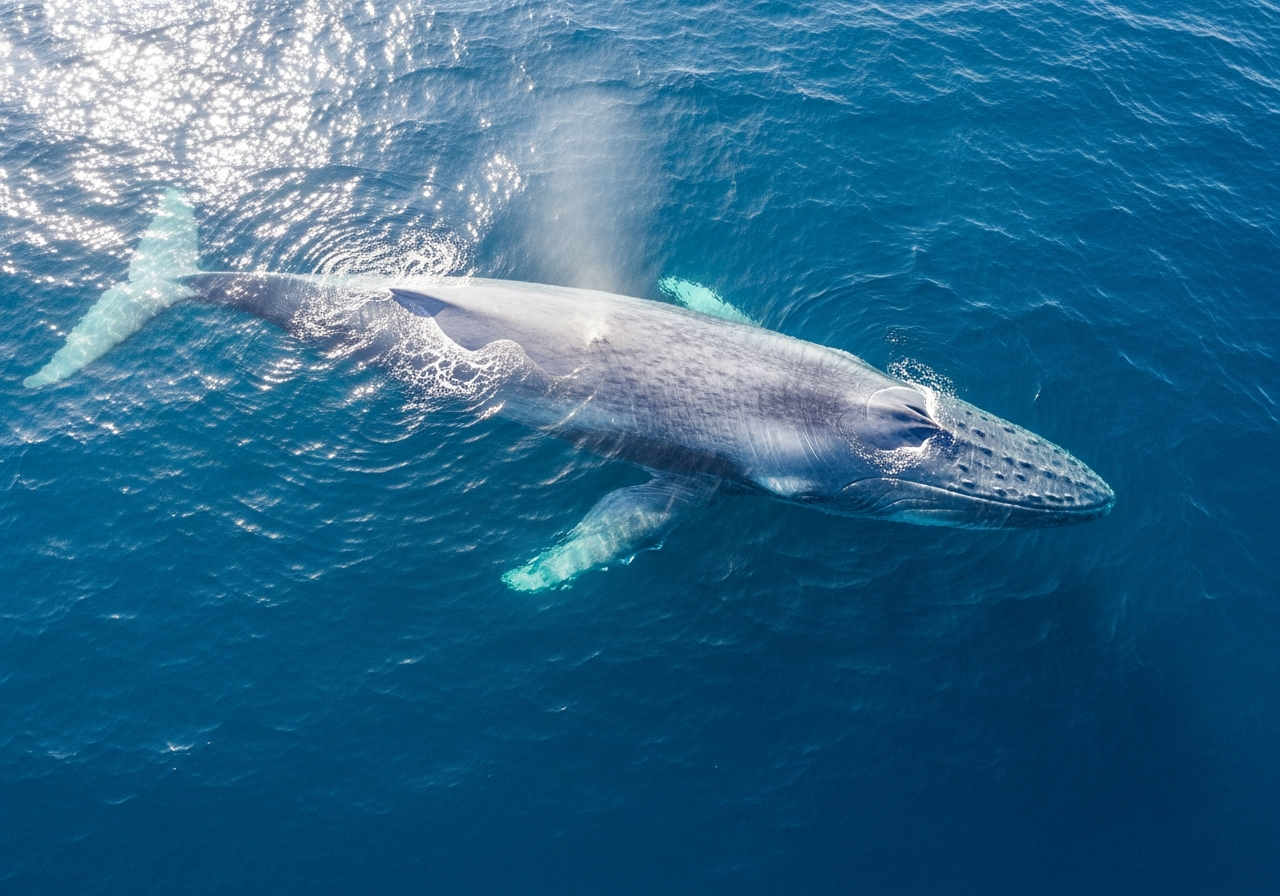
The blue whale is the largest animal known to have ever existed, reaching up to 30 m (98 ft) long and 180 tonnes. It feeds almost entirely on tiny krill, eating up to 4 tonnes a day, and its heart alone can weigh as much as a small car. Blue whales can live 80 to 90 years.
Also available in Español (Ballena azul)
Blue Whale facts at a glance
| Scientific name | Balaenoptera musculus |
|---|---|
| Diet | Carnivore (krill) |
| Habitat | Open oceans worldwide |
| Lifespan | 80–90 years |
| Length | Up to 30 m (98 ft) |
| Weight | Up to 180 tonnes |
| Conservation status | Endangered (IUCN) |
| Kingdom | Animalia |
|---|---|
| Phylum | Chordata |
| Class | Mammalia |
| Order | Artiodactyla |
| Family | Balaenopteridae |
| Genus | Balaenoptera |
Where it lives
All major oceans, from polar feeding grounds to tropical breeding waters.
What is a group of blue whales called?
Group name (collective noun)
A group of Blue Whales is called a pod.
Baby name
A baby Blue Whale is called a calf.
Explore more animal collective nouns and baby animal names .
The largest animal ever
Blue whales are bigger than any dinosaur known to science. Their tongue alone can weigh as much as an elephant, and their heart can be the size of a small car. A newborn calf is already around 7 m long and gains roughly 90 kg every day in its first months.
Feeding on the tiny
Despite their size, blue whales eat some of the smallest animals in the ocean: shrimp-like krill. They feed by gulping huge volumes of water and filtering out krill through baleen plates, consuming up to 4 tonnes of krill on a single feeding day.
Communication
Blue whales produce some of the loudest and lowest-frequency sounds of any animal. These powerful calls can travel hundreds of kilometers through the ocean, helping whales communicate across vast distances.
Conservation
Blue whales were hunted to the brink of extinction during 20th-century commercial whaling. Although they have been protected since the 1960s, recovery is slow, and they remain Endangered, facing threats from ship strikes, entanglement, and ocean change.
Feeding on krill
Blue whales are filter feeders that strain tiny shrimp-like krill through baleen plates. During the feeding season an adult can eat up to 4 tonnes of krill a day, lunging through dense swarms and gulping enormous volumes of water before pushing it back out through the baleen.
Dig deeper into the Blue Whale
- Are Blue Whale Endangered
Dig deeper into blue whale — are blue whale endangered.
- How Big Is A Blue Whale
Dig deeper into blue whale — how big is a blue whale.
- How Fast Is A Blue Whale
Dig deeper into blue whale — how fast is a blue whale.
- How Long do Blue Whale Live?
Dig deeper into blue whale — how long do blue whale live.
- What do Blue Whale Eat
Dig deeper into blue whale — what do blue whale eat.
- Where do Blue Whale Live?
Dig deeper into blue whale — where do blue whale live.
Explore the Blue Whale
Compare
Collections
Range & geography
Did you know? Blue Whale facts
- The blue whale is the largest animal known to have ever lived, reaching about 30 m.
- Its heart can be the size of a small car and weigh hundreds of kilograms.
- Blue whales feed almost entirely on tiny krill, eating tonnes per day in season.
- Their low-frequency calls are among the loudest sounds made by any animal.
- A blue whale calf gains around 90 kg a day on its mother's rich milk.
- Whaling reduced blue whales drastically; they remain endangered today.
Diet & feeding
Blue whales feed almost exclusively on krill, consuming several tonnes a day during the feeding season by lunge-feeding through dense swarms.
Adaptations
- Baleen plates filter vast quantities of krill from gulps of seawater.
- An expandable, pleated throat lets the whale engulf huge volumes in a single lunge.
- A streamlined body and powerful flukes drive efficient long-distance travel.
- Thick blubber insulates and stores energy for migration and fasting.
Behaviour & ecology
- Blue whales migrate between cold, krill-rich feeding grounds and warmer breeding areas.
- They feed by lunging through krill swarms, filtering prey through baleen.
- Individuals are often solitary or travel in small, loose groups.
- Males produce long, structured sequences of low-frequency sound.
Communication
- Extremely loud, low-frequency calls can travel across ocean basins.
- Vocal sequences likely function in spacing, mating, and contact.
- Sound is the primary channel in the vast, dark ocean they inhabit.
Habitat & range
Blue whales range through all major oceans, migrating between high-latitude feeding grounds and lower-latitude breeding areas, favouring productive waters rich in krill.
Ecological role
As enormous krill specialists, blue whales recycle nutrients across the ocean and their recovery is a barometer for the health of marine ecosystems.
Conservation status of the Blue Whale
Endangered (EN) means a species faces a very high risk of extinction in the wild. Populations are usually declining sharply due to habitat loss, hunting, disease, or climate pressure. It sits one level below Critically Endangered on the IUCN Red List.
Main threats to the blue whale
- Ship strikes
- Entanglement in fishing gear
- The legacy of commercial whaling
- Ocean noise and climate change
Blue Whale (Balaenoptera musculus) was most recently assessed for the IUCN Red List in 2018. View the full IUCN assessment .
Frequently asked questions about the Blue Whale
How big is a blue whale?
Blue whales can reach about 30 m (98 ft) long and weigh up to 180 tonnes, making them the largest animals ever to have existed.
Are blue whales endangered?
Yes. After being hunted nearly to extinction in the 20th century, blue whales are listed as Endangered, though some populations are slowly recovering under international protection.
What is the largest animal in the world?
The blue whale is the largest animal known to have ever lived, reaching up to 30 m (98 ft) in length and weighing as much as 180 tonnes, larger than any dinosaur.
What do blue whales eat?
Blue whales eat almost exclusively krill, tiny shrimp-like crustaceans. They can consume up to 4 tonnes of krill in a single day during feeding season.
How big is a blue whale's heart?
A blue whale's heart can weigh around 180 kg, roughly the size of a small car, making it the largest heart of any animal.
How long do blue whales live?
Blue whales are believed to live 80 to 90 years on average, and some individuals may live even longer.
How loud are blue whales?
Blue whales are among the loudest animals on Earth. Their low-frequency calls can exceed 180 decibels and travel hundreds of kilometers across the ocean.
What is a group of blue whales called?
A group of Blue Whales is called a pod.
What is a baby blue whale called?
A baby Blue Whale is called a calf.
Sources & references
This guide is compiled and reviewed against established zoological and conservation references. Key sources for the Blue Whale:
-
IUCN Red List of Threatened Species
Conservation status (Endangered) reflects the IUCN Red List category for Balaenoptera musculus, most recently assessed in 2018.
- Cooke, J. G. (2018). Balaenoptera musculus. IUCN Red List of Threatened Species.
Status (Endangered) and recovery.
- Animal Diversity Web — Balaenoptera musculus. University of Michigan Museum of Zoology.
Life history, morphology, and range.
- Nowak, R. M. (1999). Walker's Mammals of the World (6th ed.). Johns Hopkins University Press.
Size and biology.
-
Global Animal Guide editorial standards
How we research, source, review, and update every guide for accuracy.