Nocturnal Animals Explained: Why Some Animals Are Active at Night
Nocturnal animals hunt or forage after dark using night vision, hearing, echolocation, or smell. Why night activity evolves and classic examples from owls to bats.
Global Animal Guide · July 16, 2026
Quick answer
Nocturnal animals are mainly active at night. Night living can avoid daytime heat and predators, reduce competition, and match prey that also moves after dark. Adaptations include large eyes, acute hearing, echolocation, and strong smell.
Last updated: July 2026.
What nocturnality actually means
An animal is nocturnal when the bulk of its foraging, hunting, mating, and movement happens between dusk and dawn. It is a description of when an animal is busy, not a fixed biological category — and the boundaries are softer than the word suggests. Diurnal animals are day-active; crepuscular ones peak in the half-light of dawn and dusk; cathemeral species scatter their activity across the full 24 hours with no strong preference.
Underneath the behaviour sits an internal clock. Most animals run a circadian rhythm — a roughly 24-hour oscillation in hormones, body temperature, and alertness — that is reset each day by light. Nocturnal species have simply inverted the phase: their clock tells them to wake as light fades. Keep a nocturnal rodent in constant darkness and it will still cycle, drifting slightly, because the rhythm is generated internally rather than imposed by the sun.
That flexibility matters. Plenty of animals shift schedule when conditions change. Leopards hunt by day in remote reserves but become markedly more nocturnal near human settlements. Urban red foxes and badgers compress their activity into the quietest hours. Nocturnality is often a response to circumstance, not an inescapable trait.
Why the night is worth it
The clearest driver is heat. In deserts, daytime surface temperatures can be lethal and every breath costs water. Retreating underground until sunset solves both problems at once: the animal skips the thermal peak and loses far less moisture to evaporation. The fennec fox waits out the day in a burrow and forages in cool air; many desert rodents and reptiles do the same.
The second driver is predation. Daylight belongs to sharp-eyed hunters — eagles, hawks, big cats working open ground. Small mammals that emerge only after dark remove themselves from that whole roster of threats, trading one set of predators for a smaller and differently equipped set.
The third is competition, and it is subtler. Two species needing the same food cannot easily share a patch — unless they use it at different times. Ecologists call this temporal niche partitioning: splitting the clock rather than the map. It is why a woodland can support both a day-hunting hawk and a night-hunting owl on much the same prey base. Neither ever meets the other at the buffet.
Finally, predators follow their food. If the insects and rodents are moving at night, the things that eat them must move at night too. Bats did not choose darkness for its own sake; they chose the moths.
Eyes rebuilt for low light
Vertebrate retinas carry two photoreceptor types: cones for colour and fine detail in bright light, rods for sensitivity in dim light. Nocturnal animals load their retinas with rods, often at the cost of colour vision. The trade-off is real — better performance in the dark, a poorer and less colourful image by day.
Several structural tricks stack on top. Larger eyes with wider pupils gather more photons. The tarsier takes this to an extreme: each eyeball is roughly the size of its brain, so large it cannot rotate in the socket, which is why the animal swivels its whole head instead. Many nocturnal mammals also have a tapetum lucidum, a reflective layer behind the retina that bounces unabsorbed light back through the photoreceptors for a second pass. It is why a cat or a fox flashes in a torch beam. The cost is a slightly blurrier image, since the reflected light scatters — acceptable when the alternative is seeing nothing.
When eyes are not enough
Below a certain light level, no eye works, and other senses take over.
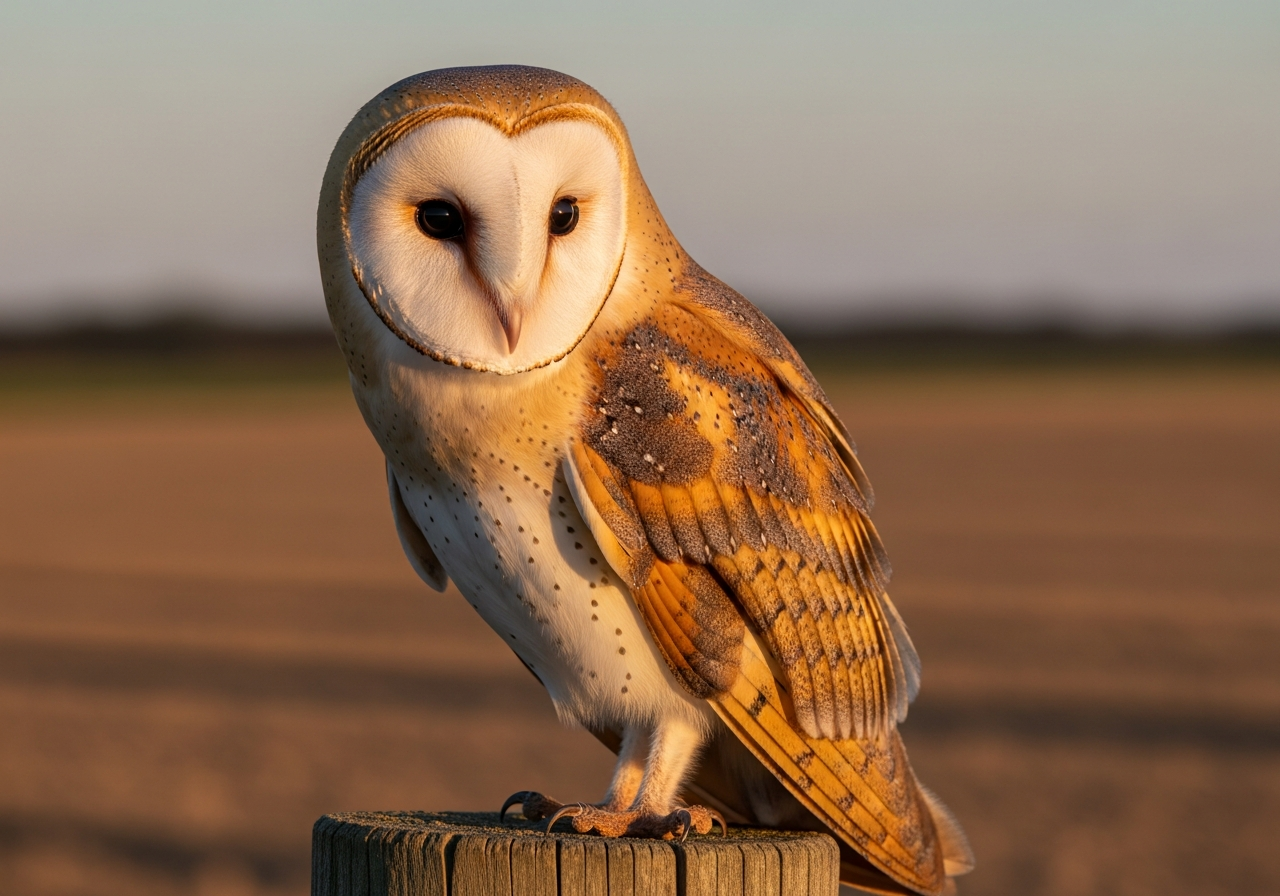
The barn owl is the classic auditory hunter. Its stiff facial disc funnels sound to the ear openings, which sit at slightly different heights on the skull — so a sound arriving from below hits one ear marginally sooner than the other. The owl reads that tiny asymmetry as vertical position and the left–right delay as horizontal position, building a two-dimensional map of a rustling mouse without seeing it. Fringed wing feathers break up the turbulence that makes flight noisy, so the prey gets no warning.
Bats went further and stopped relying on ambient light altogether. Echolocation is active sensing: the animal emits a call and reconstructs the world from the returning echoes, extracting distance, size, texture, and movement. The vampire bat adds infrared-sensitive pits around the nose to find warm blood vessels beneath skin.
Smell and touch carry others. The aardvark locates termite colonies underground by scent, its eyesight almost irrelevant. A foraging hedgehog works a suburban garden by nose and ear, snuffling audibly through leaf litter for beetles and slugs. The aye-aye taps branches with a skeletal middle finger and listens for the hollow resonance of a grub’s tunnel, then gnaws in — percussive foraging, essentially sonar performed with a fingertip. The kiwi, nearly blind, probes leaf litter with nostrils at the very tip of its bill.
Exceptions that complicate the rule
Not all owls are nocturnal. The snowy owl hunts in Arctic summer daylight, because at those latitudes there is no darkness to wait for. Some hawks hunt at dusk. The categories describe tendencies, not laws.
Islands scramble the pattern too. The kakapo is a flightless nocturnal parrot — a lineage that is otherwise emphatically diurnal — because New Zealand had no ground-dwelling mammalian predators, and darkness offered protection from the day-hunting birds that were the real threat.
Then there is the historical argument. Mammals spent much of the age of dinosaurs as small, night-active animals, and the group’s shared traits — poor colour vision compared to birds and reptiles, excellent hearing and smell, whiskers, warm-bloodedness — read as the residue of a long nocturnal apprenticeship. Diurnal mammals, including us, are arguably the ones who left.
What artificial light is doing
Electric light is the newest pressure on the oldest schedule. Skyglow over cities suppresses melatonin and desynchronises circadian rhythms in animals that evolved with nothing brighter than a full moon. Insects orbit lamps until they die of exhaustion, draining the prey base that night-hunting species depend on. Hatchling green sea turtles navigate to the sea by heading for the brightest horizon — reliably the ocean for millions of years, now often a car park. Migrating birds collide with lit towers.
The fixes are unusually cheap. Shielded fixtures that aim light downward, warmer colour temperatures, motion sensors, and simply switching things off when nobody is there restore much of the darkness these species need. Unlike most conservation problems, this one can be partly solved with a switch.
Related reading
Sources
Frequently asked questions
What does nocturnal mean?
Active primarily during the night; the opposite of diurnal (day-active). Crepuscular animals peak at dawn and dusk.
Are all owls nocturnal?
Most are, but some hunt by day. Barn owls are strongly night-active; a few species are more flexible.
Why are desert animals often nocturnal?
Night air is cooler, so animals lose less water and avoid lethal daytime heat.
How do bats see in the dark?
Many use echolocation — clicking sounds and echoes — more than eyesight for hunting insects.