Image sourcing: see credits & licences
Quick answer
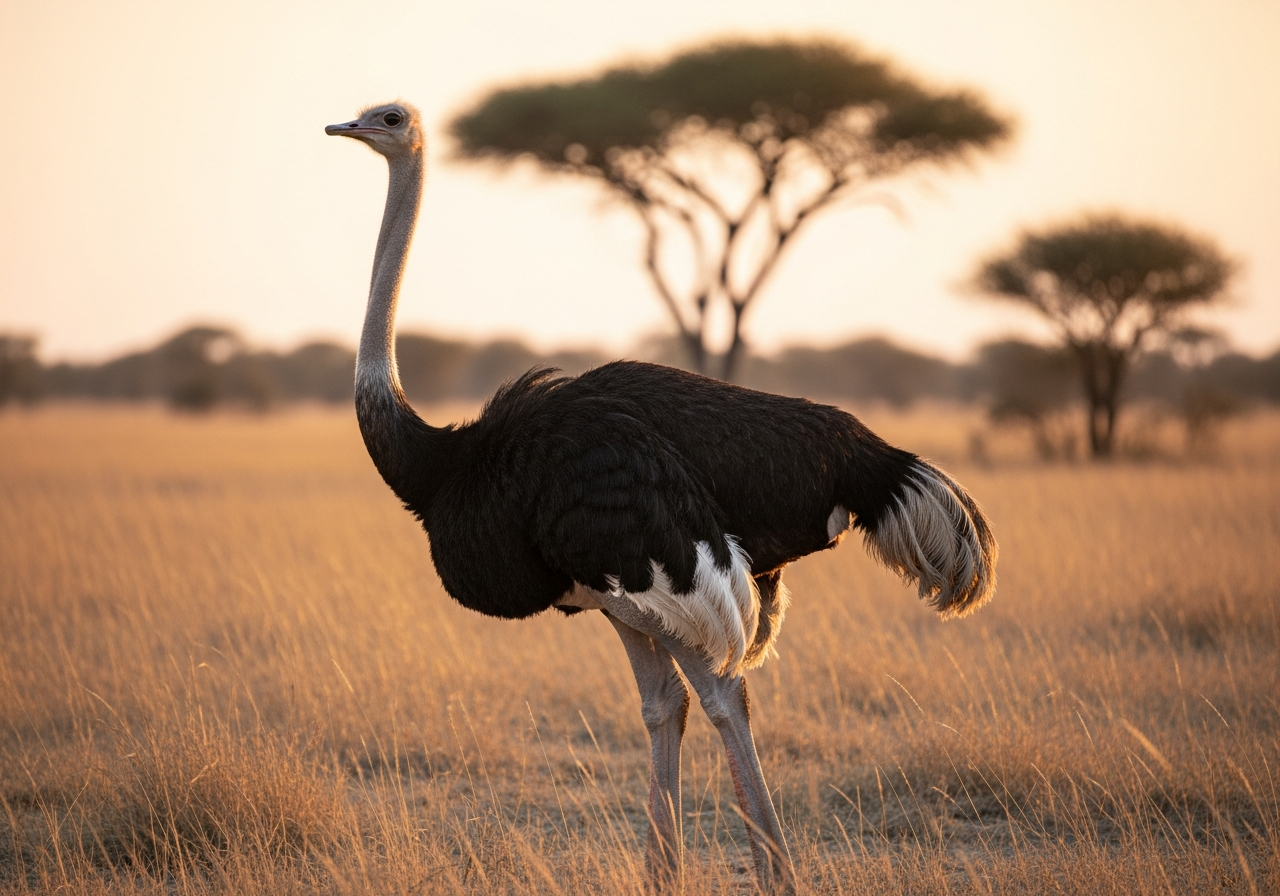
The ostrich (Struthio camelus) is the largest and heaviest living bird, a flightless native of Africa's savannas, semi-deserts, and open plains. Adults stand up to about 2.8 m tall and weigh 63 to 130 kg, yet they are the fastest bird on land, sprinting at 70 km/h. Mostly plant-eating omnivores, wild ostriches live 40 to 45 years and are listed as Least Concern.
Top questions about the Ostrich
Ostrich facts at a glance
- Weight 130 kg
- Length 2.8 m
- Top speed 70 km/h
- Lifespan 45 years
| Scientific name | Struthio camelus |
|---|---|
| Diet | Omnivore (mostly plants) |
| Habitat | Savanna, semi-desert, open plains |
| Lifespan | 40–45 years in the wild |
| Weight | 63–130 kg (140–290 lb) |
| Top speed | 70 km/h (43 mph) on foot |
| Conservation status | Least Concern (IUCN) |
| Kingdom | Animalia |
|---|---|
| Phylum | Chordata |
| Class | Aves |
| Order | Struthioniformes |
| Family | Struthionidae |
| Genus | Struthio |
Where it lives
The ostrich (Struthio camelus) is native to The savannas, semi-deserts, and open plains of sub-Saharan Africa. — recorded across Africa in this guide’s range summary.
For occurrence records, see GBIF species search and sources below.
How big is a ostrich?
An adult ostrich measures 2.8 m long — about 1.6× the height of an average adult person (1.73 m) — and weighs around 130 kg, about 1.9× an average adult’s body weight (70 kg).
Length vs an average adult’s height (to scale)
What is a group of ostriches called?
Group name (collective noun)
A group of Ostriches is called a flock. It is also known as a troop.
Baby name
A baby Ostrich is called a chick.
Explore more animal collective nouns and baby animal names .
Built for running, not flying
The ostrich long ago traded flight for speed on the ground. Its two-toed feet, unique among birds, act like sprinter's spikes and let it reach 70 km/h (43 mph), the fastest running speed of any bird. Powerful legs also deliver a forward kick strong enough to injure a lion or a person. Its stubby wings are useless for flight but work as rudders and stabilisers, helping it change direction sharply at full pace.
Size and appearance
Standing up to 2.8 m tall and weighing between 63 and 130 kg, the ostrich dwarfs every other living bird. Males are boldly marked in black and white, while females and young are a muted grey-brown that blends into dry grassland. The long bare neck and enormous eyes, each larger than the brain, give the bird sweeping vision across open country. Those eyes are among the largest of any land vertebrate.
Diet and feeding
Ostriches are omnivores that feed mainly on plants, favouring seeds, shoots, leaves, flowers, and roots. They also take insects, small reptiles, and other invertebrates when available. Lacking teeth, an ostrich swallows pebbles and grit that collect in its gizzard to grind tough plant matter. It can go for long periods without drinking, taking most of its water from the vegetation it eats.
Breeding and eggs
Ostriches lay the largest eggs of any living bird, each weighing around 1.5 kg, though they are among the smallest eggs relative to the size of the parent. A dominant female and a male share a communal nest, a simple scrape in the ground, where several females may lay. The pair take turns incubating: the drab female sits by day and the black male by night, each camouflaged for the light. Chicks hatch after about six weeks and can run with the adults within days.
Conservation and human use
The ostrich is classed as Least Concern by the IUCN, with wild populations across sub-Saharan Africa and large numbers kept on farms worldwide. Domesticated ostriches are raised for their meat, leather, and decorative feathers, an industry that dates back more than a century. Wild numbers have contracted in parts of their former range through hunting and habitat loss, and one subspecies, the North African ostrich, has become rare. Overall the species remains widespread and secure.
Dig deeper into the Ostrich
- How Fast Is An Ostrich?
Ostrich top speed is about 70 km/h (43 mph) on foot. Sprint vs endurance and what limits pace.
- How Long Do Ostrichs Live?
Ostrich lifespan is typically 40–45 years in the wild. What shortens or extends life, life stages, and status (Least Concern).
- Ostrich: Key Facts
Ostrichs (Struthio camelus) are birds found across Africa. The largest and fastest bird on land.
- What Do Ostrichs Eat?
What ostrichs eat: Omnivore (mostly plants), foraging style, and seasonal shifts in Savanna, semi-desert, open plains.
- Where Do Ostrichs Live?
Where ostrichs live: Savanna, semi-desert, open plains, native range cues, and human overlap. Status Least Concern.
Explore the Ostrich
Related Birds
Range & geography
Did you know? Ostrich facts
- The ostrich is the largest and heaviest living bird, standing up to 2.8 m tall.
- It is the fastest bird on land, running up to about 70 km/h.
- Ostriches lay the largest eggs of any living bird.
- They cannot fly, but their powerful legs deliver a dangerous kick.
- An ostrich's eye is larger than its brain.
- They do not bury their heads in sand — that is a myth.
Diet & feeding
Ostriches are omnivores eating mainly plants — seeds, shoots, and leaves — plus insects and small animals, swallowing grit to help grind food.
Adaptations
- Long, powerful legs enable high running speed and a formidable kick.
- Two-toed feet act like sprinting hooves for speed across open ground.
- Large eyes and height provide excellent long-distance vision over the plains.
- Loose feathers and bare skin help shed heat in hot climates.
Behaviour & ecology
- Ostriches live in groups and rely on speed and vigilance to evade predators.
- They defend themselves with powerful kicks rather than flight.
- Several females may lay in a communal nest tended by a dominant pair.
- They forage while walking across open savanna and semi-desert.
Communication
- Males give a deep, booming call during the breeding season.
- Visual displays of wings and neck feature in courtship and threat.
- Group vigilance and movement coordinate response to danger.
Habitat & range
Ostriches inhabit the savannas, grasslands, and semi-arid plains of Africa, favouring open country where they can see and outrun predators.
Ecological role
As large ground-dwelling omnivores, ostriches disperse seeds and, through their vigilance, often serve as early-warning sentinels for other savanna animals.
Conservation status of the Ostrich
The ostrich (Struthio camelus) is listed as Least Concern on the IUCN Red List. Least Concern (LC) is the IUCN's lowest-risk category, assigned to widespread, abundant species that have been evaluated and found not to be threatened. It does not mean a species faces no pressures — only that it is not currently at risk of extinction.
The ostrich (Struthio camelus) is assessed on the IUCN Red List. Look up on the IUCN Red List .
Frequently asked questions about the Ostrich
How fast can an ostrich run?
An ostrich can run at up to 70 km/h (43 mph), making it the fastest bird on land. It can also maintain around 50 km/h over longer distances, and each stride can cover several metres.
How big is an ostrich?
Ostriches stand up to about 2.8 m tall and weigh between 63 and 130 kg. This makes them the largest and heaviest living birds by a wide margin.
Can ostriches fly?
No. Ostriches are flightless birds with small wings unsuited to flight. Instead they escape danger by running at high speed and use their wings for balance and steering.
What do ostriches eat?
Ostriches are omnivores that eat mostly plants, including seeds, shoots, leaves, and roots, along with the occasional insect or small reptile. They swallow pebbles to help grind food in the gizzard, as they have no teeth.
Do ostriches really bury their heads in the sand?
No, that is a myth. Ostriches lower their heads to the ground to turn their eggs or feed, and they may lie flat to avoid being seen, which can look like burying the head from a distance.
How long do ostriches live?
Wild ostriches typically live 40 to 45 years. On farms and in captivity they can reach a similar age with good care.
What is a group of ostriches called?
A group of Ostriches is called a flock. It is also known as a troop.
What is a baby ostrich called?
A baby Ostrich is called a chick.
Sources & references
This guide is compiled and reviewed against established zoological and conservation references. Key sources for the Ostrich:
-
IUCN Red List of Threatened Species
Conservation status (Least Concern) reflects the IUCN Red List category for Struthio camelus.
-
iNaturalist — observations & photos
Search citizen-science observations and community IDs for Struthio camelus. Useful for range checks and recent sightings — not a substitute for formal Red List status.
-
GBIF — occurrence data
Global Biodiversity Information Facility species search for Struthio camelus. Explore published occurrence records used in range research.
-
eBird — bird observations
Cornell Lab eBird target search for Ostrich. Check recent checklists and seasonal abundance where birders report this species.
- BirdLife International (2018). Struthio camelus. IUCN Red List of Threatened Species.
Status (Least Concern) and range.
- Billerman, S. M. et al. (eds.). Birds of the World. Cornell Lab of Ornithology.
Biology and behaviour.
- Animal Diversity Web — Struthio camelus. University of Michigan Museum of Zoology.
Life history, morphology, and range.
-
Global Animal Guide editorial standards
How we research, source, review, and update every guide for accuracy.
Social life and behaviour
Outside the breeding season ostriches gather in loose flocks, often mixing with grazing zebra and antelope that benefit from the bird's sharp eyesight and early alarm. When threatened, an ostrich usually runs rather than fights, though a cornered bird will lash out with its legs. The old belief that ostriches bury their heads in the sand is a myth; the impression comes from birds lowering their heads to the ground to turn eggs or feed. They rest with their necks flat to the earth, which from a distance can look like a buried head.