Quick answer
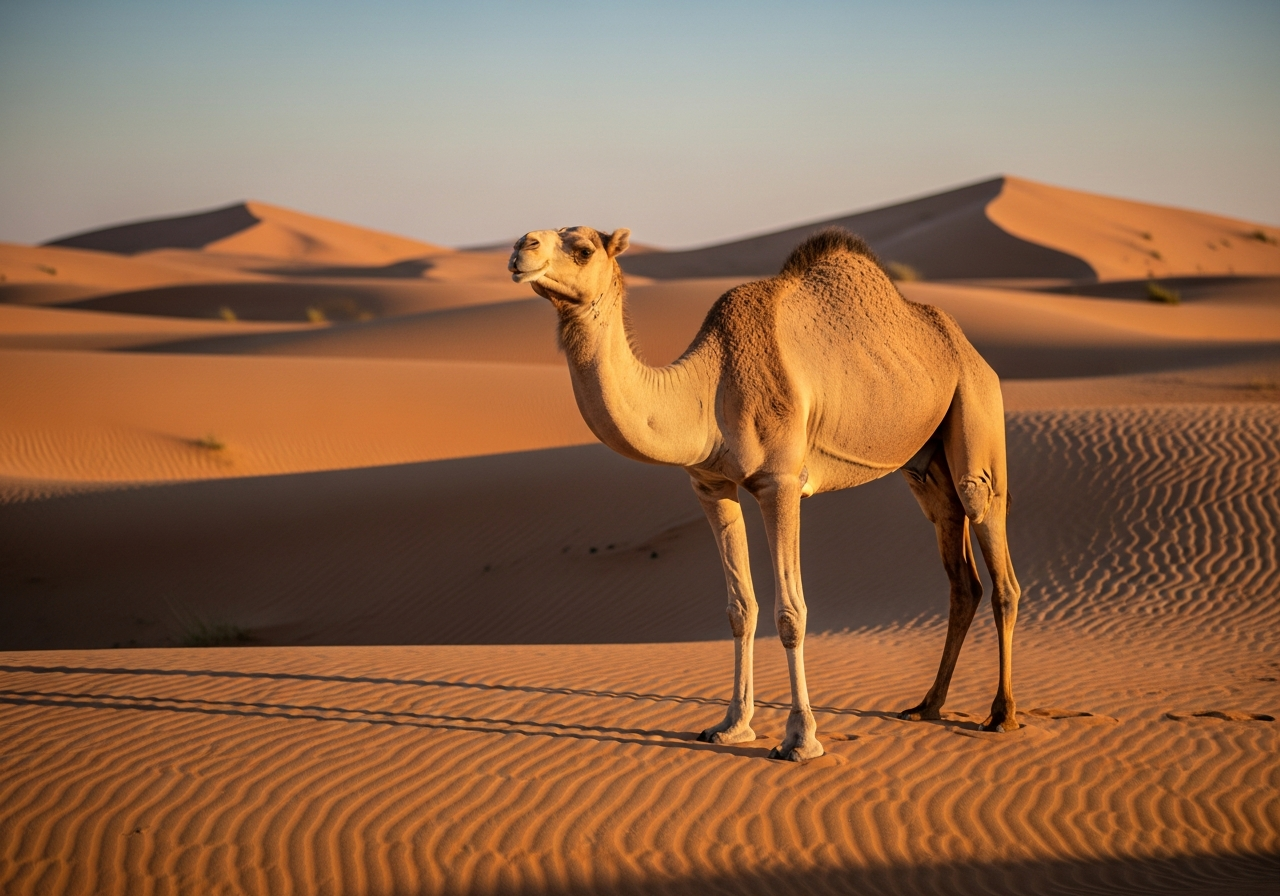
The camel is a large desert-adapted mammal famous for its humps, which store fat rather than water and let it survive long periods without food. The single-humped dromedary lives in the deserts of North Africa and the Middle East, while the two-humped Bactrian camel inhabits the cold deserts of Central Asia. Camels can go for weeks without drinking and then take in over 100 liters at once, and they have long served people as pack animals and a source of milk, meat, and wool. Domestic camels often live 40 to 50 years.
Top questions about the Camel
Camel facts at a glance
- Weight 600 kg
- Length 3 m
- Top speed 65 km/h
- Lifespan 45 years
| Scientific name | Camelus dromedarius |
|---|---|
| Diet | Herbivore |
| Habitat | Deserts and arid plains |
| Lifespan | 40–50 years |
| Weight | 400–700 kg (880–1,540 lb) |
| Top speed | Up to 65 km/h (40 mph) in short bursts |
| Conservation status | Least Concern (IUCN) |
| Kingdom | Animalia |
|---|---|
| Phylum | Chordata |
| Class | Mammalia |
| Order | Artiodactyla |
| Family | Camelidae |
| Genus | Camelus |
Where it lives
The camel (Camelus dromedarius) is native to Deserts and arid regions of North Africa, the Middle East, and Central and South Asia. — recorded across Africa, Asia in this guide’s range summary.
For occurrence records, see GBIF species search and sources below.
How big is a camel?
An adult camel measures 3 m long — about 1.7× the height of an average adult person (1.73 m) — and weighs around 600 kg, about 8.6× an average adult’s body weight (70 kg).
Length vs an average adult’s height (to scale)
What is a group of camels called?
Group name (collective noun)
A group of Camels is called a caravan. It is also known as a herd or a flock.
Baby name
A baby Camel is called a calf.
Explore more animal collective nouns and baby animal names .
Desert adaptations
Camels are superbly adapted to harsh deserts. Their humps store fat that can be broken down for energy and water when food is scarce, and they can tolerate large swings in body temperature to avoid sweating. They have thick lips for eating thorny plants, double rows of long eyelashes and closable nostrils to keep out blowing sand, and broad padded feet that spread their weight on loose ground. They can lose a third of their body water and recover rapidly when they drink.
Diet and feeding
Camels are herbivores that browse and graze on grasses, leaves, and tough, thorny desert shrubs that many animals avoid. Their leathery mouths and specialized digestion let them process dry, salty, and spiny vegetation. Like cattle, they are ruminants that chew cud to extract maximum nutrients from poor forage. When food and water are plentiful they build up the fat reserves stored in their humps.
Domestication and use
Camels were domesticated thousands of years ago and remain vital to people across arid regions as transport, pack animals, and a source of milk, meat, and wool. The dromedary, with one hump, is common in North Africa, the Middle East, and South Asia, while the Bactrian camel, with two humps, is suited to the cold deserts of Central Asia. Their ability to carry heavy loads across desert made them central to historic trade routes. A large feral dromedary population also lives in Australia.
Conservation
The domestic dromedary and Bactrian camel are common and listed as Least Concern, kept in large numbers by people. However, the truly wild Bactrian camel of Central Asia is a separate, Critically Endangered species with only a few hundred individuals remaining. Habitat loss and hunting threaten these wild camels. Conservation programs in Mongolia and China aim to protect the last wild herds.
Dig deeper into the Camel
- Camel: Key Facts
The camel is a large desert-adapted mammal famous for its humps, which store fat rather than water and let it survive long periods without food.
- How Fast Is A Camel?
Camel top speed is up to about 65 km/h (40 mph) in short bursts. Sprint vs endurance and what limits pace.
- How Long Do Camels Live?
Camel lifespan is typically 40–50 years. What shortens or extends life, life stages, and status (Least Concern).
- What Do Camels Eat?
What camels eat: Herbivore, foraging style, and seasonal shifts in Deserts and arid plains.
- Where Do Camels Live?
Where camels live: Deserts and arid plains, native range cues, and human overlap. Status Least Concern.
Explore the Camel
Compare
Range & geography
Did you know? Camel facts
- The camel is a large desert-adapted mammal famous for its humps, which store fat rather than water and let it survive long periods without food.
- No. Camel humps store fat, not water. The fat provides energy and can be metabolized when food is scarce, while special adaptations elsewhere help camels conserve water.
- Camels can survive a week or more without drinking, even in desert heat, and can lose a large fraction of their body water. When they reach water they can drink over 100 liters in a single session.
- The dromedary has one hump and lives in the hot deserts of Africa and the Middle East, while the Bactrian camel has two humps and is adapted to the cold deserts of Central Asia.
- Camels are herbivores that eat grasses, leaves, and tough, thorny desert plants other animals avoid. As ruminants, they chew cud to get the most from sparse, dry vegetation.
- Conservation: Least Concern (IUCN).
Diet & feeding
Camel feeds primarily as a herbivore. Camels are superbly adapted to harsh deserts. Their humps store fat that can be broken down for energy and water when food is scarce, and they can tolerate large swings in body temperature to avoid sweating. They have thick lips for eating thorny plants, double rows of long eyelash
Adaptations
- Camels are superbly adapted to harsh deserts. Their humps store fat that can be broken down for energy and water when food is scarce, and they can tolerate large swings in body temperature to avoid sweating. They have thick lips for eating thorny plants, double rows of long eyelashes and closable nostrils to keep out blowing sand, and broad padded feet that spread their weight on loose ground. They can lose a third of their body water and recover rapidly when they drink.
- Camels are herbivores that browse and graze on grasses, leaves, and tough, thorny desert shrubs that many animals avoid. Their leathery mouths and specialized digestion let them process dry, salty, and spiny vegetation. Like cattle, they are ruminants that chew cud to extract maximum nutrients from poor forage. When food and water are plentiful they build up the fat reserves stored in their humps.
Behaviour & ecology
- Camels are superbly adapted to harsh deserts. Their humps store fat that can be broken down for energy and water when food is scarce, and they can tolerate large swings in body temperature to avoid sweating. They have thick lips for eating thorny plants, double rows of long eyelashes and closable nostrils to keep out blowing sand, and broad padded feet that spread their weight on loose ground. They can lose a third of their body water and recover rapidly when they drink.
- Camels are herbivores that browse and graze on grasses, leaves, and tough, thorny desert shrubs that many animals avoid. Their leathery mouths and specialized digestion let them process dry, salty, and spiny vegetation. Like cattle, they are ruminants that chew cud to extract maximum nutrients from poor forage. When food and water are plentiful they build up the fat reserves stored in their humps.
- Camels were domesticated thousands of years ago and remain vital to people across arid regions as transport, pack animals, and a source of milk, meat, and wool. The dromedary, with one hump, is common in North Africa, the Middle East, and South Asia, while the Bactrian camel, with two humps, is suited to the cold deserts of Central Asia. Their ability to carry heavy loads across desert made them central to historic trade routes. A large feral dromedary population also lives in Australia.
Communication
- Camel uses scent, posture, and vocal signals to mark territory and coordinate social behaviour.
- Communication intensity often peaks during breeding seasons and territorial disputes.
Habitat & range
Deserts and arid plains
Ecological role
Camel shapes vegetation through grazing or browsing and serves as prey for larger predators where ranges overlap.
Conservation status of the Camel
The camel (Camelus dromedarius) is listed as Least Concern on the IUCN Red List. Least Concern (LC) is the IUCN's lowest-risk category, assigned to widespread, abundant species that have been evaluated and found not to be threatened. It does not mean a species faces no pressures — only that it is not currently at risk of extinction.
The camel (Camelus dromedarius) is assessed on the IUCN Red List. Look up on the IUCN Red List .
Frequently asked questions about the Camel
Do camels store water in their humps?
No. Camel humps store fat, not water. The fat provides energy and can be metabolized when food is scarce, while special adaptations elsewhere help camels conserve water.
How long can a camel go without water?
Camels can survive a week or more without drinking, even in desert heat, and can lose a large fraction of their body water. When they reach water they can drink over 100 liters in a single session.
What is the difference between dromedary and Bactrian camels?
The dromedary has one hump and lives in the hot deserts of Africa and the Middle East, while the Bactrian camel has two humps and is adapted to the cold deserts of Central Asia.
What do camels eat?
Camels are herbivores that eat grasses, leaves, and tough, thorny desert plants other animals avoid. As ruminants, they chew cud to get the most from sparse, dry vegetation.
How long do camels live?
Domestic camels commonly live 40 to 50 years. Their longevity, strength, and endurance have made them valuable working animals in desert regions for thousands of years.
Are camels endangered?
Domestic camels are abundant and listed as Least Concern. However, the separate wild Bactrian camel of Central Asia is Critically Endangered, with only a few hundred left in the wild.
What is a group of camels called?
A group of Camels is called a caravan. It is also known as a herd or a flock.
What is a baby camel called?
A baby Camel is called a calf.
Sources & references
This guide is compiled and reviewed against established zoological and conservation references. Key sources for the Camel:
-
IUCN Red List of Threatened Species
Conservation status (Least Concern) reflects the IUCN Red List category for Camelus dromedarius.
-
iNaturalist — observations & photos
Search citizen-science observations and community IDs for Camelus dromedarius. Useful for range checks and recent sightings — not a substitute for formal Red List status.
-
GBIF — occurrence data
Global Biodiversity Information Facility species search for Camelus dromedarius. Explore published occurrence records used in range research.
- IUCN Red List — Camelus dromedarius.
Conservation status (Least Concern) and population trends.
- Animal Diversity Web — Camelus dromedarius. University of Michigan Museum of Zoology.
Life history, morphology, and range.
- Wikipedia — Camel.
General taxonomy and overview (cross-check primary sources).
-
Global Animal Guide editorial standards
How we research, source, review, and update every guide for accuracy.