Image sourcing: see credits & licences
Quick answer
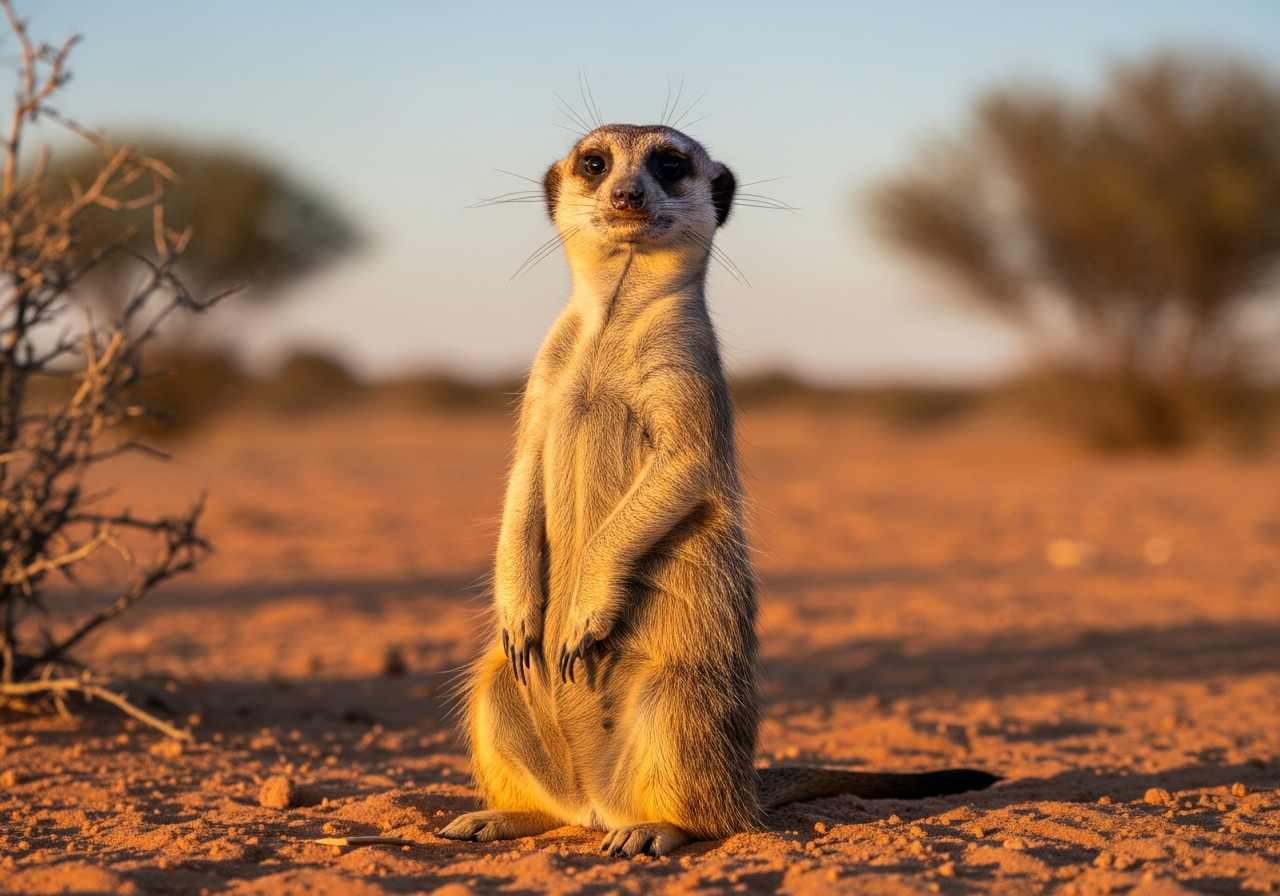
The meerkat is a small, highly social mongoose native to the deserts and dry plains of southern Africa, famous for standing upright on its hind legs to watch for danger. Meerkats live in tight-knit groups called mobs, take turns as lookout sentinels, and raise their young cooperatively. They are immune to some scorpion and snake venom and typically live around 10 years.
Top questions about the Meerkat
Meerkat facts at a glance
- Weight 800 g
- Length 35 cm
- Top speed 32 km/h
- Lifespan 10 years
| Scientific name | Suricata suricatta |
|---|---|
| Diet | Insectivore (mostly) |
| Habitat | Desert and dry savanna |
| Lifespan | About 10 years |
| Weight | 0.6–1 kg (1.3–2.2 lb) |
| Top speed | Up to 32 km/h (20 mph) |
| Conservation status | Least Concern (IUCN) |
| Kingdom | Animalia |
|---|---|
| Phylum | Chordata |
| Class | Mammalia |
| Order | Carnivora |
| Family | Herpestidae |
| Genus | Suricata |
Where it lives
The meerkat (Suricata suricatta) is native to Deserts and dry savannas of southern Africa, including the Kalahari. — recorded across Africa in this guide’s range summary.
For occurrence records, see GBIF species search and sources below.
How big is a meerkat?
An adult meerkat measures 35 cm long — about 20% of the height of an average adult person (1.73 m) — and weighs around 800 g, about 1% of an average adult’s body weight (70 kg).
Length vs an average adult’s height (to scale)
What is a group of meerkats called?
Group name (collective noun)
A group of Meerkats is called a mob. It is also known as a gang.
Baby name
A baby Meerkat is called a pup.
Explore more animal collective nouns and baby animal names .
Teamwork and sentinels
Meerkats live in cooperative groups of up to 30 or more. While most of the mob forages, one or more take turns standing guard on raised ground or a bush, scanning the sky and horizon for predators. The sentinel gives different alarm calls for different threats, telling the group whether danger comes from the air or the ground.
Raising young together
Meerkats are cooperative breeders. A dominant pair produces most of the pups, and other members of the group help by babysitting, feeding, and teaching the youngsters, including how to handle dangerous prey such as scorpions. This shared care gives pups a strong chance of survival in a harsh environment.
Built for the desert
Dark patches around the eyes cut glare from the bright desert sun, like built-in sunglasses, and long claws make meerkats expert diggers of the extensive burrow systems where they shelter from heat and predators. They are partly immune to the venom of some scorpions and snakes they hunt.
Behavior and range
Found across the Kalahari and other dry regions of southern Africa, meerkats are active by day and retreat underground at night and during the hottest hours. Their tight social bonds, sunbathing huddles, and upright watch posture have made them one of the most recognizable and popular small animals.
Dig deeper into the Meerkat
- How Fast Is A Meerkat?
Meerkat top speed is up to about 32 km/h (20 mph). Sprint vs endurance and what limits pace.
- How Long Do Meerkats Live?
Meerkat lifespan is typically About 10 years. What shortens or extends life, life stages, and status (Least Concern).
- Meerkat: Key Facts
The meerkat is a small, highly social mongoose native to the deserts and dry plains of southern Africa, famous for standing upright on its hind legs to…
- What Do Meerkats Eat?
What meerkats eat: Insectivore (mostly), foraging style, and seasonal shifts in Desert and dry savanna.
- Where Do Meerkats Live?
Where meerkats live: Desert and dry savanna, native range cues, and human overlap. Status Least Concern.
Explore the Meerkat
Compare
Range & geography
Did you know? Meerkat facts
- The meerkat is a small, highly social mongoose native to the deserts and dry plains of southern Africa, famous for standing upright on its hind legs to watch for danger.
- Meerkats stand upright to act as sentinels, getting a better view to watch for predators such as eagles and jackals. They also stand to warm up in the morning sun.
- Meerkats are mainly insectivores, feeding on beetles, larvae, and especially scorpions, to which they have some venom resistance. They also eat spiders, small reptiles, eggs, and roots.
- Yes. Meerkats are highly social and live in cooperative groups called mobs or gangs of up to 30 or more, sharing lookout duty and raising pups together.
- Meerkats have partial resistance to the venom of some scorpions and snakes they hunt, which lets them tackle prey that would harm many other animals, though they are not fully immune.
- Conservation: Least Concern (IUCN).
Diet & feeding
Meerkat feeds primarily as a insectivore (mostly). Meerkats live in cooperative groups of up to 30 or more. While most of the mob forages, one or more take turns standing guard on raised ground or a bush, scanning the sky and horizon for predators. The sentinel gives different alarm calls for different threats, telling
Adaptations
- Meerkats live in cooperative groups of up to 30 or more. While most of the mob forages, one or more take turns standing guard on raised ground or a bush, scanning the sky and horizon for predators. The sentinel gives different alarm calls for different threats, telling the group whether danger comes from the air or the ground.
- Meerkats are cooperative breeders. A dominant pair produces most of the pups, and other members of the group help by babysitting, feeding, and teaching the youngsters, including how to handle dangerous prey such as scorpions. This shared care gives pups a strong chance of survival in a harsh environment.
Behaviour & ecology
- Meerkats live in cooperative groups of up to 30 or more. While most of the mob forages, one or more take turns standing guard on raised ground or a bush, scanning the sky and horizon for predators. The sentinel gives different alarm calls for different threats, telling the group whether danger comes from the air or the ground.
- Meerkats are cooperative breeders. A dominant pair produces most of the pups, and other members of the group help by babysitting, feeding, and teaching the youngsters, including how to handle dangerous prey such as scorpions. This shared care gives pups a strong chance of survival in a harsh environment.
- Dark patches around the eyes cut glare from the bright desert sun, like built-in sunglasses, and long claws make meerkats expert diggers of the extensive burrow systems where they shelter from heat and predators. They are partly immune to the venom of some scorpions and snakes they hunt.
Communication
- Meerkat uses scent, posture, and vocal signals to mark territory and coordinate social behaviour.
- Communication intensity often peaks during breeding seasons and territorial disputes.
Habitat & range
Desert and dry savanna
Ecological role
Meerkat plays a recognised ecological role in desert and dry savanna.
Conservation status of the Meerkat
The meerkat (Suricata suricatta) is listed as Least Concern on the IUCN Red List. Least Concern (LC) is the IUCN's lowest-risk category, assigned to widespread, abundant species that have been evaluated and found not to be threatened. It does not mean a species faces no pressures — only that it is not currently at risk of extinction.
The meerkat (Suricata suricatta) is assessed on the IUCN Red List. Look up on the IUCN Red List .
Frequently asked questions about the Meerkat
Why do meerkats stand up on their hind legs?
Meerkats stand upright to act as sentinels, getting a better view to watch for predators such as eagles and jackals. They also stand to warm up in the morning sun.
What do meerkats eat?
Meerkats are mainly insectivores, feeding on beetles, larvae, and especially scorpions, to which they have some venom resistance. They also eat spiders, small reptiles, eggs, and roots.
Do meerkats live in groups?
Yes. Meerkats are highly social and live in cooperative groups called mobs or gangs of up to 30 or more, sharing lookout duty and raising pups together.
Are meerkats immune to venom?
Meerkats have partial resistance to the venom of some scorpions and snakes they hunt, which lets them tackle prey that would harm many other animals, though they are not fully immune.
Where do meerkats live?
Meerkats live in the deserts and dry savannas of southern Africa, including the Kalahari, sheltering in extensive underground burrow systems.
What is a group of meerkats called?
A group of Meerkats is called a mob. It is also known as a gang.
What is a baby meerkat called?
A baby Meerkat is called a pup.
Sources & references
This guide is compiled and reviewed against established zoological and conservation references. Key sources for the Meerkat:
-
IUCN Red List of Threatened Species
Conservation status (Least Concern) reflects the IUCN Red List category for Suricata suricatta.
-
iNaturalist — observations & photos
Search citizen-science observations and community IDs for Suricata suricatta. Useful for range checks and recent sightings — not a substitute for formal Red List status.
-
GBIF — occurrence data
Global Biodiversity Information Facility species search for Suricata suricatta. Explore published occurrence records used in range research.
- IUCN Red List — Suricata suricatta.
Conservation status (Least Concern) and population trends.
- Animal Diversity Web — Suricata suricatta. University of Michigan Museum of Zoology.
Life history, morphology, and range.
- Wikipedia — Meerkat.
General taxonomy and overview (cross-check primary sources).
-
Global Animal Guide editorial standards
How we research, source, review, and update every guide for accuracy.