Quick answer
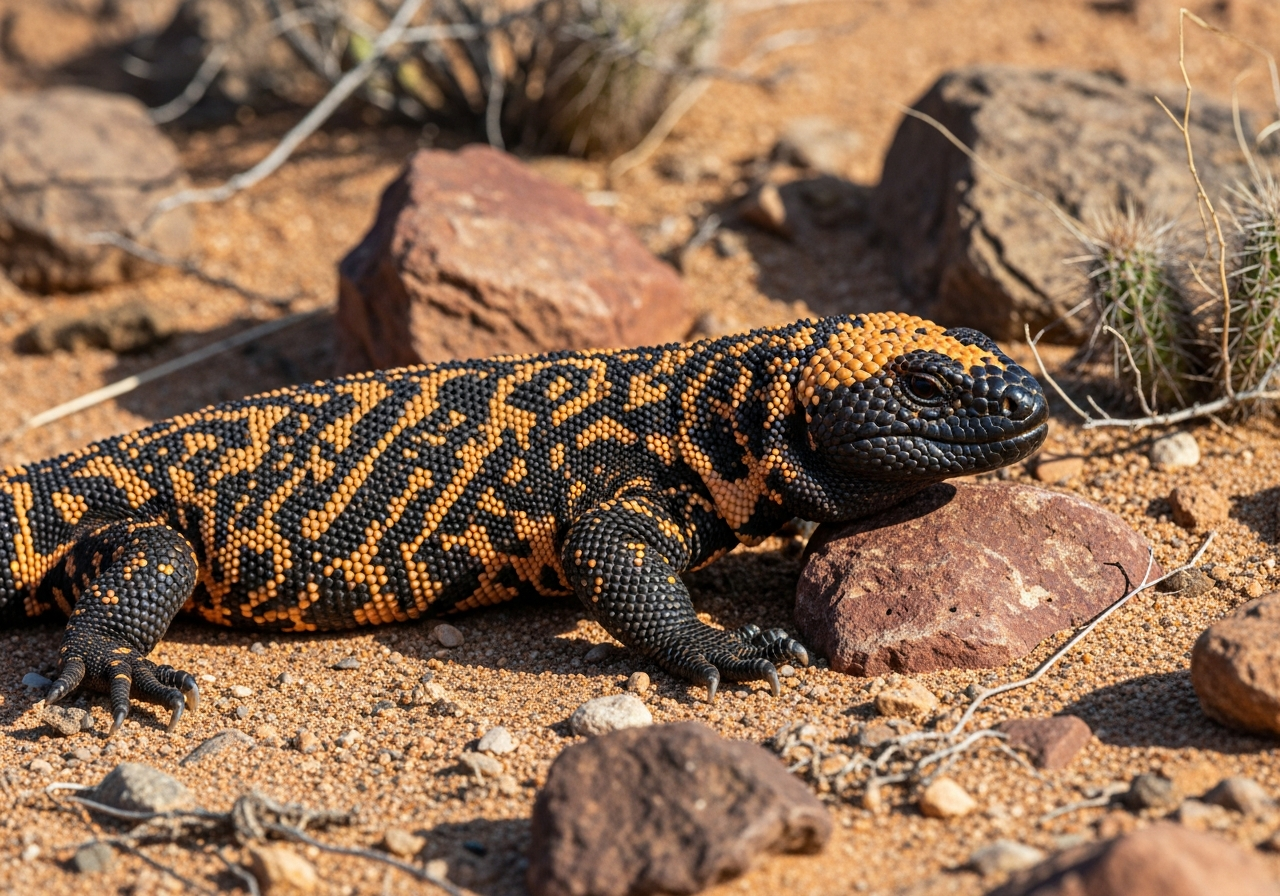
The Gila monster is a large, slow-moving venomous lizard of the deserts and scrubland of the south-western United States and north-western Mexico. It grows to about 0.6 m (2 ft) and 0.7 kg, with black skin marbled by pink or orange beading. It walks with a heavy, deliberate gait and delivers venom by chewing rather than striking. Listed as Near Threatened, it can live 20 years or more.
Top questions about the Gila Monster
Gila Monster facts at a glance
- Weight 700 g
- Length 50 cm
- Top speed 2 km/h
- Lifespan 20 years
| Scientific name | Heloderma suspectum |
|---|---|
| Diet | Carnivore |
| Habitat | Deserts and scrubland |
| Lifespan | 20+ years |
| Length | Up to 0.6 m (2 ft) |
| Venom | Venomous bite, rarely dangerous to humans |
| Conservation status | Near Threatened (IUCN) |
| Kingdom | Animalia |
|---|---|
| Phylum | Chordata |
| Class | Reptilia |
| Order | Squamata |
| Family | Helodermatidae |
| Genus | Heloderma |
Where it lives
The gila monster (Heloderma suspectum) is native to Deserts and scrubland of the southwestern United States and northwestern Mexico. — recorded across North America in this guide’s range summary.
For occurrence records, see GBIF species search and sources below.
How big is a gila monster?
An adult gila monster measures 50 cm long — about 29% of the height of an average adult person (1.73 m) — and weighs around 700 g, about 1% of an average adult’s body weight (70 kg).
Length vs an average adult’s height (to scale)
What is a group of gila monsters called?
Group name (collective noun)
A group of Gila Monsters is called a lounge.
Baby name
A baby Gila Monster is called a hatchling.
Explore more animal collective nouns and baby animal names .
Appearance and identification
The Gila monster is unmistakable, its dark body covered in bead-like scales called osteoderms patterned in pink, orange, and salmon against black. It is one of the heaviest lizards native to the United States, reaching roughly 0.5 to 0.6 m (up to 2 ft) and about 0.7 kg. The thick, sausage-shaped tail acts as a fat store, swelling after good feeding and shrinking during lean months. Its bright colouring is a warning signal, advertising to predators that the animal is venomous.
Venom and its bite
Unlike snakes that inject venom through hollow fangs, the Gila monster has grooved teeth in its lower jaw and works venom into a wound by chewing and holding on. The venom is a neurotoxin that causes intense pain, swelling, and a drop in blood pressure, but bites are rarely dangerous to healthy adults. Because the lizard is slow and reluctant to bite, almost all envenomations happen when people deliberately handle it. A compound first identified in its venom, exendin-4, inspired the diabetes drug exenatide.
Diet and feeding
The Gila monster is a carnivore that feeds mainly on the eggs of birds and reptiles, along with nestling rodents, young rabbits, and the occasional small lizard. It relies on a keen sense of smell, flicking its forked tongue to track prey and raid nests. Because meals are seasonal and unpredictable, it eats enormously when food is available, consuming up to a third of its body weight in a single sitting. Fat stored in the tail and body then sustains it through long fasts.
Habitat and behaviour
This lizard lives in the Sonoran, Mojave, and Chihuahuan deserts, favouring rocky foothills, scrubland, and areas near seasonal washes. It spends the great majority of its life underground in burrows, emerging for only a few weeks a year, mostly after spring rains. Active by day in the mild months and at dusk in the heat of summer, it walks slowly and rarely ventures far from shelter. Its low metabolism suits a life of long inactivity punctuated by brief bursts of feeding and breeding.
Lifespan and reproduction
Gila monsters are long-lived for lizards, commonly reaching 20 years or more in the wild and longer in captivity. Mating takes place in spring, and the female lays a clutch of around two to twelve eggs in summer, burying them in a burrow. The eggs incubate underground over winter and hatch the following spring, with young emerging fully independent. This slow reproductive pace means populations recover only gradually from losses.
Conservation status
The Gila monster is listed as Near Threatened by the IUCN and is legally protected across much of its range, including in the state of Arizona. Its main threats are habitat loss from development, road deaths, and illegal collection for the exotic pet trade. Because it breeds slowly and occupies fragmented desert habitat, local populations are vulnerable to disturbance. Legal protection and habitat conservation are the main tools keeping numbers stable.
Dig deeper into the Gila Monster
- Gila Monster: Key Facts
Gila Monsters (Heloderma suspectum) are reptiles found across North America. One of the few venomous lizards.
- How Long Do Gila Monsters Live?
Gila Monster lifespan is typically 20+ years. What shortens or extends life, life stages, and status (Near Threatened).
- What Do Gila Monsters Eat?
What gila monsters eat: Carnivore, foraging style, and seasonal shifts in Deserts and scrubland.
- Where Do Gila Monsters Live?
Where gila monsters live: Deserts and scrubland, native range cues, and human overlap. Status Near Threatened.
Explore the Gila Monster
Compare
Related Reptiles
Range & geography
Did you know? Gila Monster facts
- The Gila monster is a large, slow-moving lizard of the southwestern United States and northwestern Mexico, and one of the few venomous lizards in the world.
- Yes. The Gila monster is one of the few venomous lizards. It delivers venom through grooved teeth while chewing, causing severe pain and swelling, though bites are rarely fatal to humans.
- They are not aggressive and bites are uncommon, usually happening only when the lizard is handled or harassed. A bite is very painful but seldom life-threatening to a healthy adult.
- Gila monsters are carnivores that eat eggs, nestling birds, small mammals, and reptiles. They gorge when food is plentiful and store fat in their tails for lean times.
- Gila monsters can live 20 years or more, and individuals in captivity sometimes live even longer with consistent care and food.
- Conservation: Near Threatened (IUCN).
Diet & feeding
Gila Monster feeds primarily as a carnivore. These lizards are carnivores that raid nests for eggs and also eat young birds, small mammals, and reptiles. Because meals are infrequent, they gorge when food is available and store the energy as fat. A good sense of smell, aided by the flicking tongue, helps them locate bu
Adaptations
- Gila monsters are secretive and spend an estimated 90 percent of their lives in burrows and shelters, emerging mainly in the cooler hours of spring and early summer. They move slowly and rely on warning coloration rather than speed to deter predators. Their fat-storing tail lets them survive for months between meals.
- These lizards are carnivores that raid nests for eggs and also eat young birds, small mammals, and reptiles. Because meals are infrequent, they gorge when food is available and store the energy as fat. A good sense of smell, aided by the flicking tongue, helps them locate buried eggs and nests.
Behaviour & ecology
- Gila monsters are secretive and spend an estimated 90 percent of their lives in burrows and shelters, emerging mainly in the cooler hours of spring and early summer. They move slowly and rely on warning coloration rather than speed to deter predators. Their fat-storing tail lets them survive for months between meals.
- These lizards are carnivores that raid nests for eggs and also eat young birds, small mammals, and reptiles. Because meals are infrequent, they gorge when food is available and store the energy as fat. A good sense of smell, aided by the flicking tongue, helps them locate buried eggs and nests.
- The Gila monster delivers venom through grooved teeth in the lower jaw, chewing to work the venom into a wound rather than injecting it like a snake. The venom is rarely life-threatening to a healthy adult human but causes intense pain and swelling. Compounds in the venom have inspired medicines, including a drug used to treat type 2 diabetes.
Communication
- Scent marking, body posture, and head-bobbing or tail signals communicate threat and dominance.
- Vocalisations are limited in many reptiles but hissing or bellowing occurs in some groups.
Habitat & range
Deserts and scrubland
Ecological role
Gila Monster acts as a predator that helps regulate prey populations and maintain balance in deserts and scrubland.
Conservation status of the Gila Monster
The gila monster (Heloderma suspectum) is listed as Near Threatened on the IUCN Red List. Near Threatened (NT) means a species does not yet qualify as threatened but is close to it, or likely to become so in the near future without ongoing conservation. It is a watch-list category just below Vulnerable.
The gila monster (Heloderma suspectum) is assessed on the IUCN Red List. Look up on the IUCN Red List .
Frequently asked questions about the Gila Monster
Is the Gila monster venomous?
Yes. It is one of only a handful of venomous lizards and delivers a neurotoxic venom through grooved teeth in its lower jaw. The bite is very painful but rarely dangerous to a healthy adult, and the lizard is too slow to be a threat unless handled.
How big does a Gila monster get?
Adults reach around 0.5 to 0.6 m (up to 2 ft) in total length and weigh about 0.7 kg. This makes the Gila monster one of the largest lizards native to the United States.
What do Gila monsters eat?
They are carnivores that specialise in eggs, raiding the nests of birds and reptiles, and also eat young rodents and rabbits. Because meals are irregular, a Gila monster can eat up to a third of its body weight at once and store the energy as fat in its tail.
How long do Gila monsters live?
In the wild they commonly live 20 years or more, and captive individuals can live even longer. Their slow metabolism and long periods spent underground contribute to this longevity.
Where do Gila monsters live?
They inhabit the deserts and scrubland of the south-western United States and north-western Mexico, including parts of the Sonoran, Mojave, and Chihuahuan deserts. They spend most of their lives in burrows and emerge above ground for only a few weeks each year.
Are Gila monsters endangered?
They are classified as Near Threatened by the IUCN and are legally protected in much of their range. Habitat loss, road deaths, and illegal collection for the pet trade are their main threats.
What is a group of gila monsters called?
A group of Gila Monsters is called a lounge.
What is a baby gila monster called?
A baby Gila Monster is called a hatchling.
Sources & references
This guide is compiled and reviewed against established zoological and conservation references. Key sources for the Gila Monster:
-
IUCN Red List of Threatened Species
Conservation status (Near Threatened) reflects the IUCN Red List category for Heloderma suspectum.
-
iNaturalist — observations & photos
Search citizen-science observations and community IDs for Heloderma suspectum. Useful for range checks and recent sightings — not a substitute for formal Red List status.
-
GBIF — occurrence data
Global Biodiversity Information Facility species search for Heloderma suspectum. Explore published occurrence records used in range research.
- IUCN Red List — Heloderma suspectum.
Conservation status (Near Threatened) and population trends.
- Animal Diversity Web — Heloderma suspectum. University of Michigan Museum of Zoology.
Life history, morphology, and range.
- Wikipedia — Gila Monster.
General taxonomy and overview (cross-check primary sources).
-
Global Animal Guide editorial standards
How we research, source, review, and update every guide for accuracy.