Quick answer
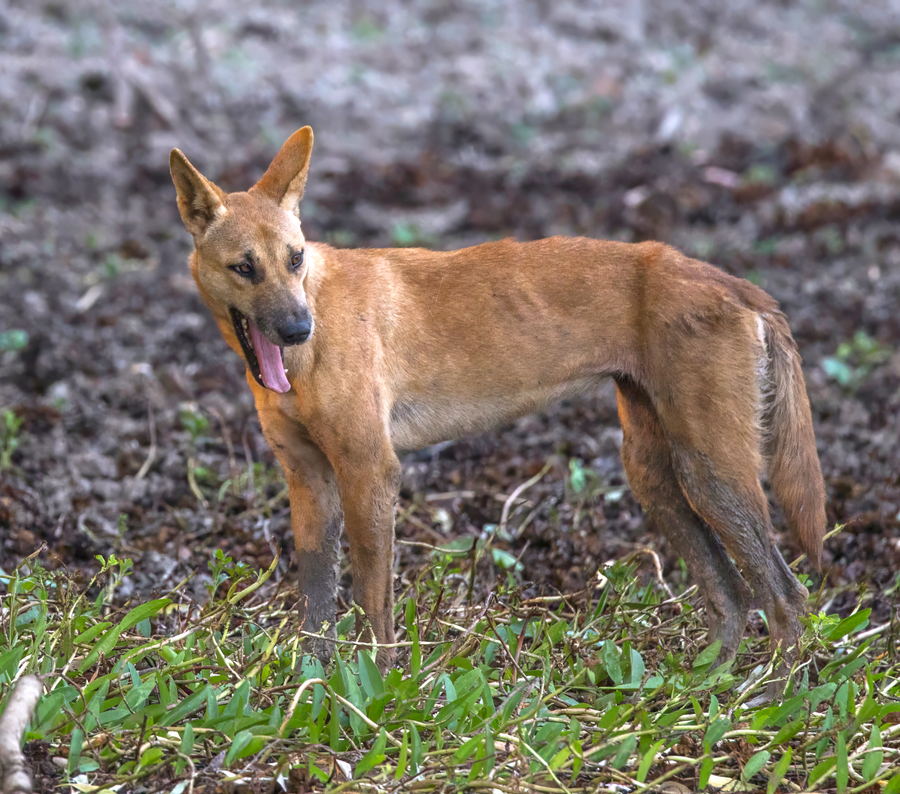
The dingo is a wild canid of Australia, descended from domestic dogs brought by humans thousands of years ago. Tan or ginger coat, erect ears, and a bushy tail distinguish most dingoes, which hunt kangaroos and rabbits across deserts, grasslands, and forests.
Top questions about the Dingo
Also available in Español (Dingo)
Dingo facts at a glance
- Weight 17 kg
- Length 1.1 m
- Top speed 60 km/h
- Lifespan 10 years
| Scientific name | Canis familiaris dingo |
|---|---|
| Diet | Carnivore — kangaroos, rabbits, rodents, and carrion |
| Habitat | Most of mainland Australia except intensive farmland |
| Lifespan | 5–10 years in the wild |
| Weight | 13–20 kg (29–44 lb); males larger |
| Top speed | Up to 60 km/h (37 mph) in pursuit |
| Conservation status | Vulnerable (IUCN) |
| Kingdom | Animalia |
|---|---|
| Phylum | Chordata |
| Class | Mammalia |
| Order | Carnivora |
| Family | Canidae |
| Genus | Canis |
Where it lives
The dingo (Canis familiaris dingo) is native to Mainland Australia across most habitats except intensive farmland; absent from Tasmania. Also occurs in parts of Southeast Asia as a related lineage. — recorded across Oceania in this guide’s range summary.
For occurrence records, see GBIF species search and sources below.
How big is a dingo?
An adult dingo measures 1.1 m long — about 64% of the height of an average adult person (1.73 m) — and weighs around 17 kg, about 24% of an average adult’s body weight (70 kg).
Length vs an average adult’s height (to scale)
What is a group of dingos called?
Group name (collective noun)
A group of Dingos is called a pack.
Baby name
A baby Dingo is called a pup.
Explore more animal collective nouns and baby animal names .
Origin and classification
Dingoes arrived in Australia at least 3,500 years ago with seafaring people. They are classified as Canis familiaris dingo — a feral or wild lineage of dog — rather than a separate wolf species. Pure dingoes rarely bark; they howl and whine.
Ecological role
As apex predators, dingoes regulate kangaroo and introduced pest numbers. Some ecologists argue dingo presence reduces mesopredator impacts on smaller native mammals. Hybridisation with domestic dogs threatens genetically pure dingo populations.
Pack and breeding
Dingoes often hunt alone or in pairs but may form small packs when prey is abundant. Breeding is once yearly, with pups born in a den during winter in southern Australia. Both parents help feed the litter.
Conservation and conflict
Pure dingoes are legally protected in some Australian states but persecuted near livestock areas. The IUCN lists ferals as Vulnerable due to hybridisation and control programmes. Debate continues over their status as native versus introduced.
Dig deeper into the Dingo
- Are Dingos Endangered?
Are dingos endangered? Status Vulnerable, main threats, and what protection means.
- Dingo: Key Facts
The dingo is a wild canid of Australia, descended from domestic dogs brought by humans thousands of years ago.
- How Long Do Dingos Live?
Dingo lifespan is typically 5–10 years in the wild. What shortens or extends life, life stages, and status (Vulnerable).
- What Do Dingos Eat?
What dingos eat: Carnivore — kangaroos, rabbits, rodents, and carrion, foraging style, and seasonal shifts in Most of mainland Australia except intensive farmland.
- Where Do Dingos Live?
Where dingos live: Most of mainland Australia except intensive farmland, native range cues, and human overlap. Status Vulnerable.
Explore the Dingo
Collections
Range & geography
Did you know? Dingo facts
- The dingo is a wild canid of Australia, descended from domestic dogs brought by humans thousands of years ago.
- Dingoes are classified as a wild type of domestic dog (Canis familiaris dingo), genetically distinct from modern pet breeds but descended from introduced dogs.
- Pure dingoes bark rarely compared to domestic dogs. They communicate mainly through howls and whines.
- Attacks are rare but documented, especially where dingoes lose fear of people near campsites. Fraser Island dingoes are closely monitored for this reason.
- Kangaroos, wallabies, rabbits, rodents, birds, fruit, and carrion — a flexible carnivorous diet across the outback.
- Conservation: Vulnerable (IUCN).
Diet & feeding
Dingo feeds primarily as a carnivore — kangaroos, rabbits, rodents, and carrion. As apex predators, dingoes regulate kangaroo and introduced pest numbers. Some ecologists argue dingo presence reduces mesopredator impacts on smaller native mammals. Hybridisation with domestic dogs threatens genetically pure dingo popula
Adaptations
- Dingoes arrived in Australia at least 3,500 years ago with seafaring people. They are classified as Canis familiaris dingo — a feral or wild lineage of dog — rather than a separate wolf species. Pure dingoes rarely bark; they howl and whine.
- As apex predators, dingoes regulate kangaroo and introduced pest numbers. Some ecologists argue dingo presence reduces mesopredator impacts on smaller native mammals. Hybridisation with domestic dogs threatens genetically pure dingo populations.
Behaviour & ecology
- Dingoes arrived in Australia at least 3,500 years ago with seafaring people. They are classified as Canis familiaris dingo — a feral or wild lineage of dog — rather than a separate wolf species. Pure dingoes rarely bark; they howl and whine.
- As apex predators, dingoes regulate kangaroo and introduced pest numbers. Some ecologists argue dingo presence reduces mesopredator impacts on smaller native mammals. Hybridisation with domestic dogs threatens genetically pure dingo populations.
- Dingoes often hunt alone or in pairs but may form small packs when prey is abundant. Breeding is once yearly, with pups born in a den during winter in southern Australia. Both parents help feed the litter.
Communication
- Dingo uses scent, posture, and vocal signals to mark territory and coordinate social behaviour.
- Communication intensity often peaks during breeding seasons and territorial disputes.
Habitat & range
Most of mainland Australia except intensive farmland
Ecological role
Dingo acts as a predator that helps regulate prey populations and maintain balance in most of mainland australia except intensive farmland.
Conservation status of the Dingo
The dingo (Canis familiaris dingo) is listed as Vulnerable on the IUCN Red List. Vulnerable (VU) means a species faces a high risk of extinction in the medium-term future. It is the lowest-risk of the three 'threatened' IUCN categories — one step below Endangered, which is itself below Critically Endangered — and is often an early warning that a population is in trouble.
The dingo (Canis familiaris dingo) is assessed on the IUCN Red List. Look up on the IUCN Red List .
Frequently asked questions about the Dingo
Is a dingo a dog or a wolf?
Dingoes are classified as a wild type of domestic dog (Canis familiaris dingo), genetically distinct from modern pet breeds but descended from introduced dogs.
Do dingoes bark?
Pure dingoes bark rarely compared to domestic dogs. They communicate mainly through howls and whines.
Are dingoes dangerous to humans?
Attacks are rare but documented, especially where dingoes lose fear of people near campsites. Fraser Island dingoes are closely monitored for this reason.
What do dingoes eat?
Kangaroos, wallabies, rabbits, rodents, birds, fruit, and carrion — a flexible carnivorous diet across the outback.
Are dingoes endangered?
Genetically pure dingoes are increasingly rare due to interbreeding with domestic dogs. Conservation status is debated but listed Vulnerable in some assessments.
What is a group of dingos called?
A group of Dingos is called a pack.
What is a baby dingo called?
A baby Dingo is called a pup.
Sources & references
This guide is compiled and reviewed against established zoological and conservation references. Key sources for the Dingo:
-
IUCN Red List of Threatened Species
Conservation status (Vulnerable) reflects the IUCN Red List category for Canis familiaris dingo.
-
iNaturalist — observations & photos
Search citizen-science observations and community IDs for Canis familiaris dingo. Useful for range checks and recent sightings — not a substitute for formal Red List status.
-
GBIF — occurrence data
Global Biodiversity Information Facility species search for Canis familiaris dingo. Explore published occurrence records used in range research.
- IUCN Red List — Canis familiaris dingo.
Conservation status (Vulnerable) and population trends.
- Animal Diversity Web — Canis familiaris dingo. University of Michigan Museum of Zoology.
Life history, morphology, and range.
-
Global Animal Guide editorial standards
How we research, source, review, and update every guide for accuracy.