Image sourcing: see credits & licences
Quick answer
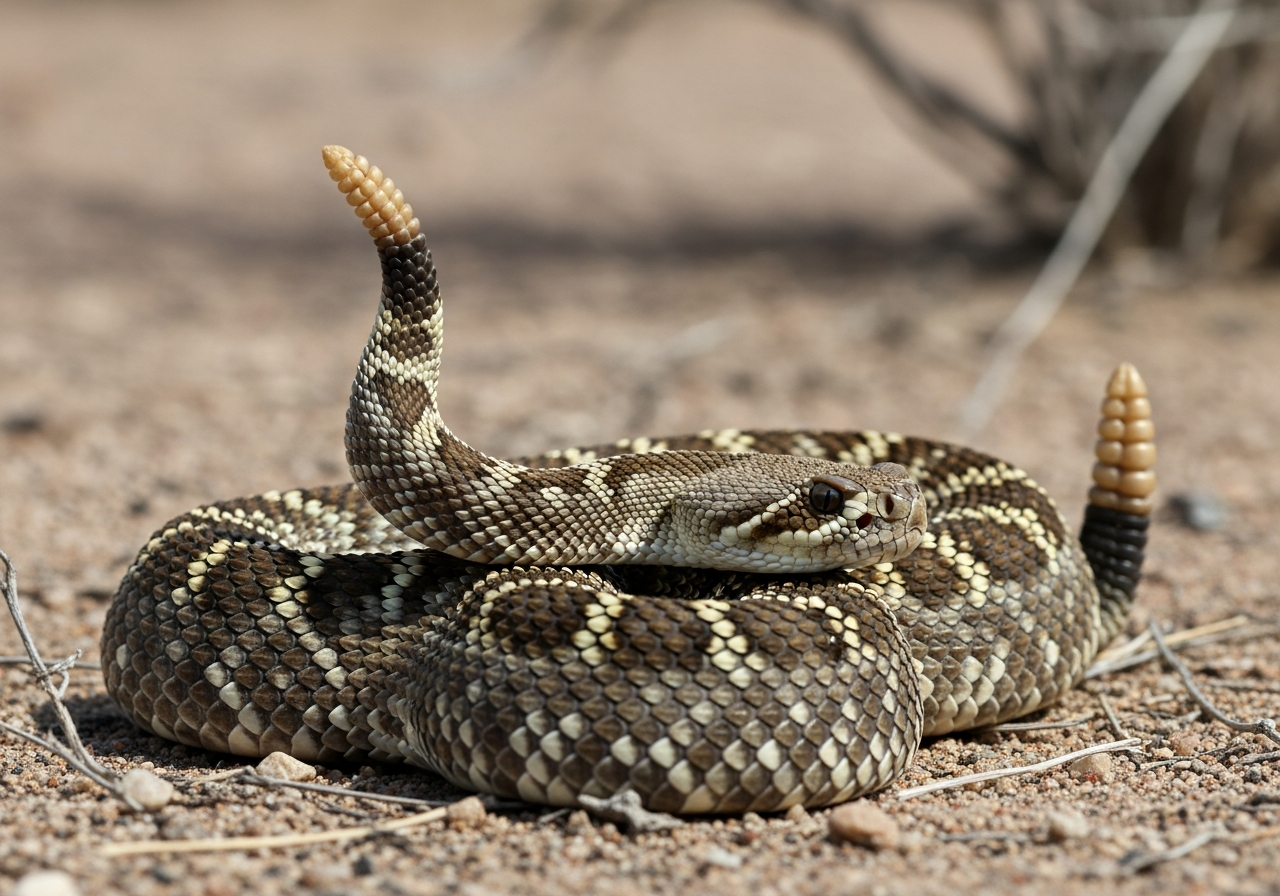
The western diamondback rattlesnake (Crotalus atrox) is a large venomous pit viper of the deserts and scrublands of the southwestern United States and northern Mexico. It grows to around 1.2 m (4 ft), sometimes up to 1.5 m, and warns intruders by shaking the hollow, interlocking segments of its tail into a distinctive rattle. A carnivore that ambushes rodents, it can live 15 to 20 years in the wild and is listed as Least Concern.
Top questions about the Western Diamondback Rattlesnake
Western Diamondback Rattlesnake facts at a glance
- Weight 1.8 kg
- Length 1.2 m
- Top speed 8 km/h
- Lifespan 18 years
| Scientific name | Crotalus atrox |
|---|---|
| Diet | Carnivore |
| Habitat | Deserts, scrubland, and rocky slopes |
| Lifespan | 15–20 years in the wild |
| Length | 1–1.5 m (3–5 ft) |
| Top speed | Up to 8 km/h (5 mph) |
| Conservation status | Least Concern (IUCN) |
| Kingdom | Animalia |
|---|---|
| Phylum | Chordata |
| Class | Reptilia |
| Order | Squamata |
| Family | Viperidae |
| Genus | Crotalus |
Where it lives
The western diamondback rattlesnake (Crotalus atrox) is native to Deserts and scrublands of the southwestern United States, including Texas and Arizona, and into northern Mexico. — recorded across North America in this guide’s range summary.
For occurrence records, see GBIF species search and sources below.
How big is a western diamondback rattlesnake?
An adult western diamondback rattlesnake measures 1.2 m long — about 69% of the height of an average adult person (1.73 m) — and weighs around 1.8 kg, about 3% of an average adult’s body weight (70 kg).
Length vs an average adult’s height (to scale)
What is a group of western diamondback rattlesnakes called?
Group name (collective noun)
A group of Western Diamondback Rattlesnakes is called a rhumba. It is also known as a nest or a den.
Baby name
A baby Western Diamondback Rattlesnake is called a snakelet. It may also be called a neonate.
Explore more animal collective nouns and baby animal names .
The warning rattle
The rattlesnake's most famous feature is the rattle at the tip of its tail, made of loose, interlocking segments of keratin. When threatened, the snake vibrates its tail so fast that the segments buzz together, producing the unmistakable warning sound. A new segment is added each time the snake sheds its skin, so the rattle grows over the animal's life, though older segments often break off. This warning lets the snake avoid conflict, since it would rather deter a large animal than waste venom defending itself.
Venom and hunting
As a pit viper, the western diamondback has a pair of heat-sensing pits between its eyes and nostrils that detect the body warmth of prey, even in darkness. It ambushes rodents, rabbits, ground birds and lizards, striking with long, hinged fangs that inject a powerful venom. The venom breaks down tissue and blood, quickly subduing prey and beginning digestion before the meal is even swallowed. After a strike the snake often releases the prey, then follows its scent trail to the fallen animal.
Habitat and range
The western diamondback is at home in the arid country of the southwestern United States and northern Mexico. It occupies deserts, dry scrubland, grassland and rocky slopes, sheltering in burrows, crevices and under rocks. It slithers across the ground on its belly, using the terrain's cover to hunt and hide from predators. During the hottest months it is most active at night, retreating to shade or shelter during the searing daytime heat.
Size and appearance
A typical adult measures around 1.2 m (4 ft) long, with large individuals reaching about 1.5 m (5 ft) and weighing close to 1.8 kg (4 lb). The snake is named for the pattern of pale-edged, diamond-shaped blotches running down its grey-brown back, which camouflages it against desert soil. Its tail bears bold black-and-white bands just before the rattle, earning it the nickname "coontail". A broad, triangular head houses the venom glands and folded fangs.
Reproduction and life cycle
Western diamondbacks give birth to live young rather than laying eggs, with a female producing a litter of roughly a dozen offspring in late summer. The newborns are fully equipped with venom and a small button of a rattle from birth, and they disperse to fend for themselves within days. In cooler parts of the range the snakes gather in communal dens to spend the winter in a dormant state called brumation. In the wild these snakes can live 15 to 20 years.
Conservation and people
The western diamondback is listed as Least Concern and remains common across much of its range. It is nonetheless persecuted through road deaths, habitat loss and organised "rattlesnake roundups", though populations have so far proved resilient. It is the leading cause of snakebite injuries in its region, but bites are rarely fatal when treated promptly with antivenom. Left alone, the snake plays a valuable role by keeping rodent numbers in check.
Dig deeper into the Western Diamondback Rattlesnake
- Are Western Diamondback Rattlesnakes Dangerous?
Are western diamondback rattlesnakes dangerous? Realistic risk, when incidents rise, and safety basics.
- How Long Do Western Diamondback Rattlesnakes Live?
Western Diamondback Rattlesnake lifespan is typically 15–20 years in the wild. What shortens or extends life, life stages, and status (Least Concern).
- Western Diamondback Rattlesnake: Key Facts
Western Diamondback Rattlesnakes (Crotalus atrox) are reptiles found across North America. The venomous pit viper with a warning rattle.
- What Do Western Diamondback Rattlesnakes Eat?
What western diamondback rattlesnakes eat: Carnivore, foraging style, and seasonal shifts in Deserts, scrubland, and rocky slopes.
- Where Do Western Diamondback Rattlesnakes Live?
Where western diamondback rattlesnakes live: Deserts, scrubland, and rocky slopes, native range cues, and human overlap. Status Least Concern.
Explore the Western Diamondback Rattlesnake
Compare
Related Reptiles
Range & geography
Did you know? Western Diamondback Rattlesnake facts
- The western diamondback rattlesnake is a large venomous pit viper of the deserts and scrublands of the southwestern United States and northern Mexico.
- Its venom is medically significant and a bite is a genuine emergency that can cause severe pain, swelling, and tissue damage. With prompt antivenom and medical care, however, deaths are uncommon.
- Rattlesnakes shake their tail to produce a buzzing sound that warns larger animals to keep away. It is a defensive signal that lets the snake avoid a costly confrontation rather than striking.
- Western diamondbacks are carnivores that mainly eat rodents, rabbits, birds, and lizards. They ambush prey and use venom to subdue it before swallowing it whole.
- Western diamondback rattlesnakes typically live around 15 to 20 years in the wild, and they can live longer in captivity with consistent food and shelter.
- Conservation: Least Concern (IUCN).
Diet & feeding
Western Diamondback Rattlesnake feeds primarily as a carnivore. Western diamondbacks are ambush predators that feed mainly on rodents, rabbits, birds, and lizards. Heat-sensing pits between the eyes and nostrils let them detect warm-blooded prey in darkness, and they strike quickly to inject venom before tracking the a
Adaptations
- The rattle is made of loose, interlocking segments of keratin that click together when the snake vibrates its tail, producing the familiar buzzing warning. A new segment is added each time the snake sheds its skin, so the rattle grows over time. The snake uses this signal to warn larger animals away rather than wasting venom in defense.
- Western diamondbacks are ambush predators that feed mainly on rodents, rabbits, birds, and lizards. Heat-sensing pits between the eyes and nostrils let them detect warm-blooded prey in darkness, and they strike quickly to inject venom before tracking the animal down. The venom both subdues prey and begins breaking down tissue for digestion.
Behaviour & ecology
- The rattle is made of loose, interlocking segments of keratin that click together when the snake vibrates its tail, producing the familiar buzzing warning. A new segment is added each time the snake sheds its skin, so the rattle grows over time. The snake uses this signal to warn larger animals away rather than wasting venom in defense.
- Western diamondbacks are ambush predators that feed mainly on rodents, rabbits, birds, and lizards. Heat-sensing pits between the eyes and nostrils let them detect warm-blooded prey in darkness, and they strike quickly to inject venom before tracking the animal down. The venom both subdues prey and begins breaking down tissue for digestion.
- This species ranges across the southwestern United States, including Texas, Arizona, and New Mexico, and into northern Mexico. It favors dry, open country such as deserts, grasslands, rocky canyons, and scrub. During cold weather it shelters in burrows and rock crevices, sometimes gathering with other snakes.
Communication
- Scent marking, body posture, and head-bobbing or tail signals communicate threat and dominance.
- Vocalisations are limited in many reptiles but hissing or bellowing occurs in some groups.
Habitat & range
Deserts, scrubland, and rocky slopes
Ecological role
Western Diamondback Rattlesnake acts as a predator that helps regulate prey populations and maintain balance in deserts, scrubland, and rocky slopes.
Conservation status of the Western Diamondback Rattlesnake
The western diamondback rattlesnake (Crotalus atrox) is listed as Least Concern on the IUCN Red List. Least Concern (LC) is the IUCN's lowest-risk category, assigned to widespread, abundant species that have been evaluated and found not to be threatened. It does not mean a species faces no pressures — only that it is not currently at risk of extinction.
The western diamondback rattlesnake (Crotalus atrox) is assessed on the IUCN Red List. Look up on the IUCN Red List .
Frequently asked questions about the Western Diamondback Rattlesnake
How does a rattlesnake's rattle work?
The rattle is made of loose, interlocking segments of keratin at the tip of the tail. When the snake vibrates its tail rapidly, the segments buzz against one another to produce the warning sound, and a new segment is added each time the snake sheds its skin.
How dangerous is a western diamondback bite?
The western diamondback is the leading cause of snakebite injuries in the southwestern United States, and its venom breaks down tissue and blood. Bites are painful and serious but are rarely fatal when treated promptly with antivenom.
How big do western diamondback rattlesnakes get?
Most adults are around 1.2 m (4 ft) long, with large individuals reaching about 1.5 m (5 ft) and weighing close to 1.8 kg (4 lb). It is one of the largest rattlesnake species.
What do rattlesnakes eat?
Rattlesnakes are carnivores that hunt rodents, rabbits, ground birds and lizards. The western diamondback uses heat-sensing pits to locate warm-blooded prey, then ambushes it with a venomous strike.
Where do western diamondback rattlesnakes live?
They live in the deserts, scrublands, grasslands and rocky slopes of the southwestern United States and northern Mexico. They shelter in burrows and crevices and are often active at night during the hottest months.
How long do rattlesnakes live?
Western diamondback rattlesnakes can live 15 to 20 years in the wild. Females give birth to live young in late summer, and the newborns have working venom and a small rattle button from birth.
What is a group of western diamondback rattlesnakes called?
A group of Western Diamondback Rattlesnakes is called a rhumba. It is also known as a nest or a den.
What is a baby western diamondback rattlesnake called?
A baby Western Diamondback Rattlesnake is called a snakelet. It may also be called a neonate.
Sources & references
This guide is compiled and reviewed against established zoological and conservation references. Key sources for the Western Diamondback Rattlesnake:
-
IUCN Red List of Threatened Species
Conservation status (Least Concern) reflects the IUCN Red List category for Crotalus atrox.
-
iNaturalist — observations & photos
Search citizen-science observations and community IDs for Crotalus atrox. Useful for range checks and recent sightings — not a substitute for formal Red List status.
-
GBIF — occurrence data
Global Biodiversity Information Facility species search for Crotalus atrox. Explore published occurrence records used in range research.
- IUCN Red List — Crotalus atrox.
Conservation status (Least Concern) and population trends.
- Animal Diversity Web — Crotalus atrox. University of Michigan Museum of Zoology.
Life history, morphology, and range.
- Wikipedia — Western Diamondback Rattlesnake.
General taxonomy and overview (cross-check primary sources).
-
Global Animal Guide editorial standards
How we research, source, review, and update every guide for accuracy.