Image sourcing: see credits & licences
Quick answer
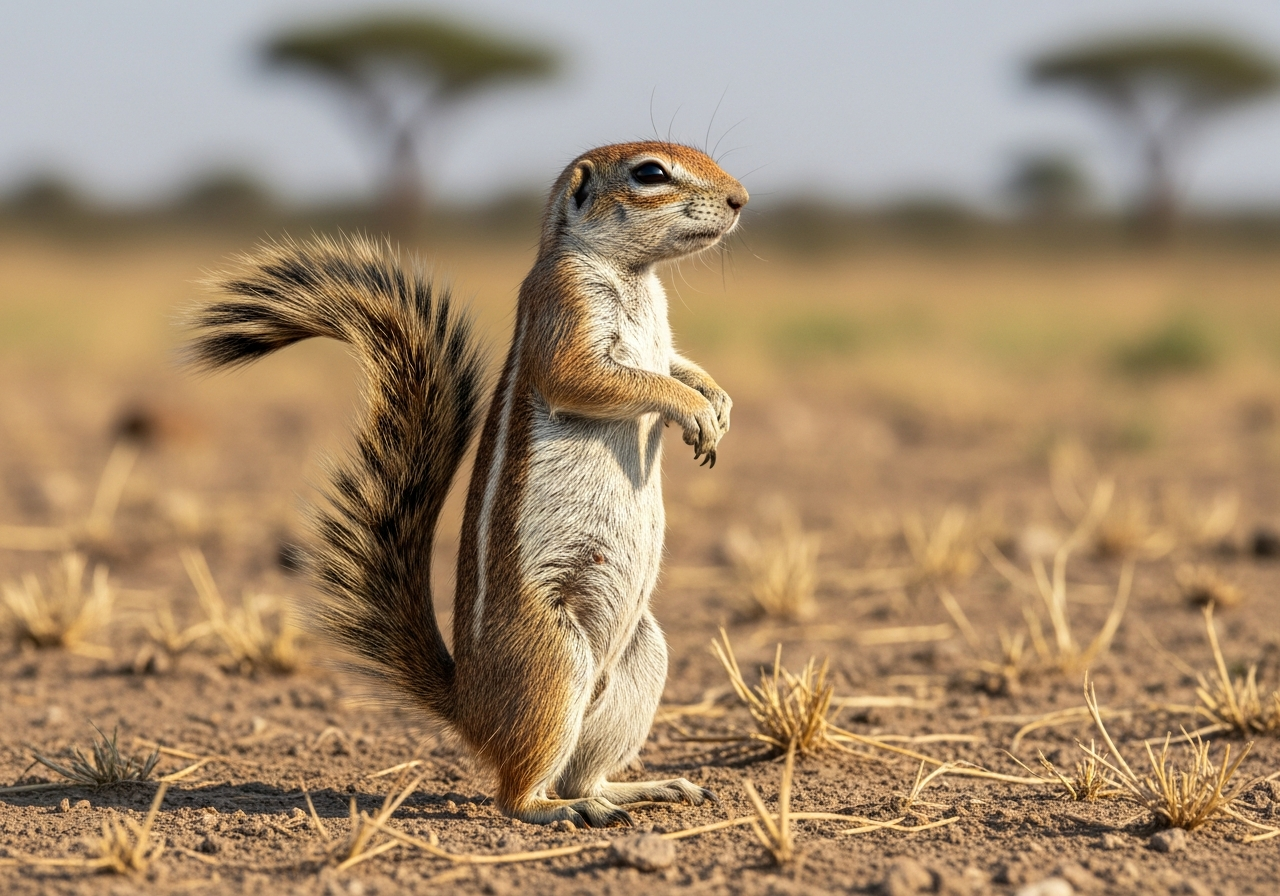
The xerus is an African ground squirrel of dry, open country, known for using its bushy tail as a parasol against the sun. Xerus live in social burrow colonies, eat seeds, roots, and insects, are active by day, and typically live around 6 years in the wild.
Top questions about the Xerus
Xerus facts at a glance
- Weight 700 g
- Length 45 cm
- Top speed 30 km/h
- Lifespan 6 years
| Scientific name | Xerus inauris |
|---|---|
| Diet | Omnivore (seeds, roots, insects) |
| Habitat | Dry savanna, scrub, and semi-desert |
| Lifespan | Around 6 years in the wild |
| Weight | 500–1,000 g (1.1–2.2 lb) |
| Top speed | Quick, darting runner |
| Conservation status | Least Concern (IUCN) |
| Kingdom | Animalia |
|---|---|
| Phylum | Chordata |
| Class | Mammalia |
| Order | Rodentia |
| Family | Sciuridae |
| Genus | Xerus |
Where it lives
The xerus (Xerus inauris) is native to Dry savannas, scrub, and semi-deserts across southern and eastern Africa. — recorded across Africa in this guide’s range summary.
For occurrence records, see GBIF species search and sources below.
How big is a xerus?
An adult xerus measures 45 cm long — about 26% of the height of an average adult person (1.73 m) — and weighs around 700 g, about 1% of an average adult’s body weight (70 kg).
Length vs an average adult’s height (to scale)
What is a group of xeruses called?
Group name (collective noun)
A group of Xeruses is called a colony.
Baby name
A baby Xerus is called a pup. It may also be called a kit.
Explore more animal collective nouns and baby animal names .
A built-in sunshade
The xerus, or African ground squirrel, fans its long bushy tail forward over its back and head to create shade in the searing heat of the open plains. This living parasol lets it stay active and forage during the hottest part of the day when few other animals are about.
Colony life underground
Xerus are highly social and live in groups that share networks of burrows. The burrows offer safety from predators and relief from extreme temperatures, and group members take turns watching for danger, giving sharp alarm calls when a hawk or snake appears.
Diet and foraging
Xerus are omnivores that eat seeds, bulbs, roots, fruit, and insects. They forage above ground during the day, using cheek pouches and quick digging to gather and store food, and rarely need to drink because they get moisture from their food.
Range and status
Found across the dry regions of southern and eastern Africa, xerus are common and adaptable, and they are listed as Least Concern. They play a useful role in their ecosystems by aerating soil and providing burrows used by other species.
Dig deeper into the Xerus
- How Fast Is A Xerus
Dig deeper into xerus — how fast is a xerus.
- How Long do Xerus Live?
Dig deeper into xerus — how long do xerus live.
- What do Xerus Eat
Dig deeper into xerus — what do xerus eat.
- Where do Xerus Live?
Dig deeper into xerus — where do xerus live.
Explore the Xerus
Range & geography
Did you know? Xerus facts
- The xerus is an African ground squirrel of dry, open country, known for using its bushy tail as a parasol against the sun.
- A xerus is an African ground squirrel that lives in dry, open habitats and is famous for using its bushy tail as a sunshade.
- The xerus fans its tail forward to cast shade over its body, which helps it stay cool and keep foraging during the hottest hours of the day.
- Xerus live across the dry savannas, scrub, and semi-deserts of southern and eastern Africa, in colonies of shared burrows.
- Xerus are omnivores that eat seeds, roots, bulbs, fruit, and insects, gathering food during the day and getting most of their water from what they eat.
- Conservation: Least Concern (IUCN).
Diet & feeding
Xerus feeds primarily as a omnivore (seeds, roots, insects). The xerus, or African ground squirrel, fans its long bushy tail forward over its back and head to create shade in the searing heat of the open plains. This living parasol lets it stay active and forage during the hottest part of the day when few other animals
Adaptations
- The xerus, or African ground squirrel, fans its long bushy tail forward over its back and head to create shade in the searing heat of the open plains. This living parasol lets it stay active and forage during the hottest part of the day when few other animals are about.
- Xerus are highly social and live in groups that share networks of burrows. The burrows offer safety from predators and relief from extreme temperatures, and group members take turns watching for danger, giving sharp alarm calls when a hawk or snake appears.
Behaviour & ecology
- The xerus, or African ground squirrel, fans its long bushy tail forward over its back and head to create shade in the searing heat of the open plains. This living parasol lets it stay active and forage during the hottest part of the day when few other animals are about.
- Xerus are highly social and live in groups that share networks of burrows. The burrows offer safety from predators and relief from extreme temperatures, and group members take turns watching for danger, giving sharp alarm calls when a hawk or snake appears.
- Xerus are omnivores that eat seeds, bulbs, roots, fruit, and insects. They forage above ground during the day, using cheek pouches and quick digging to gather and store food, and rarely need to drink because they get moisture from their food.
Communication
- Xerus uses scent, posture, and vocal signals to mark territory and coordinate social behaviour.
- Communication intensity often peaks during breeding seasons and territorial disputes.
Habitat & range
Dry savanna, scrub, and semi-desert
Ecological role
Xerus plays a recognised ecological role in dry savanna, scrub, and semi-desert.
Conservation status of the Xerus
The xerus (Xerus inauris) is listed as Least Concern on the IUCN Red List. Least Concern (LC) is the IUCN's lowest-risk category, assigned to widespread, abundant species that have been evaluated and found not to be threatened. It does not mean a species faces no pressures — only that it is not currently at risk of extinction.
The xerus (Xerus inauris) is assessed on the IUCN Red List. Look up on the IUCN Red List .
Frequently asked questions about the Xerus
What is a xerus?
A xerus is an African ground squirrel that lives in dry, open habitats and is famous for using its bushy tail as a sunshade.
Why does a xerus hold its tail over its back?
The xerus fans its tail forward to cast shade over its body, which helps it stay cool and keep foraging during the hottest hours of the day.
Where do xerus live?
Xerus live across the dry savannas, scrub, and semi-deserts of southern and eastern Africa, in colonies of shared burrows.
What do xerus eat?
Xerus are omnivores that eat seeds, roots, bulbs, fruit, and insects, gathering food during the day and getting most of their water from what they eat.
Are xerus endangered?
No. The xerus is common and adaptable and is listed as Least Concern by the IUCN.
What is a group of xeruses called?
A group of Xeruses is called a colony.
What is a baby xerus called?
A baby Xerus is called a pup. It may also be called a kit.
Sources & references
This guide is compiled and reviewed against established zoological and conservation references. Key sources for the Xerus:
-
IUCN Red List of Threatened Species
Conservation status (Least Concern) reflects the IUCN Red List category for Xerus inauris.
-
iNaturalist — observations & photos
Search citizen-science observations and community IDs for Xerus inauris. Useful for range checks and recent sightings — not a substitute for formal Red List status.
-
GBIF — occurrence data
Global Biodiversity Information Facility species search for Xerus inauris. Explore published occurrence records used in range research.
- IUCN Red List — Xerus inauris.
Conservation status (Least Concern) and population trends.
- Animal Diversity Web — Xerus inauris. University of Michigan Museum of Zoology.
Life history, morphology, and range.
-
Global Animal Guide editorial standards
How we research, source, review, and update every guide for accuracy.