Image sourcing: see credits & licences
Quick answer
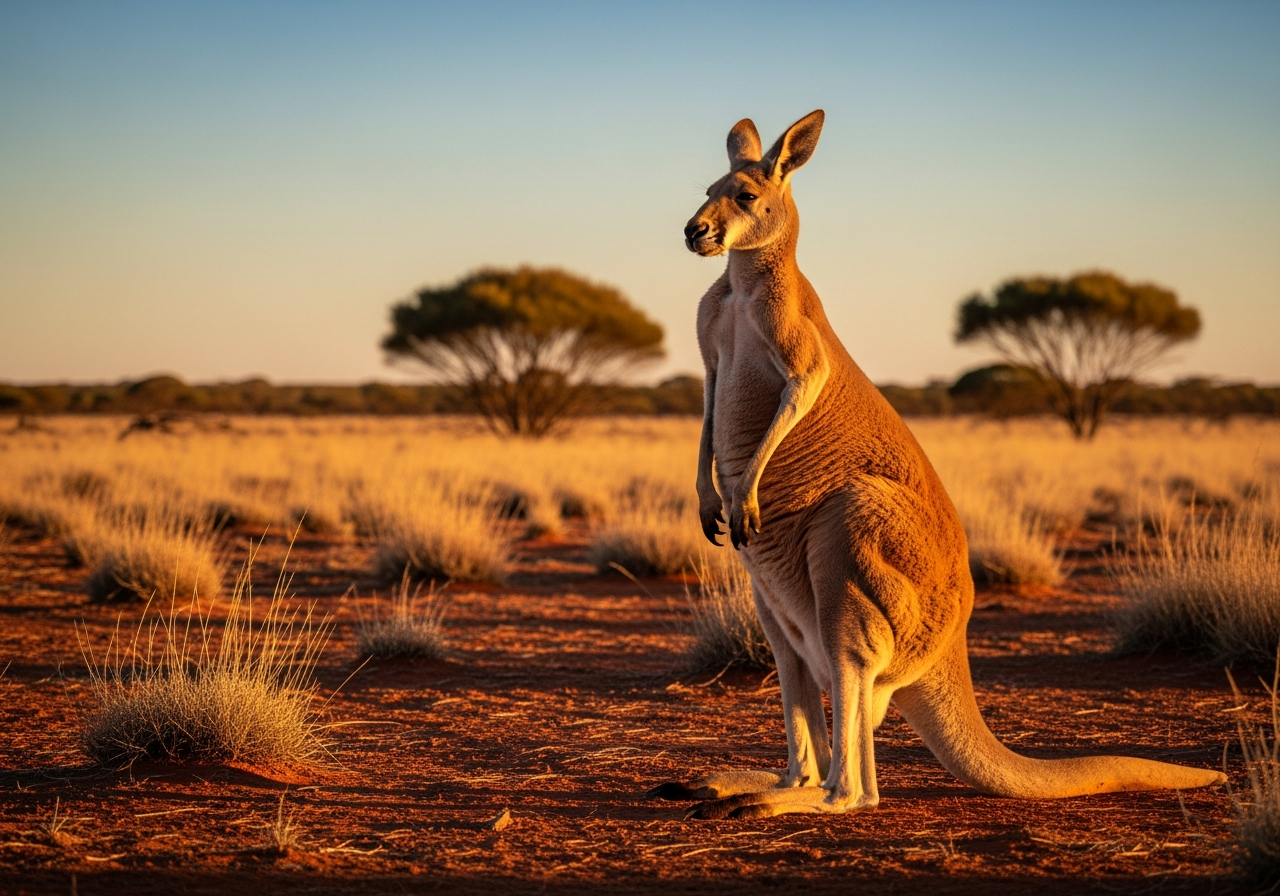
The red kangaroo is the largest marsupial on Earth, with big males standing up to 1.8 m (6 ft) tall and weighing up to 90 kg (200 lb). Native to the open plains of mainland Australia, it can hop at speeds over 50 km/h. Wild red kangaroos typically live around 12 to 18 years.
Top questions about the Red Kangaroo
Red Kangaroo facts at a glance
- Weight 90 kg
- Length 1.6 m
- Top speed 70 km/h
- Lifespan 16 years
| Scientific name | Osphranter rufus |
|---|---|
| Diet | Herbivore |
| Habitat | Arid and semi-arid plains |
| Lifespan | 12–18 years in the wild |
| Weight | Up to 90 kg (200 lb) |
| Top speed | Over 50 km/h (31 mph) |
| Conservation status | Least Concern (IUCN) |
| Kingdom | Animalia |
|---|---|
| Phylum | Chordata |
| Class | Mammalia |
| Order | Diprotodontia |
| Family | Macropodidae |
| Genus | Osphranter |
Where it lives
The red kangaroo (Osphranter rufus) is native to The open plains, grasslands, and deserts of mainland Australia. — recorded across Oceania in this guide’s range summary.
For occurrence records, see GBIF species search and sources below.
How big is a red kangaroo?
An adult red kangaroo measures 1.6 m long — about 92% of the height of an average adult person (1.73 m) — and weighs around 90 kg, about 1.3× an average adult’s body weight (70 kg).
Length vs an average adult’s height (to scale)
What is a group of red kangaroos called?
Group name (collective noun)
A group of Red Kangaroos is called a mob. It is also known as a troop.
Baby name
A baby Red Kangaroo is called a joey.
Explore more animal collective nouns and baby animal names .
Built to hop
Kangaroos are the only large animals that travel by hopping. Their powerful hind legs and long tendons act like springs, storing and releasing energy so they can cover up to 8 m (25 ft) in a single bound and reach speeds over 50 km/h. The thick, muscular tail works as a fifth limb for balance and support.
Diet and desert survival
Red kangaroos are grazing herbivores adapted to Australia's harsh, dry interior. They feed mostly on grasses and can go long periods with little water, getting much of what they need from plants. They rest in shade during the heat of the day and feed in the cool of dawn and dusk.
Life in the mob
Red kangaroos live in groups called mobs. Males compete for mates by boxing, balancing on their tails to deliver powerful kicks with their hind legs. Females carry a single tiny joey in their pouch, where it nurses and grows for several months before venturing out.
Conservation
Red kangaroos are listed as Least Concern and remain abundant across Australia, with populations that rise and fall with rainfall and drought. They are managed under government programs, and the main conservation focus is keeping that management sustainable.
Dig deeper into the Red Kangaroo
- Are Red Kangaroos Dangerous?
Are red kangaroos dangerous? Realistic risk, when incidents rise, and safety basics.
- How Fast Is A Red Kangaroo?
Red Kangaroo top speed is about Over 50 km/h (31 mph). Sprint vs endurance and what limits pace.
- How Long Do Red Kangaroos Live?
Red Kangaroo lifespan is typically 12–18 years in the wild. What shortens or extends life, life stages, and status (Least Concern).
- What Do Red Kangaroos Eat?
What red kangaroos eat: Herbivore, foraging style, and seasonal shifts in Arid and semi-arid plains.
- Where Do Red Kangaroos Live?
Where red kangaroos live: Arid and semi-arid plains, native range cues, and human overlap. Status Least Concern.
Explore the Red Kangaroo
Range & geography
Did you know? Red Kangaroo facts
- The red kangaroo is the largest marsupial and the largest land mammal native to Australia.
- It can leap around 8 m in a single bound and cruise at 20–25 km/h.
- Hopping is highly efficient — energy is stored and released in the tendons like springs.
- Females can pause a pregnancy until conditions or pouch space allow (embryonic diapause).
- Males, called 'boomers', box and kick to compete for mates.
- Kangaroos use their muscular tail as a fifth limb when moving slowly.
Diet & feeding
Red kangaroos are grazers feeding chiefly on green grasses and forbs, selecting the most nutritious growth and able to survive long dry periods on sparse vegetation.
Adaptations
- Elastic tendons in the hind legs store and return energy, making hopping very efficient. (Nowak 1999)
- A large, muscular tail provides balance at speed and support when standing.
- Embryonic diapause lets females time births to favourable conditions.
- Efficient water use and a low metabolic rate suit hot, arid environments.
Behaviour & ecology
- Red kangaroos live in groups called mobs and are most active at dawn, dusk, and night.
- Males box and grapple to establish dominance and access to females.
- They rest in shade during the heat of the day to conserve water.
- Joeys develop in the pouch for months before becoming independent.
Communication
- Kangaroos thump the ground with the hind feet to signal alarm.
- Clucks and soft calls pass between mothers and joeys.
- Postures and boxing displays settle disputes between males.
Habitat & range
Red kangaroos inhabit the arid and semi-arid grasslands, scrub, and open plains of inland Australia, adapted to heat and unpredictable rainfall.
Ecological role
As large grazing marsupials, red kangaroos shape arid grassland vegetation and are a keystone herbivore of the Australian outback.
Conservation status of the Red Kangaroo
The red kangaroo (Osphranter rufus) is listed as Least Concern on the IUCN Red List. Least Concern (LC) is the IUCN's lowest-risk category, assigned to widespread, abundant species that have been evaluated and found not to be threatened. It does not mean a species faces no pressures — only that it is not currently at risk of extinction.
The red kangaroo (Osphranter rufus) is assessed on the IUCN Red List. Look up on the IUCN Red List .
Frequently asked questions about the Red Kangaroo
How high and far can a kangaroo jump?
Red kangaroos can cover up to about 8 m (25 ft) in a single hop and clear obstacles around 1.8 m (6 ft) high, using their powerful spring-like hind legs.
What do red kangaroos eat?
Red kangaroos are herbivores that graze mainly on grasses and other low plants. They are well adapted to dry conditions and can survive long periods with very little water.
How fast can a kangaroo hop?
Red kangaroos can hop at speeds over 50 km/h (31 mph) and sprint even faster over short distances, making hopping a very efficient way to cross large distances.
Are kangaroos dangerous?
Kangaroos are usually not aggressive, but large males are powerful and can deliver dangerous kicks with their clawed hind legs if cornered or threatened. Wild kangaroos should be given plenty of space.
How big is a baby kangaroo?
A newborn kangaroo, called a joey, is tiny, about the size of a jellybean. It crawls into its mother's pouch to keep developing and nursing for several months before it is ready to leave.
What is a group of red kangaroos called?
A group of Red Kangaroos is called a mob. It is also known as a troop.
What is a baby red kangaroo called?
A baby Red Kangaroo is called a joey.
Sources & references
This guide is compiled and reviewed against established zoological and conservation references. Key sources for the Red Kangaroo:
-
IUCN Red List of Threatened Species
Conservation status (Least Concern) reflects the IUCN Red List category for Osphranter rufus.
-
iNaturalist — observations & photos
Search citizen-science observations and community IDs for Osphranter rufus. Useful for range checks and recent sightings — not a substitute for formal Red List status.
-
GBIF — occurrence data
Global Biodiversity Information Facility species search for Osphranter rufus. Explore published occurrence records used in range research.
- Ellis, M. et al. (2016). Osphranter rufus. IUCN Red List of Threatened Species.
Status (Least Concern) and range.
- Nowak, R. M. (1999). Walker's Mammals of the World (6th ed.). Johns Hopkins University Press.
Locomotion and physiology.
- Animal Diversity Web — Osphranter (Macropus) rufus. University of Michigan Museum of Zoology.
Life history, morphology, and range.
-
Global Animal Guide editorial standards
How we research, source, review, and update every guide for accuracy.