What Is the Smartest Animal on Earth?
There is no single IQ winner — dolphins, great apes, corvids, elephants, and octopuses excel at different cognitive tests from tool use to mirror self-recognition.
Global Animal Guide · June 28, 2026
Quick answer
No one species wins every test, but humans aside, contenders for exceptional intelligence include chimpanzees, dolphins, elephants, corvids, and octopuses — each excelling at different problem-solving tasks.
Last updated: June 2026 — figures reflect widely cited scientific estimates.
Why “smartest” has no single answer
There is no animal IQ league table, because intelligence is not one thing. A chimpanzee excels at physical problem-solving with its hands; an octopus solves comparable puzzles with a body that has no bones and a nervous system organised nothing like ours; a common-raven plans for a future meal. Ranking these against each other is like asking whether a violinist or a mathematician is more talented.
Worse, every test is delivered through a body. Ask a dog to recognise itself in a mirror and it fails — but dogs navigate a world of scent, and mirrors carry no smell. When researchers built a scent-based self-recognition test, dogs performed far better. The mirror test was measuring vision, not selfhood. Many “this animal is dumb” results are really “this test suited a primate”.
What scientists can do is compare species on specific, well-defined abilities: tool manufacture, causal reasoning, self-recognition, planning, social learning, and symbol use. Different species top different lists, and that spread is the honest answer.
Tool use, and the harder question of tool making
Using a tool is common. Making one is rarer, and modifying one for a job you have not yet encountered is rarer still. Chimpanzees strip leaves from twigs to fish termites from mounds, and different communities use different techniques passed down socially — a rudimentary culture. The orangutan and the bonobo show comparable flexibility.
Birds match them. New Caledonian crows craft hooked tools from twigs and carry favourites between sites, which implies they value the tool itself, not just the food. The kea, a mountain parrot from New Zealand, dismantles equipment with apparent method and collaborates with other keas on tasks requiring two birds to pull simultaneously.
The sea-otter is the clearest mammalian case outside primates: it carries a favourite stone in an armpit pouch and uses it as an anvil to crack shellfish. That the stone is kept — transported, reused, chosen — is the cognitively interesting part. Simple tool use is widespread; the octopus carries coconut shell halves to reassemble as portable armour, an odd sight and a strong claim to planning in an invertebrate.
Self-recognition and what it does not prove
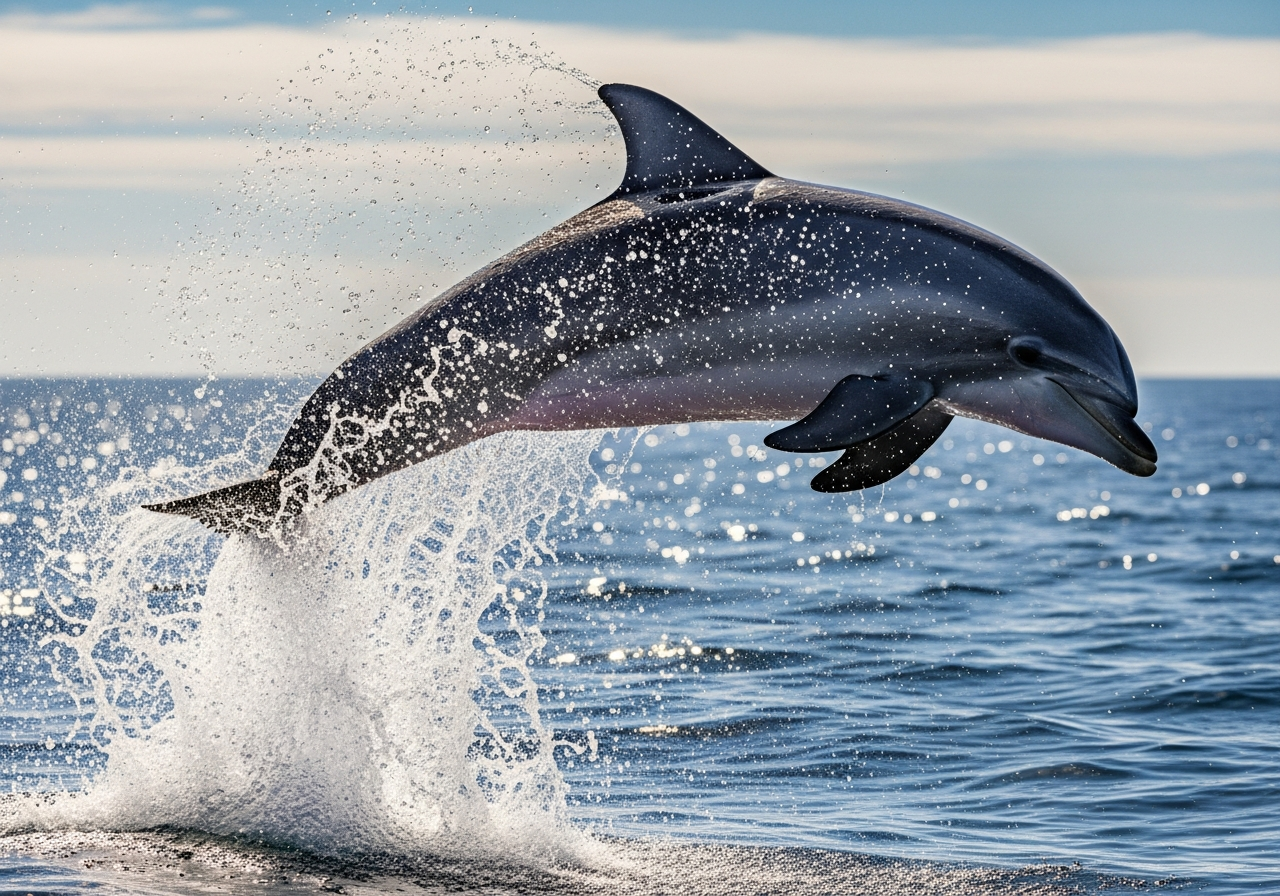
Put a mark on an animal where it can only be seen in a mirror. If the animal touches the mark on its own body rather than the reflection, it has arguably grasped that the reflection is itself. Great apes pass. So does the bottlenose-dolphin, the orca, the Asian elephant, and the magpie — a corvid, on a completely separate evolutionary branch from every other passer.
That last detail is the important one. Self-recognition evolved more than once, in lineages whose last common ancestor had nothing resembling a complex brain. It is a case of convergent evolution: similar social and ecological pressures producing similar cognition in unrelated animals.
The test’s limits are real. Failing may mean an animal lacks self-awareness — or that it does not care about marks, does not use vision as its primary sense, or finds staring at a rival rude. Species that pass are interesting; species that fail have proven little either way.
Brain size, folds, and neuron counts
Absolute brain size is a poor guide. The sperm-whale has the largest brain on Earth, and no one argues it out-thinks a human. Big bodies simply need big brains for basic housekeeping. Correcting for body size helps, but not much: it makes some small rodents look like geniuses.
Neuron counts in the forebrain track cognitive performance better than raw mass. This is where birds break the old story. A parrot or corvid brain is small, but its neurons are packed far more densely than a mammal’s, so a scarlet-macaw or a crow can carry forebrain neuron numbers comparable to a monkey’s inside a walnut-sized skull. Birds are not shrunken mammals; they built an equivalent capability with different architecture.
The octopus departs further still. Most of its neurons sit in the arms rather than the central brain, so each arm handles a good deal of its own problem-solving. Whatever intelligence means in an octopus, it is distributed — a genuinely alien design that evolved independently of ours some 600 million years ago.
Social intelligence: the pressure that builds brains
Many researchers think complex cognition is driven less by foraging puzzles than by other members of your own species. Tracking who groomed whom, who owes whom, and who is allied with whom is computationally demanding, and getting it wrong is costly. Group-living species tend to have larger, more elaborate brains.
Elephants illustrate this well. Matriarchs hold decades of social and ecological memory — which individuals are family, which waterholes survive a drought — and herds that lose their oldest female make worse decisions. The chimpanzee forms shifting political coalitions; the bottlenose-dolphin maintains alliances and identifies companions by signature whistles that function much like names.
The exception is telling. Octopuses are largely solitary, short-lived, and receive no parental teaching, yet they are formidable problem-solvers. Their intelligence appears to be driven by predation and vulnerability instead — a soft, edible animal in a sea of hunters needs to be clever. Social life is one route to intelligence, not the only one.
Runners-up, myths, and moving goalposts
Popular rankings shuffle constantly because definitions do. “Smartest” lists that lean on trainability favour dogs and pigs, which are attentive to humans — a measure of cooperativeness as much as cognition. Lists built on tool use favour primates and corvids. Lists built on memory favour elephants and food-caching birds, some of which recover thousands of hidden seeds months later.
Two myths are worth retiring. Goldfish do not have three-second memories; the goldfish can be trained on tasks lasting weeks. And “bird brain” as an insult is simply wrong, given what corvids and parrots do.
Intelligence is also expensive. Brain tissue is metabolically costly, and it only pays off where the environment is variable enough to reward flexibility. Most animals are not stupid — they are efficient, running cheap reliable instincts because their world does not change enough to warrant the overhead.
Conservation note
Record-holding species often face habitat loss and climate pressure. Protecting ecosystems preserves not only charismatic winners but the food webs they represent. The point cuts deeper for intelligent species: elephants, orcas, and great apes transmit knowledge socially, so a population that loses its oldest members loses information that no reintroduction programme can restore. Culture is part of what conservation protects.
Sources
Related reading: Animal profiles · Fastest animals on Earth · Support wildlife protection
Frequently asked questions
What Is the Smartest Animal on Earth
No one species wins every test, but humans aside, contenders for exceptional intelligence include chimpanzees, dolphins, elephants, corvids, and octopuses — each excelling at different problem-solving tasks.
How do scientists measure this record?
Records come from peer-reviewed studies, GPS tracking, high-speed video, toxicology assays, and acoustic meters — field conditions always add variation.
Can the record holder change?
Yes — new measurements, species reclassification, or better technology can update rankings. Always check whether speed, venom, or size is measured differently.