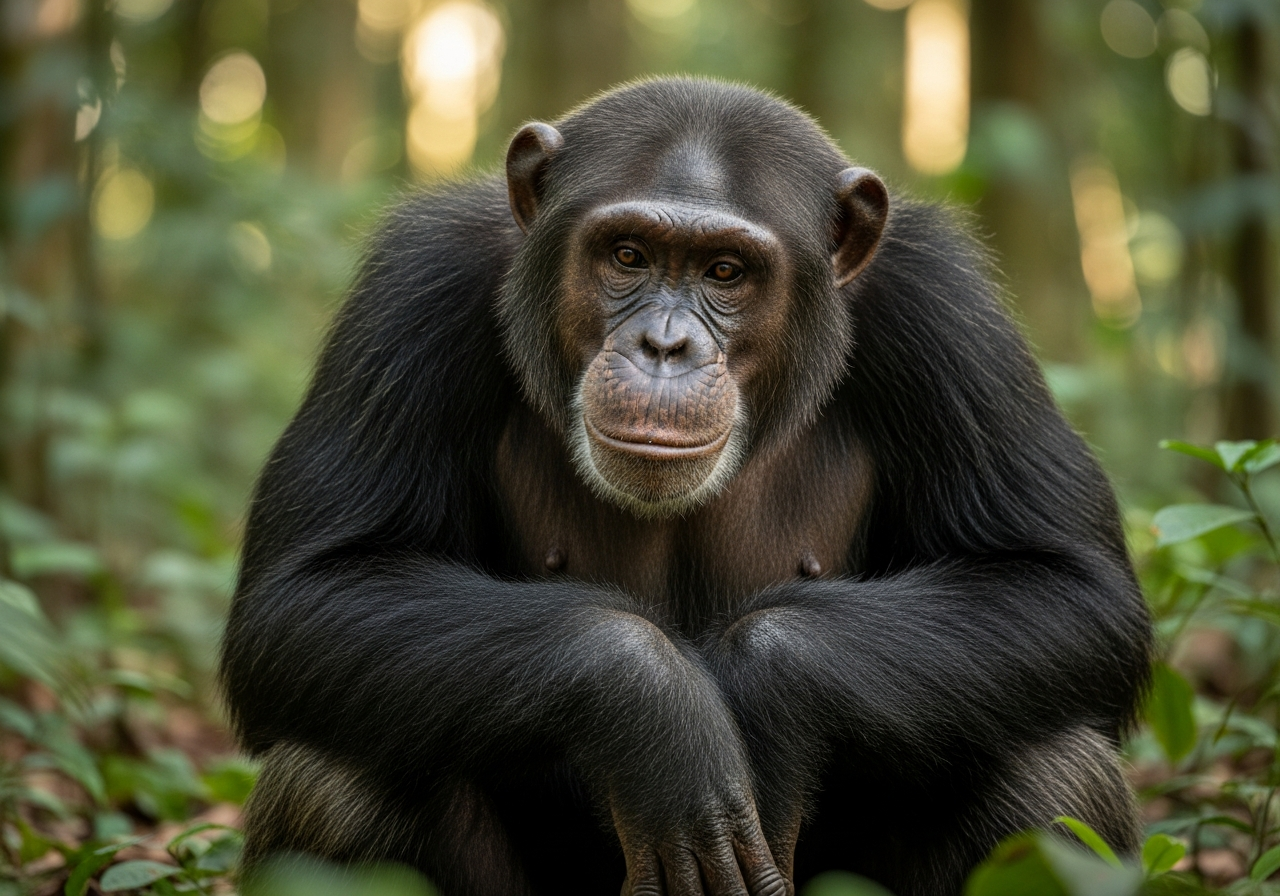
Chimpanzee
Pan troglodytes
Quick answer
The chimpanzee is a great ape native to the forests and savannas of central and western Africa and one of humanity's closest living relatives, sharing around 98% of our DNA. Chimps are highly intelligent, use and make tools, and live in complex social groups. They typically live 40 to 50 years in the wild and are listed as Endangered.
Chimpanzee facts at a glance
| Scientific name | Pan troglodytes |
|---|---|
| Diet | Omnivore |
| Habitat | Tropical forest and wooded savanna |
| Lifespan | 40–50 years in the wild |
| Weight | 30–60 kg (66–130 lb) |
| Top speed | Up to 40 km/h (25 mph) |
| Conservation status | Endangered (IUCN) |
| Kingdom | Animalia |
|---|---|
| Phylum | Chordata |
| Class | Mammalia |
| Order | Primates |
| Family | Hominidae |
| Genus | Pan |
Where it lives
Tropical forests and wooded savannas of central and western Africa.
What is a group of chimpanzees called?
Group name (collective noun)
A group of Chimpanzees is called a troop. It is also known as a community.
Baby name
A baby Chimpanzee is called an infant.
Explore more animal collective nouns and baby animal names .
Tool use and intelligence
Chimpanzees are among the most intelligent animals on Earth. They make and use tools, fishing for termites with stripped twigs, cracking nuts with stone hammers, and using chewed leaves as sponges. Different communities pass down their own tool traditions, a form of culture once thought to be uniquely human.
Diet and hunting
Chimpanzees are omnivores that eat mostly fruit, leaves, seeds, and insects, but they also hunt cooperatively, sometimes targeting monkeys. They are powerful for their size, with an upper-body strength well beyond that of a human, which they use for climbing and display.
Conservation
Chimpanzees are Endangered, with populations falling due to deforestation, the bushmeat trade, the illegal pet trade, and diseases that can pass between humans and apes. Protecting large areas of forest and reducing poaching are essential to their survival.
Dig deeper into the Chimpanzee
- Are Chimpanzee Endangered
Dig deeper into chimpanzee — are chimpanzee endangered.
- Chimpanzee Guide 5
Dig deeper into chimpanzee — chimpanzee guide 5.
- How Long do Chimpanzee Live?
Dig deeper into chimpanzee — how long do chimpanzee live.
- What do Chimpanzee Eat
Dig deeper into chimpanzee — what do chimpanzee eat.
- Where do Chimpanzee Live?
Dig deeper into chimpanzee — where do chimpanzee live.
Explore the Chimpanzee
Compare
Collections
Range & geography
Did you know? Chimpanzee facts
- Chimpanzees share roughly 98–99% of their DNA with humans.
- They make and use tools, such as stripping twigs to 'fish' for termites.
- Chimp communities have distinct, learned traditions — a form of culture.
- They live in fission–fusion societies that split and regroup through the day.
- Chimpanzees can recognise themselves in a mirror, a sign of self-awareness.
- Both chimpanzees and humans share a common ancestor from millions of years ago.
Diet & feeding
Chimpanzees are omnivores eating mainly fruit, supplemented by leaves, seeds, insects (notably termites and ants), and occasional cooperative hunting of small mammals such as monkeys.
Adaptations
- Dexterous hands with opposable thumbs enable precise tool manufacture and use. (Goodall 1986)
- A large, complex brain supports problem-solving, learning, and social strategy.
- Long, powerful arms suit climbing and moving through the forest canopy.
- Expressive faces and vocal range underpin rich social communication.
Behaviour & ecology
- Communities use tools differently by region, passing techniques down socially. (Goodall 1986)
- Fission–fusion grouping lets parties form and dissolve as food and company change.
- Males cooperate to defend territory, sometimes with lethal intergroup conflict.
- Grooming maintains alliances and reduces tension within the community.
Communication
- Chimps use a large repertoire of pant-hoots, screams, and barks over distance.
- Facial expressions and gestures convey intent and emotion at close range.
- Grooming is a key social signal that builds and maintains bonds.
Habitat & range
Chimpanzees inhabit tropical forests, woodlands, and savanna mosaics across equatorial Africa, needing fruiting trees and cover across large community ranges.
Ecological role
As large frugivores, chimpanzees disperse seeds widely and influence forest composition, while their intelligence makes them key subjects for understanding primate ecology.
Conservation status of the Chimpanzee
Endangered (EN) means a species faces a very high risk of extinction in the wild. Populations are usually declining sharply due to habitat loss, hunting, disease, or climate pressure. It sits one level below Critically Endangered on the IUCN Red List.
Main threats to the chimpanzee
- Poaching and bushmeat hunting
- Habitat loss and degradation
- Infectious disease, including Ebola
- Illegal capture for the pet trade
Chimpanzee (Pan troglodytes) was most recently assessed for the IUCN Red List in 2016. View the full IUCN assessment .
Frequently asked questions about the Chimpanzee
How much DNA do chimpanzees share with humans?
Chimpanzees share roughly 98% of their DNA with humans, making them, along with bonobos, our closest living relatives.
Do chimpanzees use tools?
Yes. Chimps make and use a variety of tools, such as twigs to fish for termites and stones to crack nuts, and they pass these skills down through generations as local traditions.
Are chimpanzees stronger than humans?
Pound for pound, chimpanzees are considerably stronger than humans, especially in the upper body, thanks to differences in muscle structure that favor powerful pulling and climbing.
What do chimpanzees eat?
Chimpanzees are omnivores. Their diet is mostly fruit and plants supplemented with insects, eggs, and occasionally meat from cooperative hunts of small mammals.
Why are chimpanzees endangered?
Chimpanzees are Endangered because of habitat loss from logging and farming, the bushmeat and pet trades, and diseases. Their slow reproduction makes recovery from these pressures difficult.
What is a group of chimpanzees called?
A group of Chimpanzees is called a troop. It is also known as a community.
What is a baby chimpanzee called?
A baby Chimpanzee is called an infant.
Sources & references
This guide is compiled and reviewed against established zoological and conservation references. Key sources for the Chimpanzee:
-
IUCN Red List of Threatened Species
Conservation status (Endangered) reflects the IUCN Red List category for Pan troglodytes, most recently assessed in 2016.
- Humle, T. et al. (2016). Pan troglodytes. IUCN Red List of Threatened Species.
Status (Endangered) and threats.
- Goodall, J. (1986). The Chimpanzees of Gombe: Patterns of Behavior. Harvard University Press.
Landmark long-term study.
- Animal Diversity Web — Pan troglodytes. University of Michigan Museum of Zoology.
Life history, morphology, and range.
-
Global Animal Guide editorial standards
How we research, source, review, and update every guide for accuracy.

Social life
Chimps live in communities of dozens of individuals with shifting alliances, hierarchies, and politics. They communicate through a rich range of calls, facial expressions, and gestures, and they groom one another to build and maintain bonds. Cooperation, sharing, and even reconciliation after fights are common.