Orangutan
Pongo pygmaeus
Quick answer
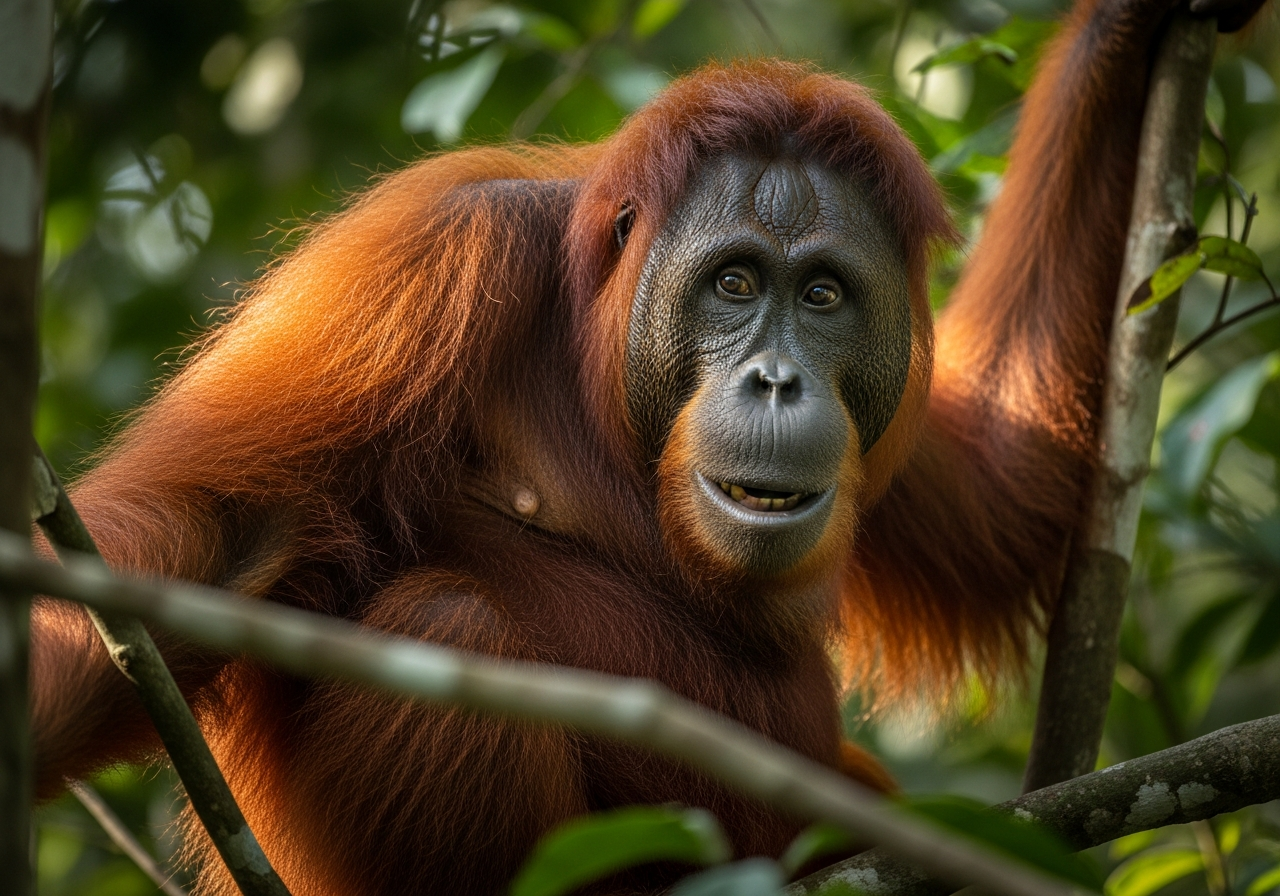
Orangutans are large, intelligent great apes that live in the rainforests of Borneo and Sumatra, the only great apes found in Asia. They spend most of their lives in the trees, swinging through the canopy with long, powerful arms that can span over 2 m (7 ft), and they feed mainly on fruit. Known for their reddish hair and tool use, orangutans are critically endangered, with populations falling sharply due to deforestation. In the wild they can live 35 to 45 years.
Orangutan facts at a glance
| Scientific name | Pongo pygmaeus |
|---|---|
| Diet | Omnivore (mostly fruit) |
| Habitat | Tropical rainforest canopy |
| Lifespan | 35–45 years in the wild |
| Weight | 30–90 kg (66–200 lb) |
| Arm span | Up to 2.2 m (7 ft) |
| Conservation status | Critically Endangered (IUCN) |
| Kingdom | Animalia |
|---|---|
| Phylum | Chordata |
| Class | Mammalia |
| Order | Primates |
| Family | Hominidae |
| Genus | Pongo |
Where it lives
Tropical rainforests of Borneo and Sumatra in Southeast Asia.
What is a group of orangutans called?
Group name (collective noun)
A group of Orangutans is called a buffoonery.
Baby name
A baby Orangutan is called an infant.
Explore more animal collective nouns and baby animal names .
Behavior and intelligence
Orangutans are among the most intelligent animals, capable of using and even making simple tools, such as sticks to extract insects or leaves used as umbrellas and gloves. They are largely solitary compared with other great apes, with adult males living alone and females accompanied only by their offspring. They build a fresh nest of branches and leaves high in the trees to sleep each night. Their name comes from Malay words meaning "person of the forest."
Diet and feeding
Orangutans are omnivores whose diet is dominated by fruit, especially energy-rich figs and the spiky durian. They also eat leaves, bark, flowers, insects, and occasionally eggs. Because fruiting is patchy in the rainforest, orangutans range widely and remember the locations and seasons of fruit trees across large areas. By spreading seeds in their droppings, they help regenerate the forest.
Habitat and range
Orangutans live only on the islands of Borneo and Sumatra in Southeast Asia, where they inhabit tropical lowland and peat-swamp rainforests. They are the most arboreal of the great apes, spending almost all their time in the canopy and rarely coming to the ground. There are three species: the Bornean, Sumatran, and the recently described Tapanuli orangutan, all of which are critically endangered. Their survival is tightly linked to the health of intact forest.
Conservation
All orangutan species are Critically Endangered, with numbers falling rapidly due to logging, conversion of forest to palm oil plantations, fires, and the illegal pet trade. Females reproduce very slowly, giving birth only once every six to eight years, so populations recover poorly from losses. Conservation efforts include protecting and restoring forest, rehabilitating rescued orphans, and promoting sustainable palm oil. Without urgent action, wild orangutans face a real risk of extinction.
Dig deeper into the Orangutan
- Are Orangutan Endangered
Dig deeper into orangutan — are orangutan endangered.
- How Long do Orangutan Live?
Dig deeper into orangutan — how long do orangutan live.
- Orangutan Guide 5
Dig deeper into orangutan — orangutan guide 5.
- What do Orangutan Eat
Dig deeper into orangutan — what do orangutan eat.
- Where do Orangutan Live?
Dig deeper into orangutan — where do orangutan live.
Explore the Orangutan
Compare
Collections
Range & geography
Did you know? Orangutan facts
- Orangutans are the largest tree-dwelling mammals and Asia's only great ape.
- Their name means 'person of the forest' in Malay.
- They share around 97% of their DNA with humans.
- Orangutans build a fresh sleeping nest in the trees almost every night.
- Mothers care for a single infant for up to eight years — among the longest of any animal.
- All orangutan species are critically endangered, mainly from habitat loss.
Diet & feeding
Orangutans are predominantly frugivorous, especially fond of figs, and also eat leaves, bark, insects, and occasionally eggs, tracking fruiting trees across their range.
Adaptations
- Long, powerful arms with a span up to 2 m suit a life moving through the canopy.
- Hook-like hands and feet grip branches for climbing and feeding.
- A large brain supports tool use, memory of fruiting trees, and problem-solving.
- Flanged adult males develop large cheek pads that amplify long calls.
Behaviour & ecology
- Orangutans are largely solitary, with adult males and females ranging alone.
- They build new nests nightly from bent and woven branches.
- Long mother–infant dependency transmits feeding knowledge across years.
- Males give a booming 'long call' to advertise presence and deter rivals.
Communication
- Flanged males produce far-carrying long calls to space themselves and attract females.
- A range of grunts, kiss-squeaks, and gestures feature in close interactions.
- Some populations use tools and learned signals passed between individuals.
Habitat & range
Orangutans live in the tropical rainforests of Borneo and Sumatra, depending on continuous canopy and fruiting trees; habitat clearance has fragmented their range.
Ecological role
As major fruit-eaters, orangutans are vital seed dispersers that help regenerate Southeast Asian rainforests, making them a flagship for forest conservation.
Conservation status of the Orangutan
Critically Endangered (CR) is the highest-risk category the IUCN Red List assigns to a wild species before Extinct in the Wild. It means a species faces an extremely high probability of extinction — usually because its population has collapsed, its range has shrunk drastically, or very few mature individuals remain. Species at this level typically depend on active conservation to survive.
Main threats to the orangutan
- Habitat loss from palm-oil plantations and logging
- Forest conversion to agriculture
- Hunting for bushmeat and body parts
- Habitat fragmentation and the pet trade
Orangutan (Pongo pygmaeus) was most recently assessed for the IUCN Red List in 2016. View the full IUCN assessment .
Frequently asked questions about the Orangutan
Where do orangutans live?
Orangutans live only in the rainforests of Borneo and Sumatra in Southeast Asia. They are the only great apes found in Asia and spend almost all their time in the trees.
What do orangutans eat?
Orangutans eat mainly fruit, especially figs and durian, along with leaves, bark, flowers, and insects. They roam widely to find fruiting trees in the rainforest.
Are orangutans endangered?
Yes. All three orangutan species are Critically Endangered, mainly because of deforestation for palm oil and timber, forest fires, and the illegal pet trade.
How intelligent are orangutans?
Orangutans are highly intelligent and known to use and make tools, solve problems, and learn complex skills. They build a new sleeping nest in the trees every night.
How long do orangutans live?
Wild orangutans typically live 35 to 45 years, and some reach over 50 years in captivity. They have one of the slowest reproductive rates of any mammal.
Are orangutans dangerous to humans?
Orangutans are generally shy and avoid people, but they are extremely strong wild animals. They are best observed from a distance and should never be approached or kept as pets.
What is a group of orangutans called?
A group of Orangutans is called a buffoonery.
What is a baby orangutan called?
A baby Orangutan is called an infant.
Sources & references
This guide is compiled and reviewed against established zoological and conservation references. Key sources for the Orangutan:
-
IUCN Red List of Threatened Species
Conservation status (Critically Endangered) reflects the IUCN Red List category for Pongo pygmaeus, most recently assessed in 2016.
- Ancrenaz, M. et al. (2016). Pongo pygmaeus. IUCN Red List of Threatened Species.
Status (Critically Endangered) and threats.
- Animal Diversity Web — Pongo pygmaeus. University of Michigan Museum of Zoology.
Life history, morphology, and range.
- Nowak, R. M. (1999). Walker's Mammals of the World (6th ed.). Johns Hopkins University Press.
Morphology and biology.
-
Global Animal Guide editorial standards
How we research, source, review, and update every guide for accuracy.
Want to help directly? Learn how to symbolically adopt a orangutan and support its conservation.