The 12 Fastest Animals on Earth (Land, Air, and Water)
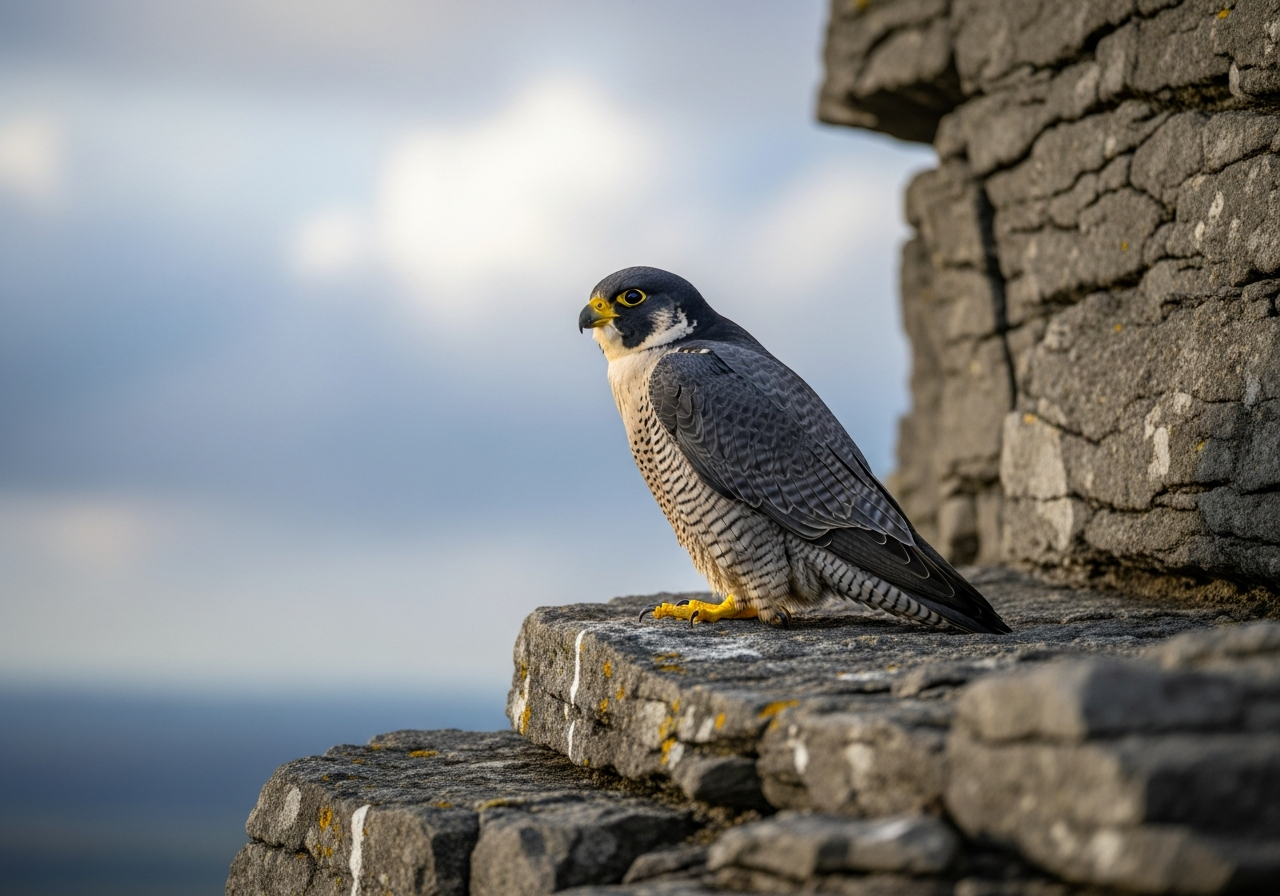
The fastest animal on Earth is the peregrine falcon, which dives at over 380 km/h. Here are the 12 fastest animals across land, air, and water, ranked by top speed.
Global Animal Guide · June 9, 2026
Quick answer
The fastest animal on Earth is the peregrine falcon, which reaches over 380 km/h (240 mph) in a hunting dive — faster than any other animal. The cheetah is the fastest land animal at about 100-120 km/h (62-75 mph), and the black marlin and sailfish are the fastest swimmers at around 100 km/h. Speed records depend on the medium: air, land, or water.
Last updated: June 2026 — speed figures are widely cited maximums and can vary by source and conditions.
The fastest animals, ranked by top speed
- Peregrine falcon — ~389 km/h (242 mph) in a dive. The undisputed speed champion. It folds its wings and stoops on prey from great height, reaching speeds no other animal can match.
- Golden eagle — ~240-320 km/h in a dive. Another raptor that turns gravity into a weapon, plummeting on hares and other prey.
- Cheetah — ~100-120 km/h (62-75 mph). The fastest animal on land, built for the sprint with a flexible spine, semi-retractable claws, and a long tail for balance.
- Black marlin and sailfish — ~100 km/h (62 mph). The fastest swimmers, slicing through open ocean with streamlined bodies and powerful tails.
- Pronghorn — ~88 km/h (55 mph). The fastest land animal over long distances, able to hold high speed far longer than a cheetah.
- Ostrich — ~70 km/h (43 mph). The fastest two-legged runner and the fastest bird on land, since it cannot fly.
- Orca — ~56 km/h (35 mph). The fastest marine mammal, fast enough to run down dolphins and seals.
Why “fastest” depends on the medium
There is no single fastest animal without saying where. Air, land, and water each have a different champion because moving through each one is a completely different physical problem. The peregrine falcon’s record relies on a steep dive, so in level flight it is much slower. The cheetah rules on land but only for seconds. And the fastest fish are limited by the drag of water, which is far denser than air.
Drag is the whole story. The force resisting a moving body rises with the square of its speed and in proportion to the density of the fluid around it, and water is roughly eight hundred times denser than air. This is why no swimmer comes close to a flying bird, and why the orca — a superbly powerful animal — tops out at a speed a fit horse would beat on land.
Air’s thinness cuts both ways. It offers little resistance, but it also offers little to push against, which is why the fastest flight is not powered at all. The peregrine falcon does not accelerate to 380 km/h by flapping; it climbs, folds into a teardrop and lets gravity do the work, trading altitude for velocity until air resistance balances its weight. The record is really a falling record. In level, muscle-powered flight the falcon is comfortably beaten by a common swift, an unremarkable-looking bird that is arguably the more impressive athlete: it sustains high speed for hours, sleeps on the wing, and can remain airborne for months at a stretch.
What the cheetah’s body actually does
The cheetah is worth dismantling because every part of it is a compromise made in favour of acceleration. Its spine flexes and extends like a bow with each stride, so the hips and shoulders swing through a far greater arc than a comparable cat’s, adding metres to each bound. Its claws are only semi-retractable and stay partly exposed, working as sprint spikes. Its long, heavy tail is a counterweight, thrown against the direction of a turn. Enlarged nasal passages and lungs feed oxygen to muscle at a punishing rate, and the price is a skull too lightly built to fight — a cheetah that breaks a leg or loses a kill to a lion has no fallback.
The interesting finding of the last decade or so is that top speed barely matters. Collars on wild hunting cheetahs showed they rarely approach their record velocity in a real chase. What decides the outcome is acceleration and, above all, deceleration — shedding speed and changing direction faster than the prey. A gazelle or a springbok cannot outrun a cheetah in a straight line, so it does not try; it jinks. The chase is a turning contest, and the headline number is a by-product of the design rather than the point of it.
The pronghorn makes the contrast. Slower at peak, it holds a speed near its maximum for minutes rather than seconds on an oversized heart, lungs and windpipe — far faster than anything that hunts it in North America today. That over-engineering is usually explained as a legacy of extinct Ice Age predators: plausible, widely repeated, and hard to test.
The records that are shakiest
Treat the fish numbers with suspicion. The famous ~100 km/h figures for sailfish and black marlin trace back to a crude method — timing how fast line stripped off a fishing reel from a hooked fish — which measures a panicking animal against a boat and a drag mechanism. High-speed video and tags give substantially lower figures. There is also a physical ceiling: past a certain speed, water flowing over a fin boils into bubbles, and the collapse of those cavitation bubbles damages tissue. The swordfish, bluefin tuna and shortfin mako shark are genuinely fast, but “fastest fish” is a far softer claim than “fastest bird”.
Even the peregrine’s number is a circumstance rather than a routine: the cited figure comes from a trained bird stooping from great altitude with a falconer measuring the descent, not from a typical hunt.
Beyond velocity: acceleration and speed for size
If the question is not “who covers ground fastest” but “who moves fastest”, velocity is the wrong measurement. The mantis shrimp fires a spring-loaded club in a few thousandths of a second, accelerating hard enough to cavitate the water in front of it — the strike produces a collapsing bubble that delivers a second blow. No muscle contracts that fast; the animal cheats by winding a latch and releasing stored elastic energy, the principle behind a crossbow. The flea does the same with a pad of resilin protein, at accelerations that would black out a human many times over.
Relative speed is another ranking entirely. Measured in body lengths per second, a hummingbird in a courtship dive outperforms a fighter jet. A dragonfly is unremarkable in absolute terms but close to unmatched in agility, driving its four wings independently to hover, reverse and intercept prey mid-air with a success rate few predators approach.
Speed is a survival tool
Almost every speed record exists for one of two reasons: catching food or avoiding becoming food. Predators like the cheetah, peregrine falcon, and orca evolved speed to hunt, while prey animals evolved it to escape. Studying these extremes tells us a lot about how bodies are shaped by the pressures of survival.
That arms race has an economic logic, which explains why speed is rarer than you might expect. It is expensive to build and to run, it trades against armour, stamina and brain, and it only pays where the habitat rewards it. Open ground produced the cheetah, the pronghorn and the ostrich; dense forest produces almost no sprinters, because there is nowhere to sprint. And prey holds an asymmetric advantage that stops the system tipping — the predator runs for a meal, the prey runs for its life, so the wildebeest need only be fast enough often enough, while the hunter must be faster nearly every time or starve.
Sources
Related reading: Cheetah · Peregrine falcon · Golden eagle · Ostrich · Orca · Support wildlife protection
Frequently asked questions
What is the fastest animal in the world?
The peregrine falcon is the fastest animal overall, exceeding 380 km/h (240 mph) in a stoop, or hunting dive.
What is the fastest land animal?
The cheetah is the fastest land animal, sprinting at roughly 100-120 km/h (62-75 mph) over short distances.
Is the cheetah faster than the peregrine falcon?
No. The cheetah is the fastest runner, but the peregrine falcon is far faster overall because of the speed it reaches while diving.