Quick answer
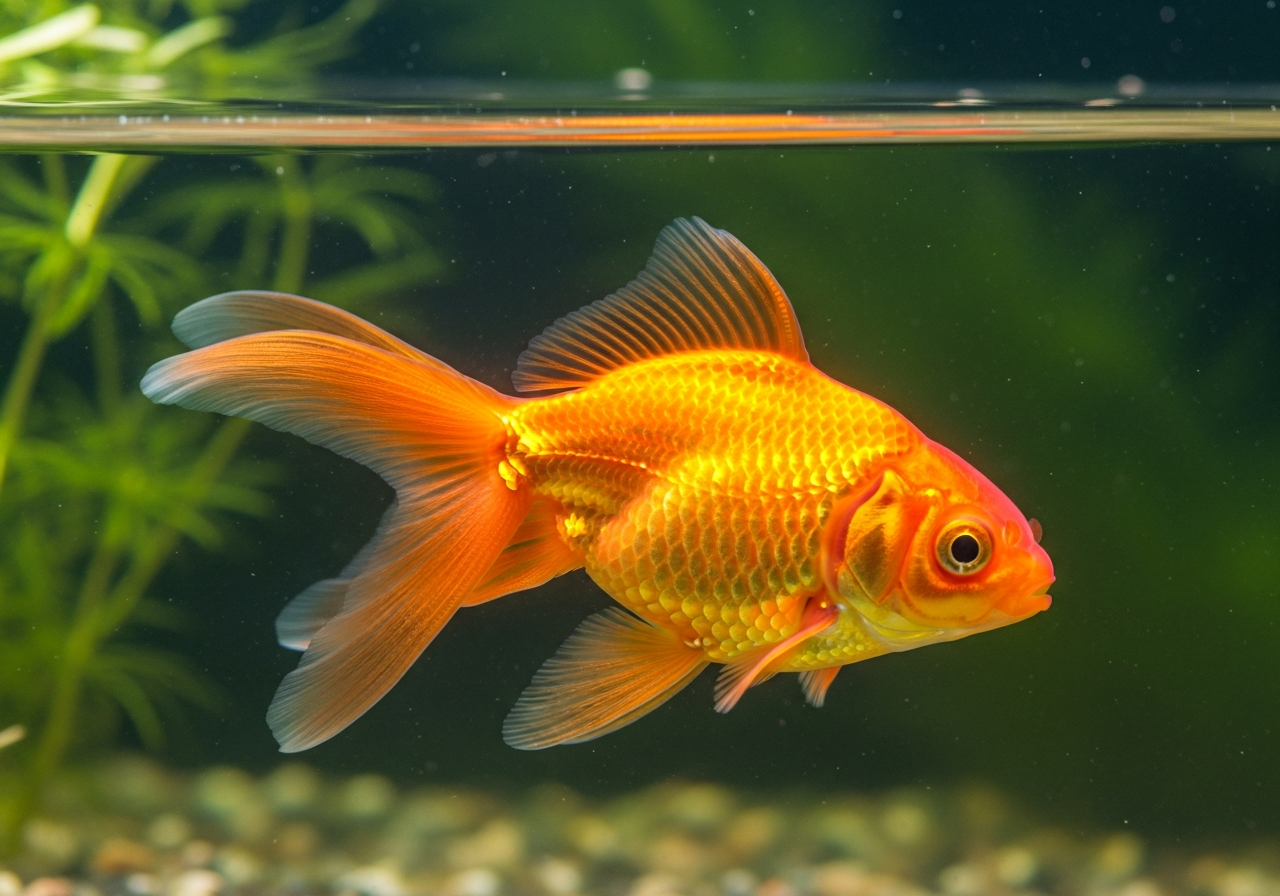
The goldfish is a small freshwater fish and the world's most popular pet fish, descended from wild carp domesticated in China more than a thousand years ago. Kept in ponds and aquariums, it commonly grows to 10 to 20 cm and swims slowly, cruising rather than darting. Hardy and long-lived, a well-cared-for goldfish often reaches 10 to 15 years and sometimes more than 20.
Top questions about the Goldfish
Goldfish facts at a glance
- Weight 300 g
- Length 18 cm
- Top speed 4 km/h
- Lifespan 15 years
| Scientific name | Carassius auratus |
|---|---|
| Diet | Omnivore |
| Habitat | Freshwater ponds and aquariums |
| Lifespan | 10–15 years, sometimes 20+ |
| Length | 10–20 cm (4–8 in), larger in ponds |
| Top speed | Slow; a gentle cruiser |
| Conservation status | Least Concern (IUCN) |
| Kingdom | Animalia |
|---|---|
| Phylum | Chordata |
| Class | Actinopterygii |
| Order | Cypriniformes |
| Family | Cyprinidae |
| Genus | Carassius |
Where it lives
The goldfish (Carassius auratus) is native to Domesticated from wild carp in East Asia and now kept in ponds and aquariums worldwide. — recorded across Asia, Europe, North America in this guide’s range summary.
For occurrence records, see GBIF species search and sources below.
How big is a goldfish?
An adult goldfish measures 18 cm long — about 10% of the height of an average adult person (1.73 m) — and weighs around 300 g, a small fraction of an average adult’s body weight (70 kg).
Length vs an average adult’s height (to scale)
What is a group of goldfish called?
Group name (collective noun)
A group of Goldfish is called a school. It is also known as a shoal.
Baby name
A baby Goldfish is called a fry.
Explore more animal collective nouns and baby animal names .
Origins and domestication
Goldfish are a domesticated form of a plain grey-brown carp native to East Asia. Keepers in imperial China began selecting for unusually coloured individuals more than a thousand years ago, gradually fixing the orange and gold hues we recognise today. From there the fish spread to Japan and eventually to Europe, becoming a fixture of ornamental ponds and, later, the home aquarium. Every fancy goldfish traces back to that single ancestral species, Carassius auratus.
Breeds and varieties
Centuries of selective breeding have produced a remarkable range of goldfish varieties. Common and comet goldfish keep the streamlined body of their wild ancestor, while fancy breeds such as the fantail, oranda, ryukin, and bubble-eye have rounded bodies, flowing fins, or dramatic head growths. Colours range from bright orange and red through white, black, and calico patterning. The more ornate breeds are generally slower swimmers and need calmer, warmer conditions than the hardy single-tailed types.
Feeding and care
Goldfish are omnivores that do well on a varied diet of prepared flakes or pellets supplemented with vegetables, and small live or frozen foods. They have no true stomach and are prone to overfeeding, so small, regular portions suit them best. Because they are messy feeders that produce a lot of waste, they need a well-filtered, spacious tank or pond with good water quality. Contrary to a common myth, a cramped bowl is unsuitable; goldfish need far more space than most people assume.
Swimming and behaviour
Goldfish are gentle, slow-moving swimmers that spend much of the day cruising and foraging along the bottom and among plants. They are social and often more active and confident when kept in groups. Surprisingly bright for a fish, goldfish can learn to recognise their owners, respond to feeding routines, and even be trained to perform simple tasks. Their memory is far better than the popular three-second myth suggests, spanning weeks or months.
Size and lifespan
In a small aquarium a goldfish typically reaches 10 to 20 cm, but in a spacious pond it can grow considerably larger. Good conditions matter enormously for how long they live: a healthy goldfish commonly reaches 10 to 15 years, and some have passed 20 or even 30. Cool, clean, well-oxygenated water and a proper diet are the keys to a long life. Most goldfish that die young do so because of poor water quality or cramped housing rather than natural causes.
Goldfish in ponds
Goldfish are popular garden pond fish because they are hardy and tolerate a wide range of temperatures. In a well-established outdoor pond they can survive cold winters by slowing their metabolism as the water cools, resting near the bottom below the ice. Pond-kept goldfish often grow larger and live longer than aquarium fish thanks to the extra space and natural food. Because they breed readily and can disrupt native wildlife, however, they should never be released into wild waterways.
Dig deeper into the Goldfish
- Goldfish: Key Facts
Goldfish (Carassius auratus) are fish found across Asia, Europe, North America. The world's most popular pet fish.
- How Long Do Goldfish Live?
Goldfish lifespan is typically 10–15 years, sometimes 20+. What shortens or extends life, life stages, and status (Least Concern).
- What Do Goldfish Eat?
What goldfish eat: Omnivore, foraging style, and seasonal shifts in Freshwater ponds and aquariums.
- Where Do Goldfish Live?
Where goldfish live: Freshwater ponds and aquariums, native range cues, and human overlap. Status Least Concern.
Explore the Goldfish
Related Fishs
Range & geography
Did you know? Goldfish facts
- The goldfish is a small freshwater fish in the carp family, domesticated in China over a thousand years ago and now the most popular pet fish in the world.
- With proper care in a spacious tank or pond, goldfish commonly live 10 to 15 years, and some reach 20 years or more. Most goldfish die young from cramped bowls and poor water rather than old age.
- No, that is a myth. Goldfish can remember things for weeks and months, learn simple tricks, and recognize the people who feed them, showing they have far better memories than the popular story claims.
- Goldfish are omnivores that eat algae, plants, small insects, crustaceans, and commercial flakes or pellets. Because they will overeat, it is best to feed small amounts once or twice a day.
- Yes. Goldfish are hardy, long-lived, and easy to care for, which makes them good beginner pets, as long as they have a properly sized tank with filtration rather than a tiny bowl.
- Conservation: Least Concern (IUCN).
Diet & feeding
Goldfish feeds primarily as a omnivore. Goldfish are social, curious fish that are far smarter than their reputation suggests. They can be trained to swim through hoops, recognize the person who feeds them, and remember routines for months rather than seconds. They are most active during the day and often beg for food
Adaptations
- Goldfish are social, curious fish that are far smarter than their reputation suggests. They can be trained to swim through hoops, recognize the person who feeds them, and remember routines for months rather than seconds. They are most active during the day and often beg for food at the surface.
- Goldfish are omnivores that eat plants, algae, small insects, crustaceans, and prepared flake or pellet food. They have no true stomach and will keep eating as long as food is offered, so overfeeding is a common cause of illness. A varied diet keeps their color bright and digestion healthy.
Behaviour & ecology
- Goldfish are social, curious fish that are far smarter than their reputation suggests. They can be trained to swim through hoops, recognize the person who feeds them, and remember routines for months rather than seconds. They are most active during the day and often beg for food at the surface.
- Goldfish are omnivores that eat plants, algae, small insects, crustaceans, and prepared flake or pellet food. They have no true stomach and will keep eating as long as food is offered, so overfeeding is a common cause of illness. A varied diet keeps their color bright and digestion healthy.
- Domestic goldfish descend from wild carp native to East Asia and now live worldwide in aquariums and garden ponds. They produce a lot of waste and need much more space and filtration than the classic small bowl provides. In a spacious pond a single goldfish can grow well over 20 cm long.
Communication
- Lateral-line and visual cues coordinate schooling, courtship, or territorial behaviour.
- Some species produce low-frequency sounds or drumming for spawning or defence.
Habitat & range
Freshwater ponds and aquariums
Ecological role
Goldfish occupies a defined trophic level in aquatic food webs, linking plankton or smaller fish to larger predators.
Conservation status of the Goldfish
The goldfish (Carassius auratus) is listed as Least Concern on the IUCN Red List. Least Concern (LC) is the IUCN's lowest-risk category, assigned to widespread, abundant species that have been evaluated and found not to be threatened. It does not mean a species faces no pressures — only that it is not currently at risk of extinction.
The goldfish (Carassius auratus) is assessed on the IUCN Red List. Look up on the IUCN Red List .
Frequently asked questions about the Goldfish
How long do goldfish live?
With good care, goldfish commonly live 10 to 15 years, and some reach 20 or more. Poor water quality and cramped housing, rather than old age, are the usual reasons they die young.
How big do goldfish get?
In an aquarium goldfish usually grow to 10 to 20 cm, but in a spacious pond they can become considerably larger. Their final size depends heavily on the space, water quality, and diet they are given.
Do goldfish really have a three-second memory?
No, that is a myth. Goldfish can remember things for weeks or months, learn feeding routines, and even recognise the person who feeds them.
Can a goldfish live in a bowl?
A small bowl is not suitable for a goldfish. They produce a lot of waste and need a spacious, well-filtered tank or pond with plenty of oxygen to stay healthy.
What do goldfish eat?
Goldfish are omnivores that thrive on prepared flakes or pellets supplemented with vegetables and small live or frozen foods. Because they have no true stomach, they should be fed small amounts regularly rather than one large meal.
Where do goldfish come from?
Goldfish were domesticated in China from a wild grey-brown carp more than a thousand years ago. Selective breeding for colour and body shape produced the ornamental fish kept around the world today.
What is a group of goldfish called?
A group of Goldfish is called a school. It is also known as a shoal.
What is a baby goldfish called?
A baby Goldfish is called a fry.
Sources & references
This guide is compiled and reviewed against established zoological and conservation references. Key sources for the Goldfish:
-
IUCN Red List of Threatened Species
Conservation status (Least Concern) reflects the IUCN Red List category for Carassius auratus.
-
iNaturalist — observations & photos
Search citizen-science observations and community IDs for Carassius auratus. Useful for range checks and recent sightings — not a substitute for formal Red List status.
-
GBIF — occurrence data
Global Biodiversity Information Facility species search for Carassius auratus. Explore published occurrence records used in range research.
- IUCN Red List — Carassius auratus.
Conservation status (Least Concern) and population trends.
- Animal Diversity Web — Carassius auratus. University of Michigan Museum of Zoology.
Life history, morphology, and range.
- Wikipedia — Goldfish.
General taxonomy and overview (cross-check primary sources).
-
Global Animal Guide editorial standards
How we research, source, review, and update every guide for accuracy.