Quick answer
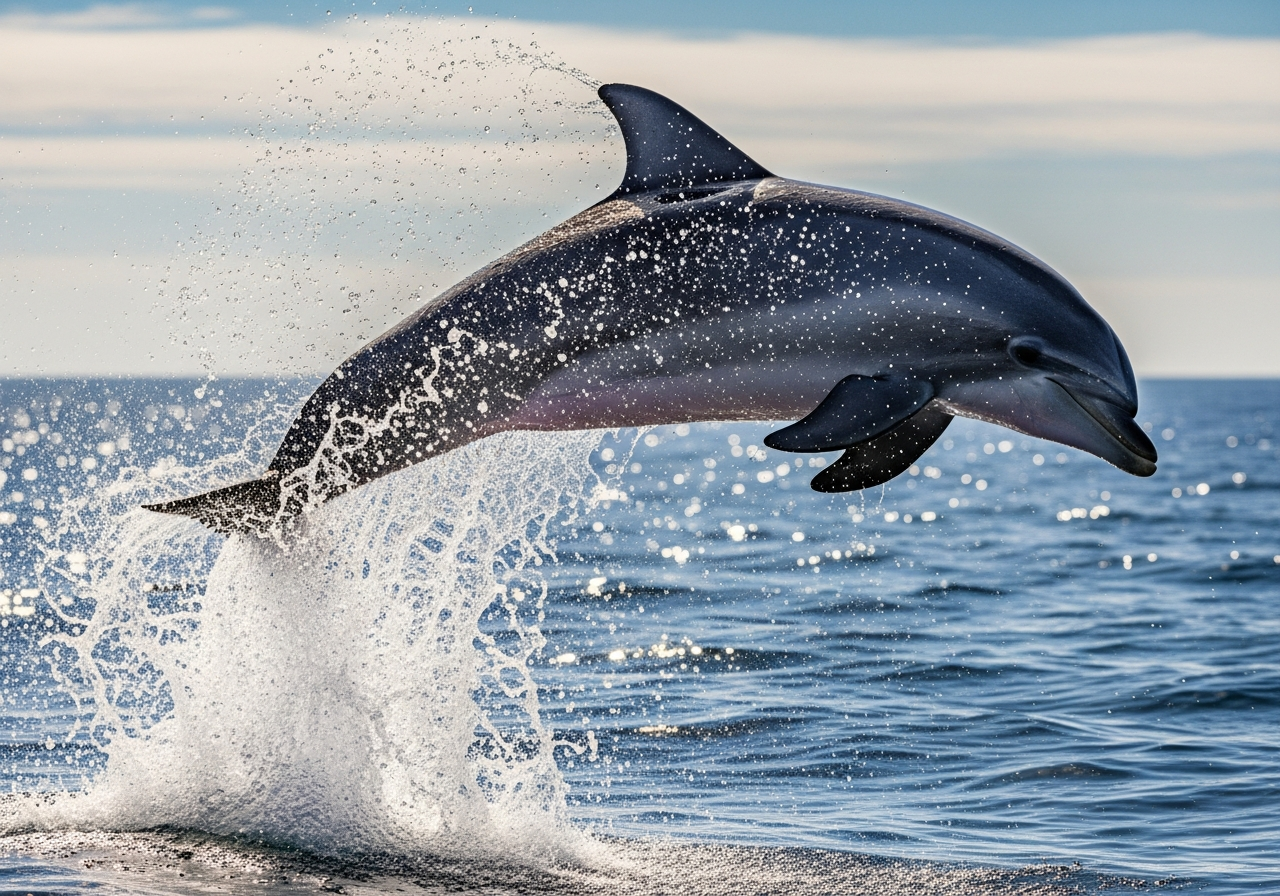
Bottlenose dolphins are highly intelligent marine mammals found in warm and temperate seas worldwide. They live in social groups called pods, use echolocation to navigate and hunt, and communicate with clicks and whistles, including signature whistles that work like names. They typically live 40 to 60 years.
Top questions about the Bottlenose Dolphin
Also available in Español (Delfín mular)
Bottlenose Dolphin facts at a glance
- Weight 300 kg
- Length 3 m
- Top speed 35 km/h
- Lifespan 45 years
| Scientific name | Tursiops truncatus |
|---|---|
| Diet | Carnivore |
| Habitat | Warm and temperate coastal and open seas |
| Lifespan | 40–60 years |
| Length | 2–4 m (6.6–13 ft) |
| Top speed | Up to 35 km/h (22 mph) |
| Conservation status | Least Concern (IUCN) |
| Kingdom | Animalia |
|---|---|
| Phylum | Chordata |
| Class | Mammalia |
| Order | Artiodactyla |
| Family | Delphinidae |
| Genus | Tursiops |
Where it lives
The bottlenose dolphin (Tursiops truncatus) is native to Warm and temperate seas worldwide, in both coastal shallows and the open ocean. — recorded across Oceans in this guide’s range summary.
For occurrence records, see GBIF species search and sources below.
How big is a bottlenose dolphin?
An adult bottlenose dolphin measures 3 m long — about 1.7× the height of an average adult person (1.73 m) — and weighs around 300 kg, about 4.3× an average adult’s body weight (70 kg).
Length vs an average adult’s height (to scale)
What is a group of bottlenose dolphins called?
Group name (collective noun)
A group of Bottlenose Dolphins is called a pod. It is also known as a school.
Baby name
A baby Bottlenose Dolphin is called a calf.
Explore more animal collective nouns and baby animal names .
Intelligence
Bottlenose dolphins are among the most intelligent animals on Earth. They use tools, recognize themselves in mirrors, solve complex problems, and teach skills to their young, such as covering their snouts with sponges to protect them while foraging.
Echolocation and communication
Dolphins navigate and hunt using echolocation, emitting clicks and interpreting the echoes to build a sound picture of their surroundings. Each dolphin develops a unique signature whistle that functions much like a name within its pod.
Conservation
Bottlenose dolphins are listed as Least Concern overall, but local populations face threats from accidental capture in fishing gear, pollution, habitat loss, and disturbance. As air-breathing marine mammals, they are sensitive indicators of ocean health.
Dig deeper into the Bottlenose Dolphin
- How Big Is A Bottlenose Dolphin?
Bottlenose Dolphin size and weight: typical about 300 kg, dimorphism, and growth.
- How Fast Is A Bottlenose Dolphin?
Bottlenose Dolphin top speed is up to about 35 km/h (22 mph). Sprint vs endurance and what limits pace.
- How Long Do Bottlenose Dolphins Live?
Bottlenose Dolphin lifespan is typically 40–60 years. What shortens or extends life, life stages, and status (Least Concern).
- How Smart Are Bottlenose Dolphins?
Bottlenose Dolphin intelligence: learning, memory, and ecological problem-solving.
- What Do Bottlenose Dolphins Eat?
What bottlenose dolphins eat: Carnivore, foraging style, and seasonal shifts in Warm and temperate coastal and open seas.
- Where Do Bottlenose Dolphins Live?
Where bottlenose dolphins live: Warm and temperate coastal and open seas, native range cues, and human overlap. Status Least Concern.
Explore the Bottlenose Dolphin
Compare
Collections
Range & geography
Did you know? Bottlenose Dolphin facts
- Bottlenose dolphins are among the most intelligent animals, using tools and teamwork.
- Each dolphin has a 'signature whistle' that works like a name.
- They use echolocation to 'see' with sound in murky water.
- Some populations carry sponges on their beaks to protect them while foraging.
- Dolphins can recognise themselves in mirrors, indicating self-awareness.
- They live in fluid social groups called pods with complex relationships.
Diet & feeding
Bottlenose dolphins are versatile predators of fish and squid, using cooperative herding, echolocation, and region-specific techniques such as mud-ring feeding to capture prey.
Adaptations
- Biological sonar (echolocation) locates prey and obstacles in dark or cloudy water.
- A streamlined body and powerful flukes deliver speed and agility.
- A large, convoluted brain supports learning, cooperation, and culture.
- Acute hearing and a sound-focusing 'melon' underpin echolocation.
Behaviour & ecology
- Dolphins live in fission–fusion pods with shifting membership and alliances.
- They cooperate to herd fish and use learned, local foraging techniques.
- Signature whistles let individuals identify and call to one another.
- Play, including with objects and other species, is common.
Communication
- Signature whistles function like names, maintaining contact and identity.
- Echolocation clicks build an acoustic picture for hunting and navigation.
- Body postures, leaps, and touches add a rich layer of social signalling.
Habitat & range
Bottlenose dolphins occur worldwide in temperate and tropical seas, from coastal bays and estuaries to open ocean, adapting to a wide range of conditions.
Ecological role
As intelligent coastal and oceanic predators, bottlenose dolphins help regulate fish and squid populations and are sentinels of marine ecosystem health.
Conservation status of the Bottlenose Dolphin
The bottlenose dolphin (Tursiops truncatus) is listed as Least Concern on the IUCN Red List. Least Concern (LC) is the IUCN's lowest-risk category, assigned to widespread, abundant species that have been evaluated and found not to be threatened. It does not mean a species faces no pressures — only that it is not currently at risk of extinction.
Main threats to the bottlenose dolphin
- Bycatch in fishing gear
- Habitat degradation in coastal waters
- Chemical and noise pollution
- Directed take in some regions
Bottlenose Dolphin (Tursiops truncatus) was most recently assessed for the IUCN Red List in 2019. View the full IUCN assessment .
Frequently asked questions about the Bottlenose Dolphin
How intelligent are dolphins?
Bottlenose dolphins are among the most intelligent animals known. They use tools, pass the mirror self-recognition test, solve problems, and teach learned behaviors to their offspring.
How do dolphins use echolocation?
Dolphins produce rapid clicks and listen to the returning echoes to locate objects, prey, and obstacles. This biological sonar lets them hunt and navigate even in murky water.
Do dolphins have names?
In a sense, yes. Each bottlenose dolphin develops a unique signature whistle that other dolphins use to identify and call it, functioning much like a name.
What do bottlenose dolphins eat?
Bottlenose dolphins are carnivores that eat fish, squid, and crustaceans. They often hunt cooperatively, herding fish into tight groups to feed.
How long do bottlenose dolphins live?
Bottlenose dolphins typically live 40 to 60 years. Females generally live longer than males, and some individuals have been documented living into their sixties.
Are dolphins fish or mammals?
Dolphins are mammals, not fish. They breathe air through a blowhole, are warm-blooded, give birth to live young, and nurse their calves with milk.
What is a group of bottlenose dolphins called?
A group of Bottlenose Dolphins is called a pod. It is also known as a school.
What is a baby bottlenose dolphin called?
A baby Bottlenose Dolphin is called a calf.
Sources & references
This guide is compiled and reviewed against established zoological and conservation references. Key sources for the Bottlenose Dolphin:
-
IUCN Red List of Threatened Species
Conservation status (Least Concern) reflects the IUCN Red List category for Tursiops truncatus, most recently assessed in 2019.
-
iNaturalist — observations & photos
Search citizen-science observations and community IDs for Tursiops truncatus. Useful for range checks and recent sightings — not a substitute for formal Red List status.
-
GBIF — occurrence data
Global Biodiversity Information Facility species search for Tursiops truncatus. Explore published occurrence records used in range research.
- Wells, R. S. et al. (2019). Tursiops truncatus. IUCN Red List of Threatened Species.
Status (Least Concern) and range.
- Animal Diversity Web — Tursiops truncatus. University of Michigan Museum of Zoology.
Life history, morphology, and range.
- Nowak, R. M. (1999). Walker's Mammals of the World (6th ed.). Johns Hopkins University Press.
Biology and behaviour.
-
Global Animal Guide editorial standards
How we research, source, review, and update every guide for accuracy.

Social life
Dolphins live in fluid social groups called pods, cooperating to hunt, raise calves, and defend against predators such as sharks. They form strong, sometimes lifelong bonds and have been observed helping injured companions reach the surface to breathe.