Quick answer
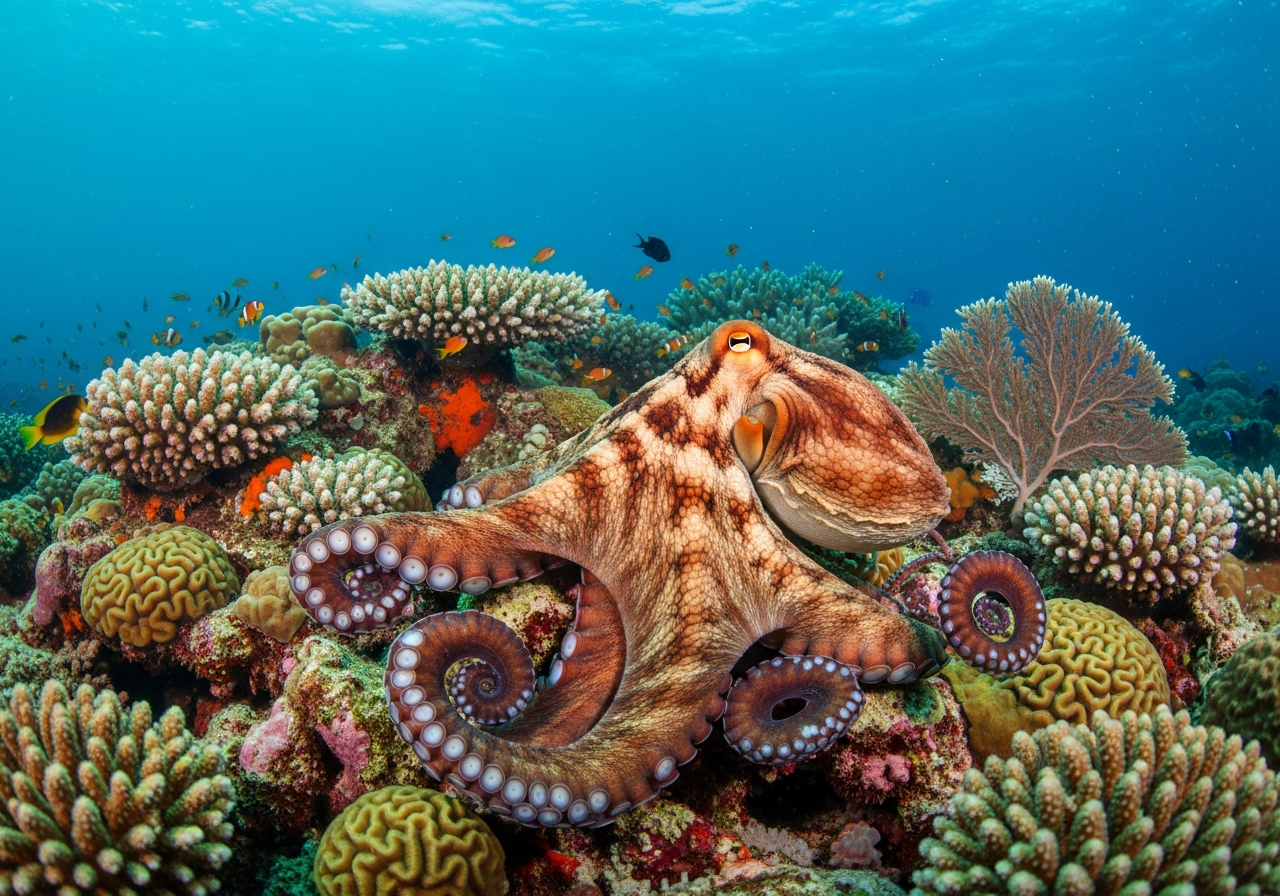
The octopus is a soft-bodied marine invertebrate with eight arms, three hearts, and blue, copper-based blood, widely regarded as the most intelligent of all invertebrates. Octopuses can change color and texture in an instant to camouflage, squeeze through tiny gaps, and solve problems and use tools. Most species are short-lived, typically around 1 to 2 years.
Top questions about the Octopus
Also available in Español (Pulpo)
Octopus facts at a glance
- Weight 3 kg
- Length 1 m
- Top speed 25 km/h
- Lifespan 2 years
| Scientific name | Octopus vulgaris |
|---|---|
| Diet | Carnivore |
| Habitat | Oceans, from reefs to the deep sea |
| Lifespan | 1–2 years (most species) |
| Weight | 3–10 kg (7–22 lb) common octopus |
| Top speed | Up to 25 km/h (16 mph) in a jet burst |
| Conservation status | Least Concern (IUCN) |
| Kingdom | Animalia |
|---|---|
| Phylum | Mollusca |
| Class | Cephalopoda |
| Order | Octopoda |
Where it lives
The octopus (Octopus vulgaris) is native to Coastal reefs, rocky seabeds, and the deep sea of oceans worldwide. — recorded across Oceans in this guide’s range summary.
For occurrence records, see GBIF species search and sources below.
How big is a octopus?
An adult octopus measures 1 m long — about 58% of the height of an average adult person (1.73 m) — and weighs around 3.0 kg, about 4% of an average adult’s body weight (70 kg).
Length vs an average adult’s height (to scale)
What is a group of octopuses called?
Group name (collective noun)
A group of Octopuses is called a consortium.
Baby name
A baby Octopus is called a larva. It may also be called a paralarva or a hatchling.
Explore more animal collective nouns and baby animal names .
Three hearts and blue blood
An octopus has three hearts: two pump blood through the gills and one circulates it to the body. Its blood is blue because it uses copper-based hemocyanin instead of iron-based hemoglobin to carry oxygen, which works well in cold, low-oxygen water. The main heart even stops beating when the octopus swims, which is why many prefer to crawl.
Masters of disguise
Octopuses can change the color, pattern, and even texture of their skin in milliseconds using millions of pigment-filled cells called chromatophores. This lets them vanish against rock, coral, or sand to ambush prey and hide from predators. Some species also mimic other animals or objects entirely.
Remarkable intelligence
Octopuses have large brains and, unusually, much of their nervous system is spread through their arms, so each arm can act semi-independently. They solve puzzles, open jars, use coconut shells and rocks as tools and shelter, and can recognize individual people, making them the most intelligent invertebrates known.
Bodies without bone
With no internal or external skeleton, an octopus can squeeze its entire body through any gap larger than its hard beak, the only rigid part. It moves by crawling on its arms or by jet propulsion, squirting water from a siphon, and can release a cloud of ink to escape danger.
Dig deeper into the Octopus
- How Long Do Octopuses Live?
Octopus lifespan is typically 1–2 years (most species). What shortens or extends life, life stages, and status (Least Concern).
- How Many Hearts
The octopus is a soft-bodied marine invertebrate with eight arms, three hearts, and blue, copper-based blood, widely regarded as the most intelligent of all invertebrates.
- Octopus Intelligence
The octopus is a soft-bodied marine invertebrate with eight arms, three hearts, and blue, copper-based blood, widely regarded as the most intelligent of all invertebrates.
- What Do Octopuses Eat?
What octopuses eat: Carnivore, foraging style, and seasonal shifts in Oceans, from reefs to the deep sea.
- Where Do Octopuses Live?
Where octopuses live: Oceans, from reefs to the deep sea, native range cues, and human overlap. Status Least Concern.
Explore the Octopus
Related Invertebrates
Collections
Range & geography
Did you know? Octopus facts
- Octopuses have three hearts and blue, copper-based blood.
- About two-thirds of an octopus's neurons are in its arms, not its central brain.
- They can change colour and texture in an instant to camouflage against almost any background.
- Octopuses are skilled problem-solvers, opening jars and navigating mazes.
- Some carry coconut shells to assemble into portable shelters — a rare example of tool use.
- An octopus can squeeze its boneless body through any gap larger than its beak.
- Most octopuses are short-lived, often dying after a single breeding season.
Diet & feeding
Octopuses are carnivores that prey mainly on crustaceans and molluscs such as crabs, clams, and snails, using the beak to bite, drilling into shells, and injecting venom to subdue prey.
Adaptations
- Pigment-filled chromatophores plus reflective cells allow near-instant colour and pattern change. (Hanlon & Messenger 2018)
- Skin papillae let the octopus also change texture to match coral, rock, or sand.
- Each sucker can taste as well as grip, sensing chemicals on contact.
- Copper-based haemocyanin carries oxygen efficiently in cold, low-oxygen water.
- A boneless body and a small hard beak let large octopuses pass through tiny openings.
Behaviour & ecology
- Octopuses are largely solitary and den in crevices, often marking the entrance with shells. (Mather 2008)
- They hunt by exploration, using arms semi-independently to probe crevices for prey.
- Problem-solving and apparent play with objects suggest advanced cognition.
- When threatened, they jet away, release ink, and rely on rapid camouflage.
Communication
- Some species signal mood and threat through rapid colour and pattern changes.
- Body postures — spreading the arms or standing tall — can serve as displays.
- Most octopuses are solitary, so communication is limited compared with social animals.
Habitat & range
Octopuses occupy nearly all marine habitats, from tropical coral reefs and rocky shores to the cold deep sea, sheltering in dens among rocks, crevices, and debris.
Ecological role
As both predator and prey, octopuses help regulate populations of crabs, shellfish, and small fish, while themselves feeding a wide range of fish, marine mammals, and seabirds.
Conservation status of the Octopus
The octopus (Octopus vulgaris) is listed as Least Concern on the IUCN Red List. Least Concern (LC) is the IUCN's lowest-risk category, assigned to widespread, abundant species that have been evaluated and found not to be threatened. It does not mean a species faces no pressures — only that it is not currently at risk of extinction.
The octopus (Octopus vulgaris) is assessed on the IUCN Red List. Look up on the IUCN Red List .
Frequently asked questions about the Octopus
How many hearts does an octopus have?
An octopus has three hearts. Two pump blood through the gills, and one pumps it to the rest of the body. The main heart stops when the octopus swims, which is one reason they often prefer to crawl.
Why is octopus blood blue?
Octopus blood is blue because it uses a copper-based molecule called hemocyanin, rather than the iron-based hemoglobin in our red blood, to carry oxygen efficiently in cold seawater.
How do octopuses change color?
Octopuses change color using millions of tiny pigment cells called chromatophores in their skin, plus layers that reflect light, allowing near-instant camouflage in color, pattern, and texture.
Are octopuses intelligent?
Yes. Octopuses are the most intelligent invertebrates known. They solve puzzles, use tools, open jars, escape enclosures, and can recognize individual people, with much of their nervous system in their arms.
How long do octopuses live?
Most octopuses are short-lived, typically 1 to 2 years. They usually die soon after reproducing, with females guarding their eggs until they hatch and then passing away.
What is a group of octopuses called?
A group of Octopuses is called a consortium.
What is a baby octopus called?
A baby Octopus is called a larva. It may also be called a paralarva or a hatchling.
Sources & references
This guide is compiled and reviewed against established zoological and conservation references. Key sources for the Octopus:
-
IUCN Red List of Threatened Species
Conservation status (Least Concern) reflects the IUCN Red List category for Octopus vulgaris.
-
iNaturalist — observations & photos
Search citizen-science observations and community IDs for Octopus vulgaris. Useful for range checks and recent sightings — not a substitute for formal Red List status.
-
GBIF — occurrence data
Global Biodiversity Information Facility species search for Octopus vulgaris. Explore published occurrence records used in range research.
- Hanlon, R. T. & Messenger, J. B. (2018). Cephalopod Behaviour (2nd ed.). Cambridge University Press.
Camouflage, behaviour, and cognition.
- Mather, J. A. (2008). Cephalopod consciousness: Behavioural evidence. Consciousness and Cognition.
Cognition and behaviour.
- Animal Diversity Web — Octopus. University of Michigan Museum of Zoology.
Physiology and life history.
- Courtney-Jones, S. K. B. et al. (2022). Octopus IUCN assessments. The IUCN Red List of Threatened Species.
Status varies by species.
-
Global Animal Guide editorial standards
How we research, source, review, and update every guide for accuracy.