Quick answer
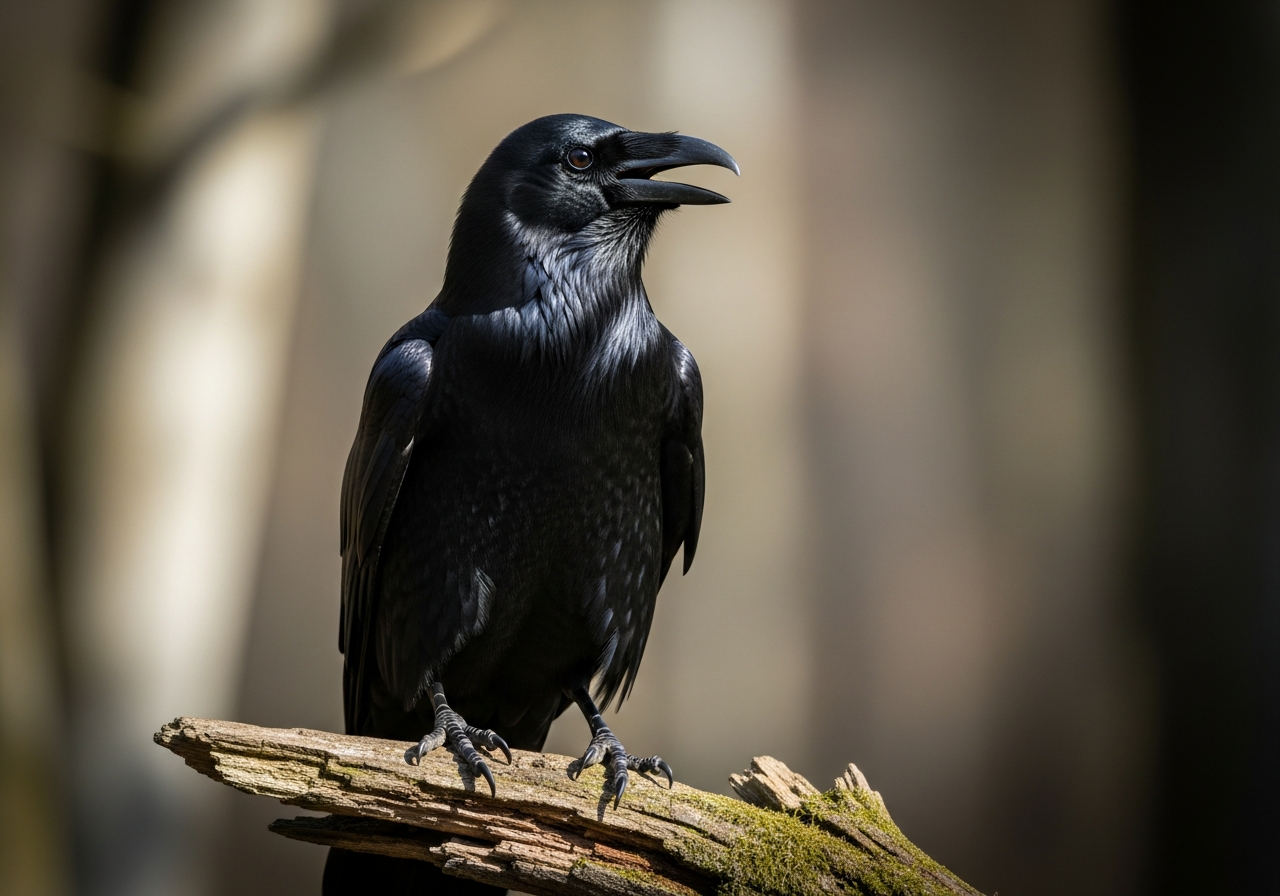
The common raven is a large, all-black songbird found across the Northern Hemisphere and one of the most intelligent of all animals. Ravens can solve complex problems, use tools, mimic sounds, and even appear to plan for the future. Larger than crows, with a deep croaking call and shaggy throat feathers, they live in many habitats and often reach 10 to 15 years in the wild.
Top questions about the Common Raven
Common Raven facts at a glance
- Weight 1.2 kg
- Length 63 cm
- Top speed 80 km/h
- Lifespan 13 years
| Scientific name | Corvus corax |
|---|---|
| Diet | Omnivore (carrion, small animals, fruit, scraps) |
| Habitat | Forests, mountains, deserts, coasts, and cities |
| Lifespan | 10–15 years in the wild |
| Wingspan | 1.0–1.5 m (3.3–4.9 ft) |
| Top speed | Up to 80 km/h (50 mph) |
| Conservation status | Least Concern (IUCN) |
| Kingdom | Animalia |
|---|---|
| Phylum | Chordata |
| Class | Aves |
| Order | Passeriformes |
| Family | Corvidae |
| Genus | Corvus |
Where it lives
The common raven (Corvus corax) is native to Across the Northern Hemisphere, from the Arctic through forests, mountains, and deserts of North America, Europe, Asia, and North Africa. — recorded across North America, Europe, Asia, Africa in this guide’s range summary.
For occurrence records, see GBIF species search and sources below.
How big is a common raven?
An adult common raven measures 63 cm long — about 36% of the height of an average adult person (1.73 m) — and weighs around 1.2 kg, about 2% of an average adult’s body weight (70 kg).
Length vs an average adult’s height (to scale)
What is a group of common ravens called?
Group name (collective noun)
A group of Common Ravens is called an unkindness. It is also known as a conspiracy.
Baby name
A baby Common Raven is called a chick.
Explore more animal collective nouns and baby animal names .
Remarkable intelligence
Ravens rank among the smartest animals on Earth, with brains large for their body size. They can solve multi-step puzzles, fashion and use simple tools, remember individual human faces, and seem to plan ahead by caching food for later. In experiments they have shown problem-solving abilities that rival those of great apes.
Communication and play
Common ravens have a rich vocabulary of croaks, knocks, and other calls, and they can mimic sounds, including human speech. They are also notably playful, sliding down snowy slopes, dropping and catching objects in mid-air, and performing acrobatic rolls and tumbles in flight, behavior that suggests intelligence and curiosity.
Diet and adaptability
Ravens are omnivores and opportunists, eating carrion, insects, small animals, eggs, fruit, grain, and human food scraps. This flexible diet lets them thrive almost anywhere, from Arctic tundra and deserts to forests and busy cities. They often follow predators or scan roadsides to find food others have left behind.
Raven or crow?
Ravens are larger and heavier than crows, with a thicker beak, shaggy throat feathers, and a wedge-shaped tail visible in flight. Their call is a deep, hoarse croak rather than the higher cawing of a crow. Ravens also tend to soar more and are often seen in pairs, while crows frequently gather in larger flocks.
Dig deeper into the Common Raven
- How Fast Is A Common Raven?
Common Raven top speed is up to about 80 km/h (50 mph). Sprint vs endurance and what limits pace.
- How Long Do Common Ravens Live?
Common Raven lifespan is typically 10–15 years in the wild. What shortens or extends life, life stages, and status (Least Concern).
- What Do Common Ravens Eat?
What common ravens eat: Omnivore (carrion, small animals, fruit, scraps), foraging style, and seasonal shifts in Forests, mountains, deserts, coasts, and cities.
- Where Do Common Ravens Live?
Where common ravens live: Forests, mountains, deserts, coasts, and cities, native range cues, and human overlap. Status Least Concern.
Explore the Common Raven
Related Birds
Range & geography
Did you know? Common Raven facts
- The common raven is a large, all-black songbird found across the Northern Hemisphere and one of the most intelligent of all animals.
- Ravens are among the most intelligent animals known. They solve complex puzzles, use tools, recognize individual human faces, and appear to plan for the future, with abilities that rival great apes.
- Ravens are larger, with heavier beaks, shaggy throat feathers, and wedge-shaped tails, and they give a deep croak. Crows are smaller, caw at a higher pitch, and often gather in bigger flocks.
- Ravens are omnivores that eat almost anything, including carrion, insects, small animals, eggs, fruit, grain, and human food scraps, which helps them survive in many environments.
- Yes. Ravens can imitate a wide range of sounds, including human words, and captive ravens sometimes mimic speech as clearly as a parrot.
- Conservation: Least Concern (IUCN).
Diet & feeding
Common Raven feeds primarily as a omnivore (carrion, small animals, fruit, scraps). Ravens rank among the smartest animals on Earth, with brains large for their body size. They can solve multi-step puzzles, fashion and use simple tools, remember individual human faces, and seem to plan ahead by caching food for later.
Adaptations
- Ravens rank among the smartest animals on Earth, with brains large for their body size. They can solve multi-step puzzles, fashion and use simple tools, remember individual human faces, and seem to plan ahead by caching food for later. In experiments they have shown problem-solving abilities that rival those of great apes.
- Common ravens have a rich vocabulary of croaks, knocks, and other calls, and they can mimic sounds, including human speech. They are also notably playful, sliding down snowy slopes, dropping and catching objects in mid-air, and performing acrobatic rolls and tumbles in flight, behavior that suggests intelligence and curiosity.
Behaviour & ecology
- Ravens rank among the smartest animals on Earth, with brains large for their body size. They can solve multi-step puzzles, fashion and use simple tools, remember individual human faces, and seem to plan ahead by caching food for later. In experiments they have shown problem-solving abilities that rival those of great apes.
- Common ravens have a rich vocabulary of croaks, knocks, and other calls, and they can mimic sounds, including human speech. They are also notably playful, sliding down snowy slopes, dropping and catching objects in mid-air, and performing acrobatic rolls and tumbles in flight, behavior that suggests intelligence and curiosity.
- Ravens are omnivores and opportunists, eating carrion, insects, small animals, eggs, fruit, grain, and human food scraps. This flexible diet lets them thrive almost anywhere, from Arctic tundra and deserts to forests and busy cities. They often follow predators or scan roadsides to find food others have left behind.
Communication
- Common Raven uses calls and visual displays to communicate territory, alarm, and breeding status.
- Vocal repertoires vary by species and are often learned or refined during development.
Habitat & range
Forests, mountains, deserts, coasts, and cities
Ecological role
Common Raven contributes to seed dispersal, insect control, or nutrient cycling depending on diet and foraging habits.
Conservation status of the Common Raven
The common raven (Corvus corax) is listed as Least Concern on the IUCN Red List. Least Concern (LC) is the IUCN's lowest-risk category, assigned to widespread, abundant species that have been evaluated and found not to be threatened. It does not mean a species faces no pressures — only that it is not currently at risk of extinction.
The common raven (Corvus corax) is assessed on the IUCN Red List. Look up on the IUCN Red List .
Frequently asked questions about the Common Raven
How intelligent are ravens?
Ravens are among the most intelligent animals known. They solve complex puzzles, use tools, recognize individual human faces, and appear to plan for the future, with abilities that rival great apes.
What is the difference between a raven and a crow?
Ravens are larger, with heavier beaks, shaggy throat feathers, and wedge-shaped tails, and they give a deep croak. Crows are smaller, caw at a higher pitch, and often gather in bigger flocks.
What do ravens eat?
Ravens are omnivores that eat almost anything, including carrion, insects, small animals, eggs, fruit, grain, and human food scraps, which helps them survive in many environments.
Can ravens talk or mimic sounds?
Yes. Ravens can imitate a wide range of sounds, including human words, and captive ravens sometimes mimic speech as clearly as a parrot.
How long do ravens live?
In the wild common ravens usually live 10 to 15 years, and birds in captivity have lived 40 years or more.
Where do common ravens live?
Common ravens range across the Northern Hemisphere, from the Arctic to deserts and mountains, and they adapt well to forests, coastlines, and even cities.
What is a group of common ravens called?
A group of Common Ravens is called an unkindness. It is also known as a conspiracy.
What is a baby common raven called?
A baby Common Raven is called a chick.
Sources & references
This guide is compiled and reviewed against established zoological and conservation references. Key sources for the Common Raven:
-
IUCN Red List of Threatened Species
Conservation status (Least Concern) reflects the IUCN Red List category for Corvus corax.
-
iNaturalist — observations & photos
Search citizen-science observations and community IDs for Corvus corax. Useful for range checks and recent sightings — not a substitute for formal Red List status.
-
GBIF — occurrence data
Global Biodiversity Information Facility species search for Corvus corax. Explore published occurrence records used in range research.
-
eBird — bird observations
Cornell Lab eBird target search for Common Raven. Check recent checklists and seasonal abundance where birders report this species.
- IUCN Red List — Corvus corax.
Conservation status (Least Concern) and population trends.
- Animal Diversity Web — Corvus corax. University of Michigan Museum of Zoology.
Life history, morphology, and range.
- Wikipedia — Common Raven.
General taxonomy and overview (cross-check primary sources).
-
Global Animal Guide editorial standards
How we research, source, review, and update every guide for accuracy.