Bonobo
Pan paniscus
Quick answer
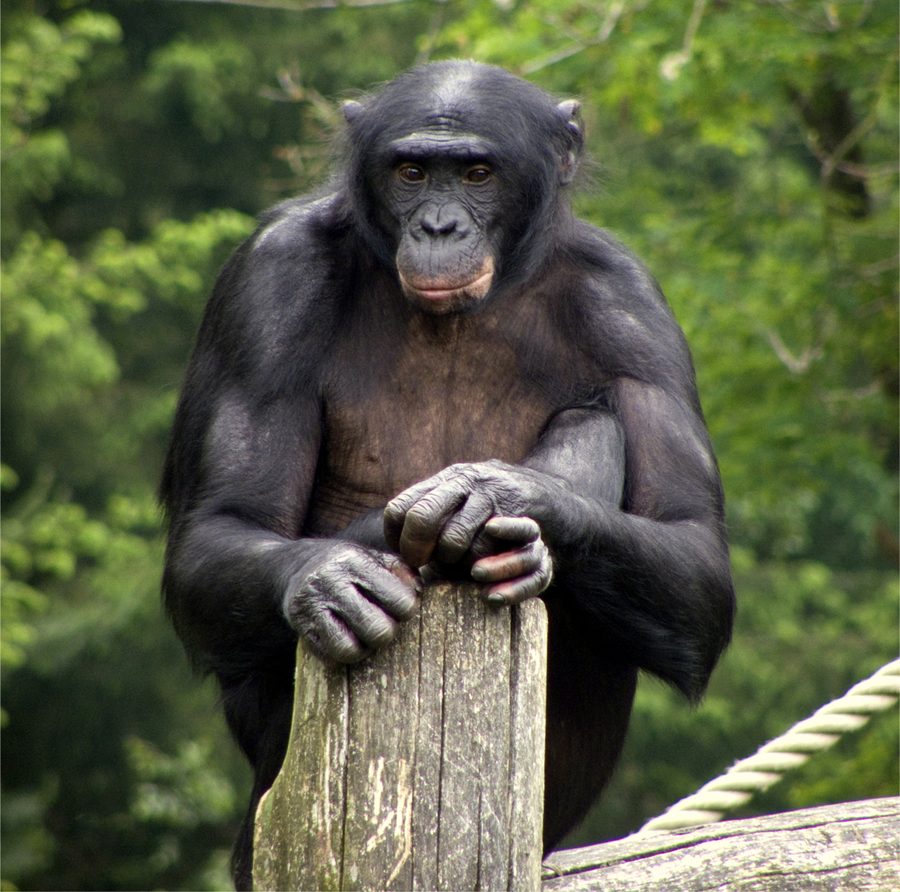
Bonobos are great apes found only in the Democratic Republic of Congo, closely related to chimpanzees but generally less aggressive, with female-led social bonds and extensive use of social behaviour to resolve conflict. Listed Endangered, they weigh 30–50 kg and face habitat loss and bushmeat hunting.
Also available in Español (Bonobo)
Bonobo facts at a glance
| Scientific name | Pan paniscus |
|---|---|
| Diet | Omnivore — fruit, leaves, seeds, and occasional small mammals |
| Habitat | Lowland and swamp forests south of the Congo River |
| Lifespan | 40–50 years in the wild |
| Weight | 30–50 kg (66–110 lb); females slightly smaller |
| Top speed | Knuckle-walking; agile in trees |
| Conservation status | Endangered (IUCN) |
| Kingdom | Animalia |
|---|---|
| Phylum | Chordata |
| Class | Mammalia |
| Order | Primates |
| Family | Hominidae |
| Genus | Pan |
Where it lives
Lowland and swamp forests exclusively south of the Congo River in the Democratic Republic of Congo.
What is a group of bonobos called?
Group name (collective noun)
A group of Bonobos is called a troop.
Baby name
A baby Bonobo is called an infant.
Explore more animal collective nouns and baby animal names .
Female-centred society
Bonobo groups are led by strong female alliances that cooperate to manage aggression and access food. Females migrate between groups and form bonds that reduce male dominance compared with chimpanzees. Social grooming and play are central to group cohesion.
Congo River isolation
Bonobos evolved separately from chimpanzees after the Congo River formed a barrier roughly two million years ago. They occupy forests exclusively south of the river in the DRC — a range far smaller and more fragmented than that of chimps.
Intelligence and tool use
Bonobos pass mirror tests, use tools in captivity, and show advanced communication in language research projects. In the wild they forage mainly for ripe fruit, sharing patches peacefully more often than chimpanzees do.
Conservation crisis
Fewer than 20,000 bonobos may remain, listed Endangered from bushmeat hunting, logging, and civil conflict in the DRC. Protected areas such as Salonga National Park are critical, but enforcement remains challenging in remote rainforest.
Dig deeper into the Bonobo
- Are Bonobo Endangered
Dig deeper into bonobo — are bonobo endangered.
- Bonobo Facts 5
Dig deeper into bonobo — bonobo facts 5.
- How Long do Bonobo Live?
Dig deeper into bonobo — how long do bonobo live.
- What do Bonobo Eat
Dig deeper into bonobo — what do bonobo eat.
- Where do Bonobo Live?
Dig deeper into bonobo — where do bonobo live.
Explore the Bonobo
Compare
Collections
Range & geography
Did you know? Bonobo facts
- Bonobos are great apes found only in the Democratic Republic of Congo, closely related to chimpanzees but generally less aggressive, with female-led social bonds and extensive use of social behaviour to resolve conflict.
- Bonobos are slimmer, more often walk upright, and have less aggressive male-dominated politics. Chimpanzees live north of the Congo River; bonobos live south.
- They are less violent than chimpanzees toward their own kind, using social bonding to reduce tension — though they are not conflict-free and can still fight.
- Only in the Democratic Republic of Congo, in forests south of the Congo River — nowhere else in the wild.
- Among the most intelligent non-human animals, with advanced social cognition, tool use in research settings, and complex communication abilities.
- Conservation: Endangered (IUCN).
Diet & feeding
Bonobo feeds primarily as a omnivore — fruit, leaves, seeds, and occasional small mammals. Fewer than 20,000 bonobos may remain, listed Endangered from bushmeat hunting, logging, and civil conflict in the DRC. Protected areas such as Salonga National Park are critical, but enforcement remains challenging in remote rain
Adaptations
- Bonobo groups are led by strong female alliances that cooperate to manage aggression and access food. Females migrate between groups and form bonds that reduce male dominance compared with chimpanzees. Social grooming and play are central to group cohesion.
- Bonobos evolved separately from chimpanzees after the Congo River formed a barrier roughly two million years ago. They occupy forests exclusively south of the river in the DRC — a range far smaller and more fragmented than that of chimps.
Behaviour & ecology
- Bonobo groups are led by strong female alliances that cooperate to manage aggression and access food. Females migrate between groups and form bonds that reduce male dominance compared with chimpanzees. Social grooming and play are central to group cohesion.
- Bonobos evolved separately from chimpanzees after the Congo River formed a barrier roughly two million years ago. They occupy forests exclusively south of the river in the DRC — a range far smaller and more fragmented than that of chimps.
- Bonobos pass mirror tests, use tools in captivity, and show advanced communication in language research projects. In the wild they forage mainly for ripe fruit, sharing patches peacefully more often than chimpanzees do.
Communication
- Bonobo uses scent, posture, and vocal signals to mark territory and coordinate social behaviour.
- Communication intensity often peaks during breeding seasons and territorial disputes.
Habitat & range
Lowland and swamp forests south of the Congo River
Ecological role
Bonobo plays a recognised ecological role in lowland and swamp forests south of the congo river.
Frequently asked questions about the Bonobo
Bonobo vs chimpanzee — what is the difference?
Bonobos are slimmer, more often walk upright, and have less aggressive male-dominated politics. Chimpanzees live north of the Congo River; bonobos live south.
Are bonobos peaceful?
They are less violent than chimpanzees toward their own kind, using social bonding to reduce tension — though they are not conflict-free and can still fight.
Where do bonobos live?
Only in the Democratic Republic of Congo, in forests south of the Congo River — nowhere else in the wild.
How intelligent are bonobos?
Among the most intelligent non-human animals, with advanced social cognition, tool use in research settings, and complex communication abilities.
Are bonobos endangered?
Yes — Endangered on the IUCN Red List, mainly from hunting and habitat destruction in one of the world's poorest and most conflict-affected regions.
What is a group of bonobos called?
A group of Bonobos is called a troop.
What is a baby bonobo called?
A baby Bonobo is called an infant.
Sources & references
This guide is compiled and reviewed against established zoological and conservation references. Key sources for the Bonobo:
-
IUCN Red List of Threatened Species
Conservation status (Endangered) reflects the IUCN Red List category for Pan paniscus.
- IUCN Red List — Pan paniscus.
Conservation status (Endangered) and population trends.
- Animal Diversity Web — Pan paniscus. University of Michigan Museum of Zoology.
Life history, morphology, and range.
-
Global Animal Guide editorial standards
How we research, source, review, and update every guide for accuracy.