Largest Animal in the World: Blue Whale Facts
The blue whale is the largest animal ever known — longer and heavier than any dinosaur. Size records, diet, and how it compares with land giants.
Global Animal Guide · July 16, 2026
Quick answer
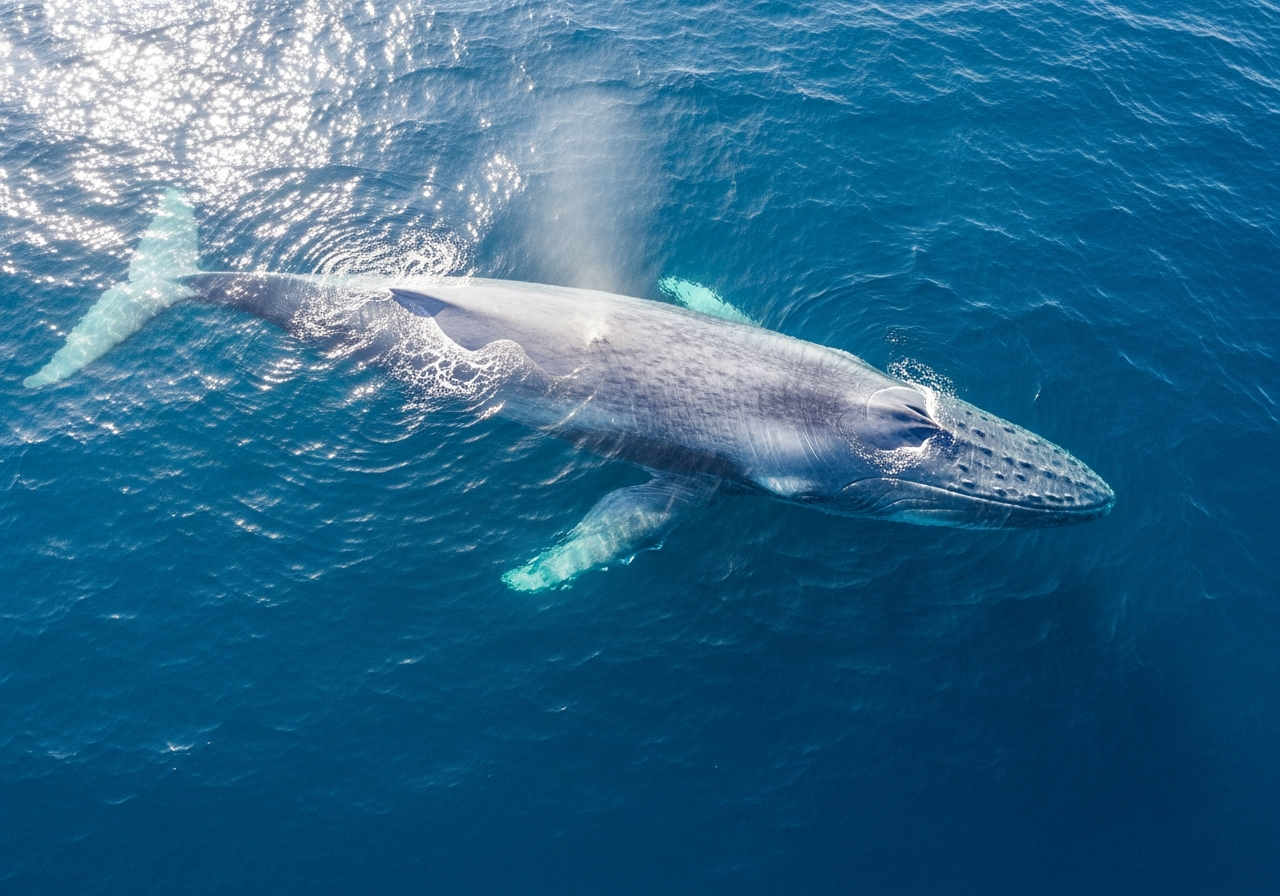
The blue whale is the largest animal on Earth and the heaviest animal ever known to have lived. Adults can reach about 25–30 metres (80–100 feet) and weigh over 100 tonnes — bigger than any dinosaur by mass — while feeding almost entirely on tiny krill.
Last updated: July 2026.
The blue whale is the largest animal alive today, and as far as anyone can tell from the fossil record, the heaviest animal that has ever existed. A large adult stretches 25–30 metres and can exceed 150 tonnes — heavier than the biggest sauropod dinosaurs, heavier than any land animal could ever be. What makes the record stranger is the diet. This animal is built almost entirely out of krill: shrimp-like crustaceans a few centimetres long, eaten by the tonne.
Size at a glance
| Measure | Blue whale (approx.) |
|---|---|
| Length | 25–30 m (80–100 ft) |
| Weight | 100–150+ tonnes |
| Heart | Roughly the size of a small car |
| Tongue | Can weigh as much as an elephant |
Read the full profile: blue whale.
Why the ocean allows giants that land cannot
The single most important fact about blue whale size is that it happens in water. Weight on land must be carried by bone. As an animal scales up, its mass grows with the cube of its length while the cross-sectional area of its legs grows only with the square — double the length and you get eight times the weight supported by four times the bone. Limbs must thicken disproportionately, and eventually the geometry simply runs out. That ceiling is why the African elephant, at around six tonnes, is the heaviest land animal today, and why sauropods needed hollow, air-filled bones to push past it.
Seawater removes the problem. A whale’s body is close to neutrally buoyant, so its skeleton carries almost no compressive load; ribs and vertebrae serve as muscle anchors rather than columns. A stranded blue whale dies partly because its own weight, unsupported, crushes its lungs and organs — the same body that is effortless at sea is fatal on a beach.
Water helps in a second way. Large bodies lose heat slowly because volume grows faster than surface area, and in cold, energy-rich polar water that is an advantage rather than a liability. It is no accident that the largest baleen whales feed at high latitudes.
How eating the smallest prey builds the biggest animal
It seems backwards that the largest animal eats some of the smallest. The logic is in the harvesting method. Blue whales are lunge feeders: the whale accelerates into a krill swarm, opens its jaw to nearly ninety degrees, and engulfs a volume of water that can exceed its own body volume, the throat pleats ballooning outward. It then closes its mouth and drives the water out through baleen plates — fringed keratin sheets that act as a sieve — leaving the krill behind to be swallowed.
Each lunge is enormously expensive, costing a burst of muscular work and a drag penalty that briefly halts the whale. It only pays off if the krill patch is dense enough. This is the key constraint: blue whales cannot graze thin water, they must find concentrated swarms, and their whole migratory pattern is organised around locating them.
Crucially, the efficiency of filter feeding improves with size. A bigger mouth engulfs disproportionately more water per lunge while the energy cost per lunge rises more slowly, so larger whales extract more calories per unit effort. Size begets feeding efficiency, which permits more size. Toothed hunters like the sperm whale and the orca catch prey one at a time and never reached this scale; the largest animals — blue, fin whale, humpback whale, minke whale — are almost all filterers, and so are the largest fish, the whale shark and the basking shark, which converged on the same solution independently.
The consequences of being that large
Blue whale anatomy is a catalogue of superlatives that follow from mass rather than being ends in themselves. The heart is roughly the size of a small car and beats extraordinarily slowly — as low as a couple of beats per minute during a deep dive, rising to perhaps thirty at the surface. The aorta is wide enough for a child to crawl through. The tongue alone can weigh as much as an elephant.
Calves are born at around seven metres and gain weight at a rate that has no parallel in the animal kingdom, put on entirely from milk with a fat content many times that of cow’s milk. A blue whale mother fasts through much of this, converting her own blubber into a calf. That reproductive strategy — one enormous, slow, hugely expensive offspring at intervals of two or three years — is what makes the species so vulnerable to population loss.
Communication scales too. Blue whale calls are infrasonic, mostly below the range of human hearing, and travel across ocean basins. In an animal this dispersed and this dependent on finding widely scattered food and mates, low-frequency sound is the only sense that operates at the right range.
Blue whales against the dinosaurs
The comparison people most want is with sauropods, and it needs splitting into two questions. On length, the contest is genuinely close: the longest sauropod estimates rival or approach a large blue whale, though many of those estimates rest on fragmentary remains and get revised downward as often as up. On mass, it is not close. Even generous sauropod reconstructions fall short of a large blue whale, and their skeletons were riddled with air sacs precisely because carrying that weight on land demanded weight savings.
There is also the matter of what “largest” means. The giraffe is the tallest living animal; the ostrich the largest bird; the saltwater crocodile the largest reptile; the ocean sunfish the heaviest bony fish. Some colonial siphonophores — relatives of the jellyfish — form strings tens of metres long, but they are colonies of specialised units rather than single bodies, which is why they win on length and lose on any sensible definition of an individual animal.
Largest by category
- Living animal overall: blue whale
- Living land animal: African elephant
- Living fish (bony/cartilaginous giants): whale shark / large sharks among fishes
- Ever lived (length debates): some sauropods rival whale length; whales win on mass
Why so few are left
Blue whales were largely beyond the reach of hunters until steam power and the explosive harpoon made them catchable, at which point the industry took them in staggering numbers through the twentieth century, working southward through the Antarctic. The species was reduced to a small fraction of its original abundance before protection arrived in the 1960s.
Recovery has been real but slow, and the arithmetic explains why: an animal that matures late and produces one calf every few years simply cannot rebuild quickly. Ship strikes, entanglement in fishing gear, and rising ocean noise that masks those long-distance calls all remain pressures. The largest animal that has ever lived depends, in the end, on the continued abundance of one of the smallest — and krill distribution is shifting as polar seas warm.
Related reading
Sources
Frequently asked questions
Is the blue whale bigger than any dinosaur?
By weight, yes — blue whales outweigh even the largest sauropods. Some dinosaurs were similar in length, but not as heavy.
What is the largest land animal?
The African elephant is the largest living land animal. Extinct sauropod dinosaurs were larger on land in the past.
What do blue whales eat?
Mostly krill — small shrimp-like crustaceans filtered through baleen plates.
Are blue whales endangered?
They are listed Endangered after industrial whaling; populations are recovering slowly in some oceans.