Photo: Obtained from Molly Ebersold of the St. Augustine Alligator Farm · Public domain · source · credits
Quick answer
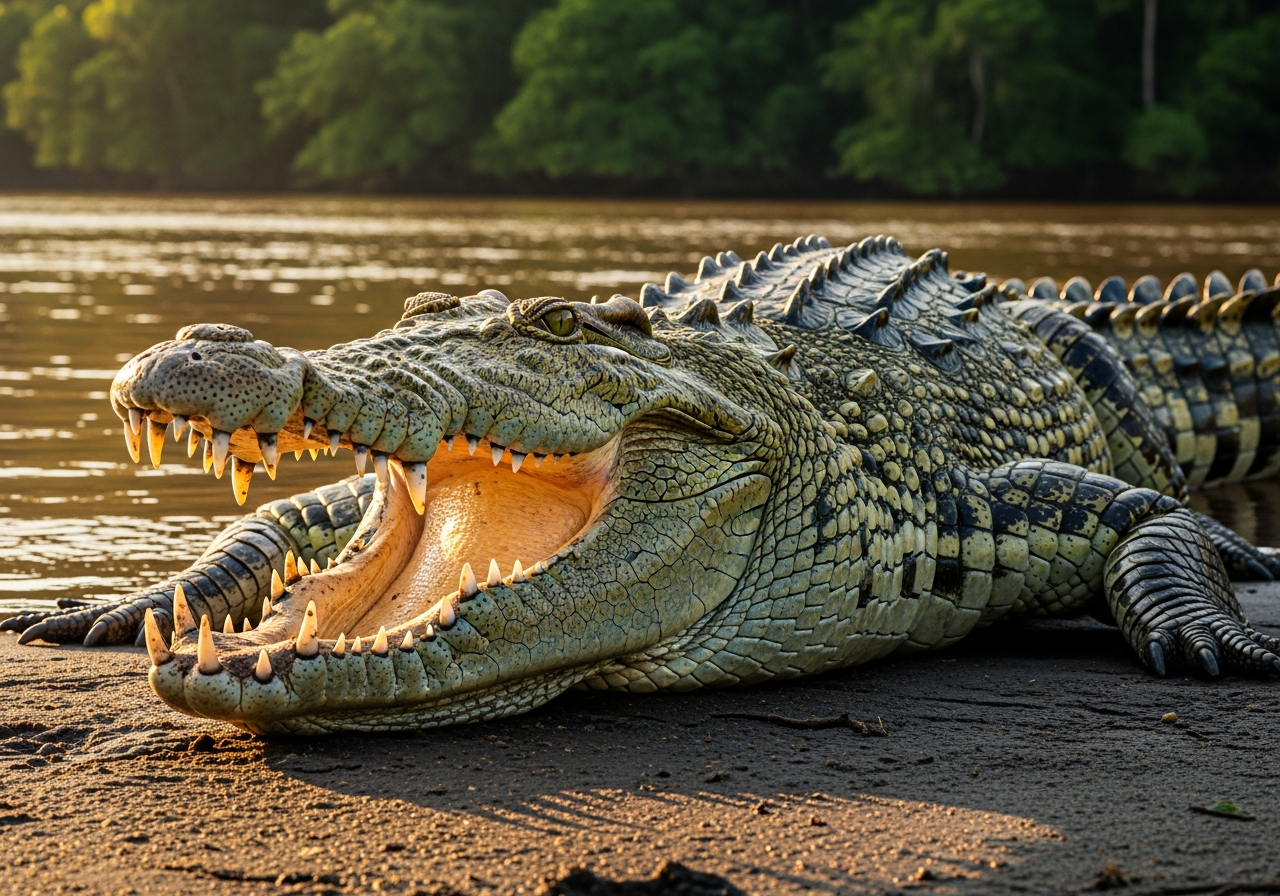
The saltwater crocodile is the largest living reptile, with big males reaching up to 6 m (20 ft) and over 1,000 kg (2,200 lb). Found across the Indo-Pacific from India to northern Australia, it has the strongest bite force ever measured in a living animal and is an ambush predator that can survive in both fresh and salt water. Saltwater crocodiles can live 70 years or more.
Top questions about the Saltwater Crocodile
Saltwater Crocodile facts at a glance
- Weight 1000 kg
- Length 5.5 m
- Top speed 29 km/h
- Lifespan 70 years
| Scientific name | Crocodylus porosus |
|---|---|
| Diet | Carnivore |
| Habitat | Estuaries, mangroves, rivers, coasts |
| Lifespan | 70+ years |
| Length | Up to 6 m (20 ft) |
| Bite force | ~3,700 psi, the strongest measured |
| Conservation status | Least Concern (IUCN) |
| Kingdom | Animalia |
|---|---|
| Phylum | Chordata |
| Class | Reptilia |
| Order | Crocodilia |
| Family | Crocodylidae |
| Genus | Crocodylus |
Where it lives
The saltwater crocodile (Crocodylus porosus) is native to Coasts, rivers, and estuaries from eastern India through Southeast Asia to northern Australia. — recorded across Asia, Oceania in this guide’s range summary.
For occurrence records, see GBIF species search and sources below.
How big is a saltwater crocodile?
An adult saltwater crocodile measures 5.5 m long — about 3.2× the height of an average adult person (1.73 m) — and weighs around 1000 kg, about 14× an average adult’s body weight (70 kg).
Length vs an average adult’s height (to scale)
What is a group of saltwater crocodiles called?
Group name (collective noun)
A group of Saltwater Crocodiles is called a bask. It is also known as a float.
Baby name
A baby Saltwater Crocodile is called a hatchling.
Explore more animal collective nouns and baby animal names .
Behavior and hunting
Saltwater crocodiles are patient ambush predators. They lie almost motionless at the water's edge, then explode forward to seize prey and drag it under in a "death roll." They are highly territorial, and large males defend stretches of river and coast aggressively.
Diet and bite
Salties eat almost anything they can overpower, from fish, crabs, and turtles to large mammals that come to drink. Their bite force is the strongest ever measured in a living animal, but the muscles that open the jaws are weak, which is why a crocodile's mouth can be held shut by hand.
Habitat and range
The saltwater crocodile ranges across the Indo-Pacific, from eastern India and Southeast Asia to northern Australia and the western Pacific. Unusually for a reptile, it tolerates salt water well and can travel long distances along coastlines between river systems.
Conservation
Hunted heavily for their skins in the 20th century, saltwater crocodiles were pushed to low numbers in many areas. Protection and managed populations, especially in Australia, allowed a strong recovery, and the species is now listed as Least Concern overall, though some regional populations remain at risk.
Dig deeper into the Saltwater Crocodile
- Are Saltwater Crocodiles Dangerous?
Are saltwater crocodiles dangerous? Realistic risk, when incidents rise, and safety basics.
- How Long Do Saltwater Crocodiles Live?
Saltwater Crocodile lifespan is typically 70+ years. What shortens or extends life, life stages, and status (Least Concern).
- Saltwater Crocodile: Key Facts
The saltwater crocodile is the largest living reptile, with big males reaching up to 6 m (20 ft) and over 1,000 kg (2,200 lb).
- What Do Saltwater Crocodiles Eat?
What saltwater crocodiles eat: Carnivore, foraging style, and seasonal shifts in Estuaries, mangroves, rivers, coasts.
- Where Do Saltwater Crocodiles Live?
Where saltwater crocodiles live: Estuaries, mangroves, rivers, coasts, native range cues, and human overlap. Status Least Concern.
Explore the Saltwater Crocodile
Compare
Related Reptiles
Collections
Range & geography
Did you know? Saltwater Crocodile facts
- The saltwater crocodile is the largest living reptile, reaching over 6 m.
- It has the strongest measured bite force of any living animal.
- 'Salties' can travel long distances at sea between rivers and islands.
- They are ambush hunters that can launch from the water with explosive speed.
- Crocodiles have changed little in form over many millions of years.
- They are dangerous to humans and treated with great caution in their range.
Diet & feeding
Saltwater crocodiles are opportunistic ambush predators taking fish, crustaceans, birds, and mammals up to the size of buffalo, seizing prey at the water's edge.
Adaptations
- Enormous jaw muscles deliver the most powerful bite force recorded in any animal.
- Eyes, ears, and nostrils on top of the head allow ambush from just below the surface.
- Salt glands let saltwater crocodiles tolerate the sea and travel between coasts.
- Armoured skin and a powerful tail provide protection and explosive lunging power.
Behaviour & ecology
- Saltwater crocodiles ambush prey at the water's edge with a sudden lunge.
- Large males hold and defend territories along rivers and estuaries.
- They use a 'death roll' to subdue and dismember large prey.
- Females guard nests and carry hatchlings gently to the water.
Communication
- Crocodiles bellow, hiss, and produce low-frequency sounds, especially in breeding.
- Head-slaps on the water and posturing assert dominance.
- Hatchlings call to summon the guarding mother.
Habitat & range
Saltwater crocodiles inhabit coastal rivers, estuaries, mangroves, and open sea from India through Southeast Asia to northern Australia, moving between fresh and salt water.
Ecological role
As the apex predator of tropical coastal waterways, the saltwater crocodile regulates prey populations and shapes the ecology of estuarine and riverine systems.
Conservation status of the Saltwater Crocodile
The saltwater crocodile (Crocodylus porosus) is listed as Least Concern on the IUCN Red List. Least Concern (LC) is the IUCN's lowest-risk category, assigned to widespread, abundant species that have been evaluated and found not to be threatened. It does not mean a species faces no pressures — only that it is not currently at risk of extinction.
The saltwater crocodile (Crocodylus porosus) is assessed on the IUCN Red List. Look up on the IUCN Red List .
Frequently asked questions about the Saltwater Crocodile
How big do saltwater crocodiles get?
Saltwater crocodiles are the largest living reptiles. Large males commonly reach 4.5 to 5 m, and exceptional individuals exceed 6 m (20 ft) and weigh over 1,000 kg.
How strong is a saltwater crocodile's bite?
The saltwater crocodile has the strongest bite force ever measured in a living animal, around 3,700 psi. However, the muscles that open its jaws are weak enough to be held shut by hand.
Can saltwater crocodiles live in the ocean?
Yes. Unlike most crocodilians, saltwater crocodiles tolerate salt water and can swim long distances along coastlines, which is how they spread across so many islands.
What do saltwater crocodiles eat?
They are opportunistic carnivores that eat fish, crustaceans, turtles, birds, and mammals. Large adults can take prey as big as water buffalo by ambushing animals at the water's edge.
How fast can a saltwater crocodile move?
In water they can burst to around 29 km/h (18 mph) over short distances. On land they are much slower and rely on surprise rather than chasing prey.
How long do saltwater crocodiles live?
Saltwater crocodiles are long-lived, commonly reaching 70 years and sometimes more in the wild and in captivity.
What is a group of saltwater crocodiles called?
A group of Saltwater Crocodiles is called a bask. It is also known as a float.
What is a baby saltwater crocodile called?
A baby Saltwater Crocodile is called a hatchling.
Sources & references
This guide is compiled and reviewed against established zoological and conservation references. Key sources for the Saltwater Crocodile:
-
IUCN Red List of Threatened Species
Conservation status (Least Concern) reflects the IUCN Red List category for Crocodylus porosus.
-
iNaturalist — observations & photos
Search citizen-science observations and community IDs for Crocodylus porosus. Useful for range checks and recent sightings — not a substitute for formal Red List status.
-
GBIF — occurrence data
Global Biodiversity Information Facility species search for Crocodylus porosus. Explore published occurrence records used in range research.
- Webb, G. et al. (2021). Crocodylus porosus. IUCN Red List of Threatened Species.
Status (Least Concern) and range.
- Webb, G. & Manolis, C. (1989). Crocodiles of Australia. Reed Books.
Biology and behaviour.
- The Reptile Database (reptile-database.org).
Taxonomy and distribution.
-
Global Animal Guide editorial standards
How we research, source, review, and update every guide for accuracy.