Fin Whale
Balaenoptera physalus
Quick answer
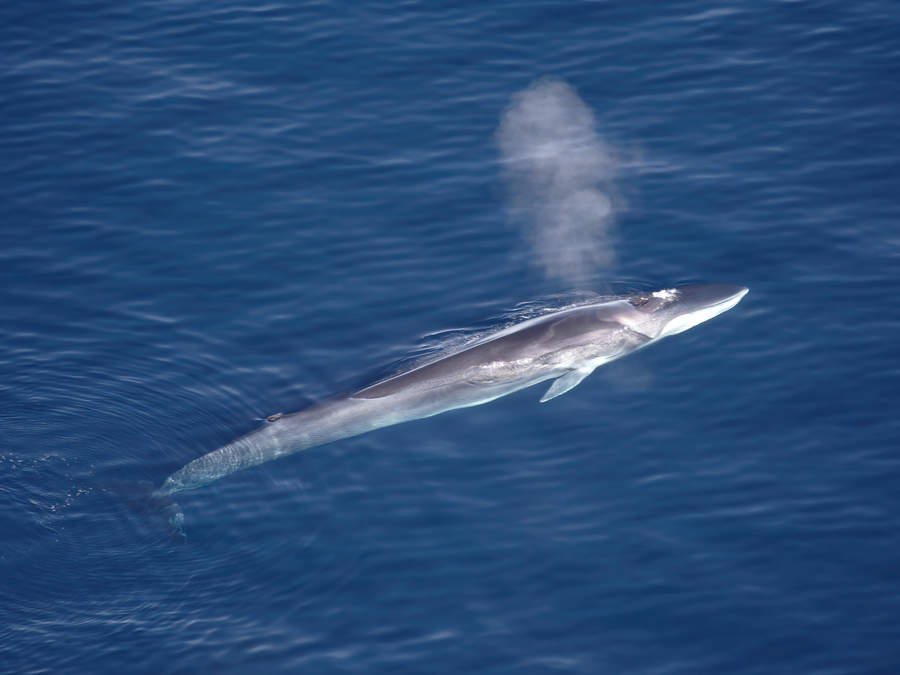
The fin whale is the second-largest animal on Earth after the blue whale, reaching 25 m (82 ft) and 70 tonnes with an asymmetric jaw colouring. A fast baleen whale capable of 40 km/h bursts, it filters krill and small fish and is listed Vulnerable after decades of commercial whaling.
Fin Whale facts at a glance
| Scientific name | Balaenoptera physalus |
|---|---|
| Diet | Carnivore — krill, small fish, and copepods (filter feeder) |
| Habitat | Open oceans worldwide; migrates between feeding and breeding areas |
| Lifespan | 80–90 years |
| Weight | Up to 70,000 kg (154,000 lb) |
| Top speed | Up to 40 km/h (25 mph); called the 'greyhound of the sea' |
| Conservation status | Vulnerable (IUCN) |
| Kingdom | Animalia |
|---|---|
| Phylum | Chordata |
| Class | Mammalia |
| Order | Artiodactyla |
| Family | Balaenopteridae |
| Genus | Balaenoptera |
Where it lives
All major oceans from polar feeding grounds to temperate and tropical breeding areas; most abundant in the North Atlantic and Southern Ocean.
What is a group of fin whales called?
Group name (collective noun)
A group of Fin Whales is called a pod.
Baby name
A baby Fin Whale is called a calf.
Explore more animal collective nouns and baby animal names .
Filter feeding at scale
Fin whales gulp enormous mouthfuls of water and strain krill and fish through baleen plates — keratin fringes hanging from the upper jaw. They lunge-feed in productive upwellings and may cooperate loosely to concentrate prey.
Asymmetric coloration
The right lower jaw is white, the left dark — a unique asymmetry whose function is debated, possibly related to corralling prey while swimming on their side. A prominent dorsal fin set far back gives a sleek profile unlike blue whales.
Migration and song
Fin whales migrate between high-latitude feeding grounds and lower-latitude breeding areas. Their low-frequency vocalisations carry hundreds of kilometres underwater and may help navigation or mate finding across ocean basins.
Recovery from whaling
Industrial whaling decimated fin whales in the 20th century. Listed Vulnerable, populations are increasing in the North Atlantic and Southern Ocean where hunting has largely ceased, but ship strikes and entanglement remain significant threats.
Dig deeper into the Fin Whale
- Are Fin Whale Endangered
Dig deeper into fin whale — are fin whale endangered.
- Fin Whale Facts 5
Dig deeper into fin whale — fin whale facts 5.
- How Long do Fin Whale Live?
Dig deeper into fin whale — how long do fin whale live.
- What do Fin Whale Eat
Dig deeper into fin whale — what do fin whale eat.
- Where do Fin Whale Live?
Dig deeper into fin whale — where do fin whale live.
Explore the Fin Whale
Compare
Collections
Did you know? Fin Whale facts
- The fin whale is the second-largest animal on Earth after the blue whale, reaching 25 m (82 ft) and 70 tonnes with an asymmetric jaw colouring.
- Up to about 25 m and 70 tonnes — second only to the blue whale among all animals.
- Blue whales are larger with a mottled blue-grey body and small dorsal fin. Fin whales are slightly smaller, faster, with a swept-back dorsal fin and asymmetric jaw.
- The white right lower jaw may help fin whales see prey when rolling to feed on their right side — though the exact reason is not fully confirmed.
- Commercial whaling is banned internationally, though Iceland and Japan have taken fin whales in limited numbers. Most populations are recovering under protection.
- Conservation: Vulnerable (IUCN).
Diet & feeding
Fin Whale feeds primarily as a carnivore — krill, small fish, and copepods (filter feeder). Fin whales gulp enormous mouthfuls of water and strain krill and fish through baleen plates — keratin fringes hanging from the upper jaw. They lunge-feed in productive upwellings and may cooperate loosely to concentrate prey.
Adaptations
- Fin whales gulp enormous mouthfuls of water and strain krill and fish through baleen plates — keratin fringes hanging from the upper jaw. They lunge-feed in productive upwellings and may cooperate loosely to concentrate prey.
- The right lower jaw is white, the left dark — a unique asymmetry whose function is debated, possibly related to corralling prey while swimming on their side. A prominent dorsal fin set far back gives a sleek profile unlike blue whales.
Behaviour & ecology
- Fin whales gulp enormous mouthfuls of water and strain krill and fish through baleen plates — keratin fringes hanging from the upper jaw. They lunge-feed in productive upwellings and may cooperate loosely to concentrate prey.
- The right lower jaw is white, the left dark — a unique asymmetry whose function is debated, possibly related to corralling prey while swimming on their side. A prominent dorsal fin set far back gives a sleek profile unlike blue whales.
- Fin whales migrate between high-latitude feeding grounds and lower-latitude breeding areas. Their low-frequency vocalisations carry hundreds of kilometres underwater and may help navigation or mate finding across ocean basins.
Communication
- Fin Whale uses scent, posture, and vocal signals to mark territory and coordinate social behaviour.
- Communication intensity often peaks during breeding seasons and territorial disputes.
Habitat & range
Open oceans worldwide; migrates between feeding and breeding areas
Ecological role
Fin Whale acts as a predator that helps regulate prey populations and maintain balance in open oceans worldwide; migrates between feeding and breeding areas.
Frequently asked questions about the Fin Whale
How big is a fin whale?
Up to about 25 m and 70 tonnes — second only to the blue whale among all animals.
Fin whale vs blue whale?
Blue whales are larger with a mottled blue-grey body and small dorsal fin. Fin whales are slightly smaller, faster, with a swept-back dorsal fin and asymmetric jaw.
Why is the jaw two colours?
The white right lower jaw may help fin whales see prey when rolling to feed on their right side — though the exact reason is not fully confirmed.
Are fin whales still hunted?
Commercial whaling is banned internationally, though Iceland and Japan have taken fin whales in limited numbers. Most populations are recovering under protection.
What do fin whales eat?
Mainly krill in cold waters and small schooling fish such as herring and sand lance, filtered through baleen.
What is a group of fin whales called?
A group of Fin Whales is called a pod.
What is a baby fin whale called?
A baby Fin Whale is called a calf.
Sources & references
This guide is compiled and reviewed against established zoological and conservation references. Key sources for the Fin Whale:
-
IUCN Red List of Threatened Species
Conservation status (Vulnerable) reflects the IUCN Red List category for Balaenoptera physalus.
- IUCN Red List — Balaenoptera physalus.
Conservation status (Vulnerable) and population trends.
- Animal Diversity Web — Balaenoptera physalus. University of Michigan Museum of Zoology.
Life history, morphology, and range.
- Wikipedia — Fin Whale.
General taxonomy and overview (cross-check primary sources).
-
Global Animal Guide editorial standards
How we research, source, review, and update every guide for accuracy.