Quick answer
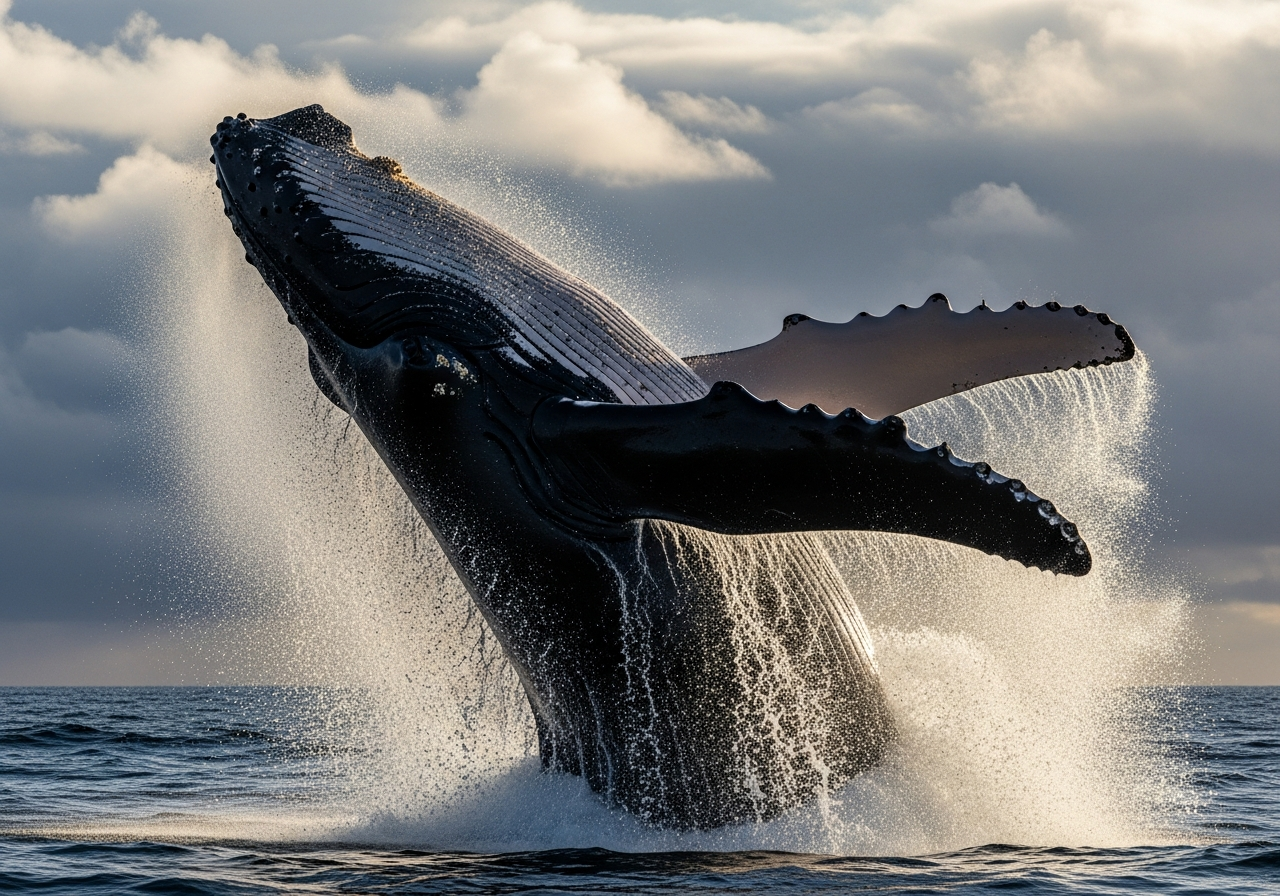
The humpback whale is a large baleen whale found in oceans worldwide, famous for its complex, haunting songs, spectacular breaching, and enormous wing-like flippers. Humpbacks can grow to 15 m (49 ft), migrate thousands of miles between feeding and breeding grounds, and live up to 80 years or more. Once hunted to the brink, they are now a conservation success story listed as Least Concern.
Top questions about the Humpback Whale
Also available in Español (Ballena jorobada)
Humpback Whale facts at a glance
- Weight 30000 kg
- Length 15 m
- Top speed 27 km/h
- Lifespan 80 years
| Scientific name | Megaptera novaeangliae |
|---|---|
| Diet | Carnivore (krill and small fish) |
| Habitat | Oceans worldwide |
| Lifespan | Up to 80–90 years |
| Weight | 25,000–30,000 kg (28–33 tons) |
| Top speed | Up to 27 km/h (17 mph) |
| Conservation status | Least Concern (IUCN) |
| Kingdom | Animalia |
|---|---|
| Phylum | Chordata |
| Class | Mammalia |
| Order | Artiodactyla |
| Family | Balaenopteridae |
| Genus | Megaptera |
Where it lives
The humpback whale (Megaptera novaeangliae) is native to Every major ocean, migrating between polar feeding grounds and tropical breeding waters. — recorded across Oceans in this guide’s range summary.
For occurrence records, see GBIF species search and sources below.
How big is a humpback whale?
An adult humpback whale measures 15 m long — about 8.7× the height of an average adult person (1.73 m) — and weighs around 30000 kg, about 429× an average adult’s body weight (70 kg).
Length vs an average adult’s height (to scale)
What is a group of humpback whales called?
Group name (collective noun)
A group of Humpback Whales is called a pod.
Baby name
A baby Humpback Whale is called a calf.
Explore more animal collective nouns and baby animal names .
The whale that sings
Male humpbacks produce some of the longest and most complex songs in the animal kingdom, sequences of moans, cries, and whistles that can last 20 minutes and be repeated for hours. All the males in a population sing the same evolving song, which gradually changes from year to year, likely as part of breeding behavior.
Bubble-net feeding
Humpbacks are baleen whales that filter krill and small fish from the water. Groups use a remarkable cooperative technique called bubble-net feeding, blowing a spiraling curtain of bubbles to herd prey into a tight ball before lunging up through the middle with mouths wide open.
Migration and acrobatics
Humpbacks undertake some of the longest migrations of any mammal, traveling thousands of miles between cold, food-rich feeding grounds and warm breeding waters. They are famous for breaching, hurling their huge bodies out of the water, and for slapping the surface with their long flippers and tail.
Conservation
Commercial whaling drove humpbacks to the edge of extinction in the 20th century. Since an international hunting ban, most populations have rebounded strongly, and the species is now listed as Least Concern, a landmark conservation success. Ship strikes, entanglement, and noise pollution remain ongoing threats.
Dig deeper into the Humpback Whale
- How Big Is A Humpback Whale?
Humpback Whale size and weight: typical 25,000–30,000 kg (28–33 tons), dimorphism, and growth.
- How Long Do Humpback Whales Live?
Humpback Whale lifespan is typically Up to 80–90 years. What shortens or extends life, life stages, and status (Least Concern).
- Humpback Whale: Key Facts
The humpback whale is a large baleen whale found in oceans worldwide, famous for its complex, haunting songs, spectacular breaching, and enormous…
- What Do Humpback Whales Eat?
What humpback whales eat: Carnivore (krill and small fish), foraging style, and seasonal shifts in Oceans worldwide.
- Where Do Humpback Whales Live?
Where humpback whales live: Oceans worldwide, native range cues, and human overlap. Status Least Concern.
Explore the Humpback Whale
Compare
Collections
Range & geography
Did you know? Humpback Whale facts
- Male humpbacks sing long, complex songs that can last over 20 minutes.
- Whole populations share a song that evolves and changes over time.
- Humpbacks use 'bubble nets' to corral fish into tight balls before feeding.
- They undertake some of the longest migrations of any mammal.
- Their huge pectoral fins can be nearly a third of their body length.
- Once heavily whaled, humpbacks have recovered strongly in many regions.
Diet & feeding
Humpbacks feed on krill and small schooling fish such as herring and sand lance, using cooperative bubble-net feeding to concentrate prey before lunging.
Adaptations
- Exceptionally long pectoral fins give agility for tight feeding manoeuvres.
- Baleen filters small fish and krill from large mouthfuls of water.
- A heavily pleated throat expands to engulf concentrated prey.
- Thick blubber fuels long migrations between feeding and breeding grounds.
Behaviour & ecology
- Humpbacks cooperate to blow spiralling bubble nets that trap schooling fish.
- They migrate thousands of kilometres between cold feeding and warm breeding waters.
- Males sing structured songs on the breeding grounds.
- Breaching, lobtailing, and fin-slapping are common surface behaviours.
Communication
- Long, evolving songs are sung mainly by males during breeding season.
- Social sounds and surface slaps convey information at closer range.
- Song culture spreads between populations across ocean basins.
Habitat & range
Humpback whales occur in all major oceans, feeding at high latitudes in summer and migrating to tropical and subtropical waters to breed and calve in winter.
Ecological role
As migratory baleen whales, humpbacks transfer nutrients between feeding and breeding regions and help structure the small-fish and krill communities they exploit.
Conservation status of the Humpback Whale
The humpback whale (Megaptera novaeangliae) is listed as Least Concern on the IUCN Red List. Least Concern (LC) is the IUCN's lowest-risk category, assigned to widespread, abundant species that have been evaluated and found not to be threatened. It does not mean a species faces no pressures — only that it is not currently at risk of extinction.
The humpback whale (Megaptera novaeangliae) is assessed on the IUCN Red List. Look up on the IUCN Red List .
Frequently asked questions about the Humpback Whale
Why do humpback whales sing?
Mainly male humpbacks sing, most often on breeding grounds, so the songs are thought to play a role in attracting mates or competing with other males. All males in a population share the same slowly changing song.
What do humpback whales eat?
Humpbacks are baleen whales that feed on tiny krill and small schooling fish, filtering huge mouthfuls of water through their baleen plates, sometimes using cooperative bubble-net feeding.
How big do humpback whales get?
Humpback whales typically grow to about 14 to 15 m (46 to 49 ft) long and weigh around 30,000 kg (33 tons), with females slightly larger than males.
Why do humpback whales breach?
Humpbacks breach, leaping out of the water, for reasons that may include communication, dislodging parasites, or play. The huge splash can be seen and heard from far away.
Are humpback whales endangered?
No longer overall. After near-extinction from whaling, most humpback populations have recovered well and the species is now Least Concern, though ship strikes and entanglement remain threats.
What is a group of humpback whales called?
A group of Humpback Whales is called a pod.
What is a baby humpback whale called?
A baby Humpback Whale is called a calf.
Sources & references
This guide is compiled and reviewed against established zoological and conservation references. Key sources for the Humpback Whale:
-
IUCN Red List of Threatened Species
Conservation status (Least Concern) reflects the IUCN Red List category for Megaptera novaeangliae.
-
iNaturalist — observations & photos
Search citizen-science observations and community IDs for Megaptera novaeangliae. Useful for range checks and recent sightings — not a substitute for formal Red List status.
-
GBIF — occurrence data
Global Biodiversity Information Facility species search for Megaptera novaeangliae. Explore published occurrence records used in range research.
- Cooke, J. G. (2018). Megaptera novaeangliae. IUCN Red List of Threatened Species.
Status (Least Concern) and recovery.
- Animal Diversity Web — Megaptera novaeangliae. University of Michigan Museum of Zoology.
Life history, morphology, and range.
- Nowak, R. M. (1999). Walker's Mammals of the World (6th ed.). Johns Hopkins University Press.
Biology and migration.
-
Global Animal Guide editorial standards
How we research, source, review, and update every guide for accuracy.