What Is the Smallest Animal in the World?
The smallest animals depend on the category — myxozoans and other microscopic animals, Paedocypris fish, bee hummingbirds, and tiny frogs compete for titles.
Global Animal Guide · July 10, 2026
Quick answer
There is no single 'smallest animal' — it depends on the group. Among vertebrates, tiny frogs (e.g. Paedophryne) and fish (Paedocypris) are contenders at under 8–10 mm. The bee hummingbird is the smallest bird. Many invertebrates are microscopic. Always check whether a claim means smallest vertebrate, mammal, bird, or animal overall.
Last updated: July 2026.
Why headlines disagree
Media lists mix body length, mass, and taxonomic scope. A “smallest animal” list that only includes mammals ignores insects and worms that are orders of magnitude smaller. Ask three questions of any claim: smallest by what measure, within what group, and at what life stage?
Length and mass rank animals differently. A seahorse is long relative to its weight; a shrew is compact and dense. Two animals of identical length can differ several-fold in mass, so a “smallest” list built on millimetres will not match one built on grams. Records also drift as taxonomists split species and as better specimens turn up, which is why careful sources hedge with “among the smallest” rather than naming one winner.
Life stage matters too. Almost every animal is microscopic as a fertilised egg, and many are vanishingly small as larvae. The convention is to compare adult body size, otherwise a newly hatched blue whale larva-equivalent argument would make the category meaningless. Where adults vary by sex, the smaller sex is usually quoted — in many parasitic invertebrates, males are a fraction of the female’s size.
The microscopic winners: animals you cannot see
If the question is “smallest animal overall, no qualifiers”, the answer lives under a microscope. Myxozoans — parasitic relatives of jellyfish and other cnidarians — have been reduced by parasitism to a few cells, spending most of their lives as spores. They are genuine animals by ancestry, but they have shed nearly everything we associate with animal bodies: no gut, no nerves, no muscles in the usual sense.
Free-living microscopic animals are more familiar. Rotifers, tardigrades — the water bear is one — and nematodes all complete a full animal life cycle at sub-millimetre scale, with a mouth, a gut, muscle, and a nervous system compressed into a body smaller than a grain of salt. Tardigrades manage this while also surviving desiccation, freezing, and vacuum.
The mechanism behind extreme miniaturisation is cell-count reduction rather than cell shrinking. Cells cannot fall much below a certain size and still hold a nucleus and the machinery of life, so tiny animals build with fewer cells, not smaller ones. Some rotifers are eutelic — every adult has a fixed, species-typical number of cells. That fixes an eventual floor: keep shrinking and there are simply not enough cells left to make a brain, a gut, and a gonad.
The smallest vertebrates: frogs and fish in a race
Vertebrates hit a wall much earlier, because a backbone, a skull, a heart, and paired eyes take space. The record has bounced between tiny frogs and tiny fish for years. Paedophryne frogs from New Guinea and Paedocypris fish from Southeast Asian peat swamps are the usual contenders, both mature at well under a centimetre — small enough to sit comfortably on a fingernail.
Both examples are paedomorphic: adults keep juvenile proportions. Their skulls are large relative to the body, digits and skull bones are reduced or lost, and the sensory system is simplified. The axolotl shows the same developmental trick at a much larger size, retaining larval gills for life, which suggests miniaturisation and paedomorphosis are two outcomes of the same lever on developmental timing.
Habitat explains the pattern. These frogs live in leaf litter and these fish in acidic blackwater swamps — cluttered, structurally complex places full of prey items too small for anything larger to bother with. Being tiny is not a curiosity here; it is the entry ticket to an unoccupied niche. The trade-off is severe. A body that small dries out or overheats within minutes, so both groups are effectively confined to permanently damp microhabitats and cannot disperse across dry ground.
Why mammals and birds cannot get much smaller
Warm-blooded animals face a hard physical floor that reptiles and amphibians do not. Heat is lost through the body surface but generated by the body volume, and as an animal shrinks, its surface area grows relative to its volume. Halve the length and you lose heat far faster per gram of tissue than before. Below roughly two grams, a mammal or bird must eat almost continuously to stay warm.
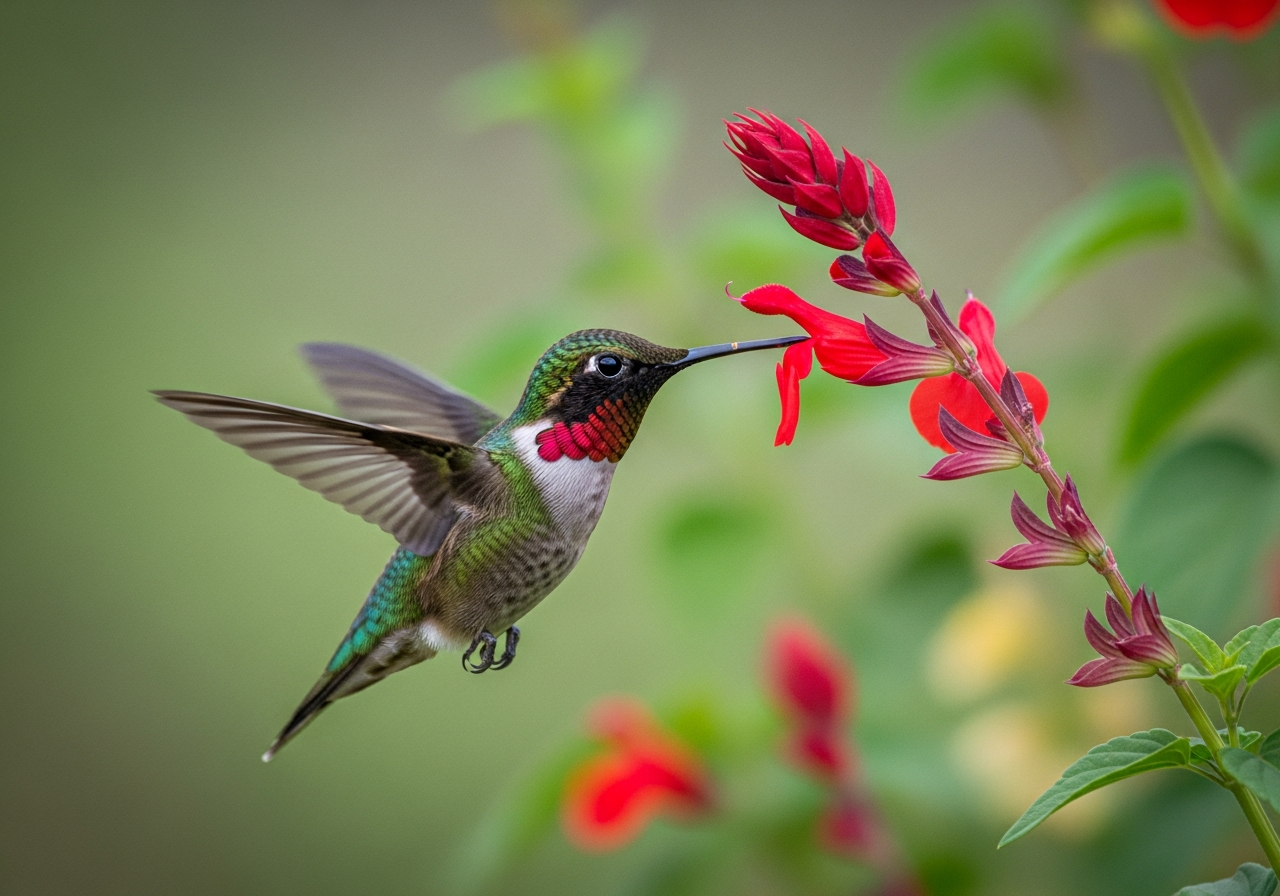
That is why the smallest mammals and birds live like they are permanently late. The Etruscan shrew and the bumblebee bat sit at the mammalian limit; the bee hummingbird of Cuba holds the avian record at around 5–6 cm. Their hearts beat hundreds of times a minute, and shrews in general — see the shrew profile — must eat close to their own body weight daily or starve within hours. Many small bat and hummingbird species escape the arithmetic by entering nightly torpor, letting body temperature drop to save fuel until conditions improve.
Compare that with an equally small frog or fish. A poison-dart-frog or a guppy does not pay a heating bill at all, because it takes its temperature from the surroundings. That single difference is why cold-blooded vertebrates hold the vertebrate size record and warm-blooded ones never will.
Small versions of famously large groups
The size range within a group is often more surprising than the overall record. Sharks are the classic case: the whale-shark reaches bus-like proportions, while the dwarf lanternshark could rest in a human hand — the same body plan spanning two orders of magnitude. Cephalopods run from the giant-pacific-octopus down to pygmy species barely larger than a thumbnail.
Insects push the lower boundary of complex nervous systems. Parasitoid fairy wasps are smaller than some single-celled protists, and to fit a working brain into that space, their neurons are shrunk and, in some species, adults lose most of the nuclei in their neurons. This is a striking demonstration of the cell-count floor: the animal did not find a way around the limit so much as sacrifice components to squeeze past it.
The bumblebee and the ant illustrate the practical ceiling on smallness in flying and walking insects. Below a certain size, air behaves like syrup, and the tiniest wasps row through it with bristle-fringed wings rather than beating solid membranes.
What extreme smallness costs
Miniaturisation is not simply a scaled-down version of being big. Water dominates. At millimetre scale, surface tension is strong enough to trap an insect in a droplet, and a film of water clinging to the body is a real burden. Tiny animals dehydrate quickly, which locks most of them into moist or aquatic habitats.
Metabolic rate per gram climbs steeply with smallness, so tiny endotherms live fast and briefly. Reproduction is constrained too: small bodies hold few eggs, and clutch sizes drop. Some of the smallest frogs lay only a couple of eggs at a time and skip the tadpole stage entirely, hatching directly into miniature adults because there is no room for a larval phase.
The compensation is opportunity. Small animals exploit resources nothing else can reach — the water film on a moss leaf, the interior of a single ant, the gaps between grains of sand. That is a vast, largely uncontested world, and it is why the great majority of animal species are small ones. The famous large animals are the exceptions.
Related reading
Sources
Frequently asked questions
What is the smallest mammal?
The Etruscan shrew and bumblebee bat are among the lightest/smallest living mammals.
What is the smallest bird?
The bee hummingbird of Cuba — about 5–6 cm long.
What is the smallest dog breed?
Chihuahuas are often cited among the smallest breeds by weight — see our breed guides.