Whale Shark
Rhincodon typus
Image sourcing: see credits & licences
Quick answer
The whale shark (Rhincodon typus) is the largest fish in the world, a gentle filter-feeder that swims slowly through warm open and coastal oceans. It can reach around 12 m long, and sometimes up to 18 m, weighing as much as 19,000 kg, yet it feeds almost entirely on tiny plankton and small fish. Cruising at only about 5 km/h, it may live 70 to 100 years. The species is listed as Endangered.
Whale Shark facts at a glance
| Scientific name | Rhincodon typus |
|---|---|
| Diet | Filter feeder (plankton, small fish) |
| Habitat | Warm open and coastal oceans |
| Lifespan | Estimated 70–100 years |
| Length | Up to about 18 m (59 ft) |
| Weight | Up to roughly 19,000 kg (42,000 lb) |
| Conservation status | Endangered (IUCN) |
| Kingdom | Animalia |
|---|---|
| Phylum | Chordata |
| Class | Chondrichthyes |
| Order | Orectolobiformes |
| Family | Rhincodontidae |
| Genus | Rhincodon |
Where it lives
Warm tropical and subtropical seas around the world, often at coastal feeding hotspots.
What is a group of whale sharks called?
Group name (collective noun)
A group of Whale Sharks is called a shiver. It is also known as a school.
Baby name
A baby Whale Shark is called a pup.
Explore more animal collective nouns and baby animal names .
The largest fish in the ocean
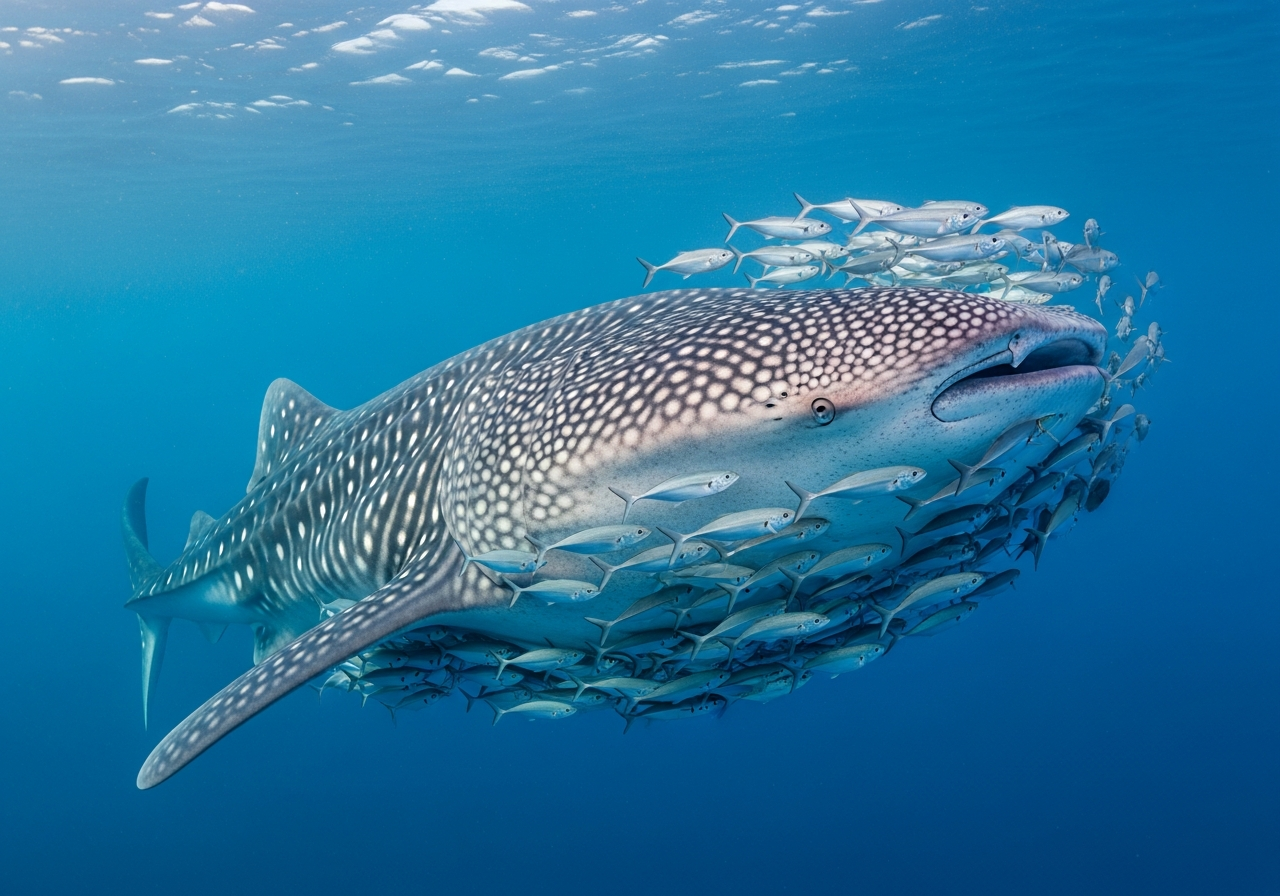
The whale shark is a true shark, not a whale, and the biggest fish alive today. Typical adults measure around 12 m, but the largest confirmed individuals approach 18 m and weigh up to roughly 19,000 kg. Its broad, flattened head and enormous mouth, which can stretch well over a metre wide, sit right at the front of the body. Each animal carries a unique pattern of pale spots and stripes on grey skin, allowing researchers to identify individuals like a fingerprint.
Filter feeding on plankton
Despite its size, the whale shark eats some of the smallest prey in the sea. It is a filter feeder, taking in plankton, fish eggs, krill, and small fish by opening its huge mouth as it swims or by hanging vertically to suck in dense patches of food. Water passes out through the gills while fine sieve-like pads trap the food. A feeding whale shark can filter thousands of litres of water an hour, and it has no need for the large teeth of a hunting shark.
How it swims and moves
Whale sharks are slow, deliberate swimmers, cruising at only about 5 km/h by sweeping the whole body from side to side. They are highly migratory, crossing entire ocean basins to reach seasonal feeding grounds where plankton blooms. Individuals dive to depths of over 1,000 m yet spend much time near the surface where food is richest. Their unhurried movement and surface feeding make them one of the easiest large sharks for divers to swim alongside.
Range and gatherings
Whale sharks live in warm open and coastal oceans around the tropics and subtropics, usually where surface temperatures stay above about 21 degrees Celsius. At certain times of year they gather in large numbers at predictable sites, such as off Western Australia, the Yucatan, and the Philippines, drawn by seasonal food. These aggregations are among the great wildlife spectacles of the sea. Outside such gatherings they tend to roam alone across vast stretches of ocean.
Life cycle and lifespan
Whale sharks are slow to mature, thought to take around 25 to 30 years to reach breeding age, and may live 70 to 100 years. Females give birth to live young, carrying hundreds of embryos that hatch from eggs inside the body and are born as small pups. Very few newborns are ever seen, and much of the species' early life remains a mystery to scientists. This slow, late reproduction makes the population very sensitive to losses.
Why it is endangered
The whale shark is listed as Endangered by the IUCN, with numbers falling over recent decades. It is threatened by fishing for its fins and meat, by ship strikes as it feeds near the surface, and by entanglement in nets. Its slow growth and late breeding mean populations recover only very slowly once reduced. Regulated tourism and international trade protection now play a growing part in its conservation.
Dig deeper into the Whale Shark
- Are Whale Shark Endangered
Dig deeper into whale shark — are whale shark endangered.
- How Long do Whale Shark Live?
Dig deeper into whale shark — how long do whale shark live.
- Whale Shark Guide 5
Dig deeper into whale shark — whale shark guide 5.
- What do Whale Shark Eat
Dig deeper into whale shark — what do whale shark eat.
- Where do Whale Shark Live?
Dig deeper into whale shark — where do whale shark live.
Explore the Whale Shark
Compare
Related Fishs
Collections
Range & geography
Did you know? Whale Shark facts
- The whale shark is the largest fish in the world, reaching up to about 18 m.
- Despite its size, it feeds on tiny plankton by filter-feeding.
- Each whale shark has a unique pattern of spots, used to identify individuals.
- They are gentle and harmless to humans, often allowing divers to swim alongside.
- Whale sharks gather in large numbers where plankton or fish spawn is abundant.
- They are endangered, threatened by fishing and ship strikes.
Diet & feeding
Whale sharks filter-feed on plankton, krill, fish eggs, and small fish, straining prey from large volumes of water through specialised gill pads.
Adaptations
- Specialised filter pads strain plankton and small fish from huge volumes of water. (Compagno 2001)
- An enormous mouth and gill apparatus enable efficient filter-feeding.
- A patterned skin provides camouflage and individual identification.
- A large, slow-moving body suits long migrations between feeding hotspots.
Behaviour & ecology
- Whale sharks filter-feed at or near the surface, sometimes feeding vertically.
- They aggregate seasonally at sites of high plankton or fish-spawn density.
- They undertake long-distance migrations across ocean basins.
- Generally solitary, they tolerate one another at rich feeding sites.
Communication
- Whale sharks are not known for vocal communication.
- Aggregations are driven by shared food cues rather than social signalling.
- They rely on keen senses to detect plankton blooms and spawning events.
Habitat & range
Whale sharks roam warm tropical and temperate oceans worldwide, frequenting coastal feeding hotspots and open water, often near the surface.
Ecological role
As the ocean's largest filter-feeder, the whale shark links plankton production to the broader food web and is a flagship for open-ocean conservation.
Conservation status of the Whale Shark
Endangered (EN) means a species faces a very high risk of extinction in the wild. Populations are usually declining sharply due to habitat loss, hunting, disease, or climate pressure. It sits one level below Critically Endangered on the IUCN Red List.
The whale shark (Rhincodon typus) is assessed on the IUCN Red List. Look up on the IUCN Red List .
Frequently asked questions about the Whale Shark
How big is a whale shark?
Whale sharks typically reach around 12 m long, with the largest confirmed individuals approaching 18 m. They can weigh as much as roughly 19,000 kg, making them the largest fish in the world.
Is a whale shark a whale or a shark?
It is a shark, and therefore a fish, not a whale. It gets its name from its whale-like size and its filter-feeding habit, but like all sharks it breathes through gills and swims using its tail.
Are whale sharks dangerous to humans?
No, whale sharks are harmless to people. They are gentle filter-feeders that eat tiny plankton and small fish, and they let divers swim close by. Their teeth are tiny and play no part in feeding.
What do whale sharks eat?
Whale sharks are filter feeders that eat plankton, krill, fish eggs, and small fish. They open their huge mouths while swimming to strain food from the water through sieve-like pads in front of the gills.
How long do whale sharks live?
Whale sharks are estimated to live between 70 and 100 years. They grow slowly and may not reach breeding age until around 25 to 30 years old.
Why are whale sharks endangered?
Whale sharks are Endangered because of fishing for their fins and meat, ship strikes, and net entanglement. Their slow growth and late breeding mean populations recover very slowly once numbers fall.
What is a group of whale sharks called?
A group of Whale Sharks is called a shiver. It is also known as a school.
What is a baby whale shark called?
A baby Whale Shark is called a pup.
Sources & references
This guide is compiled and reviewed against established zoological and conservation references. Key sources for the Whale Shark:
-
IUCN Red List of Threatened Species
Conservation status (Endangered) reflects the IUCN Red List category for Rhincodon typus.
- Pierce, S. J. & Norman, B. (2016). Rhincodon typus. IUCN Red List of Threatened Species.
Status (Endangered) and threats.
- Compagno, L. J. V. (2001). Sharks of the World. FAO Species Catalogue for Fishery Purposes.
Taxonomy and feeding biology.
- Froese, R. & Pauly, D. (eds.). FishBase — Rhincodon typus.
Size, distribution, and biology.
-
Global Animal Guide editorial standards
How we research, source, review, and update every guide for accuracy.