Image sourcing: see credits & licences
Quick answer
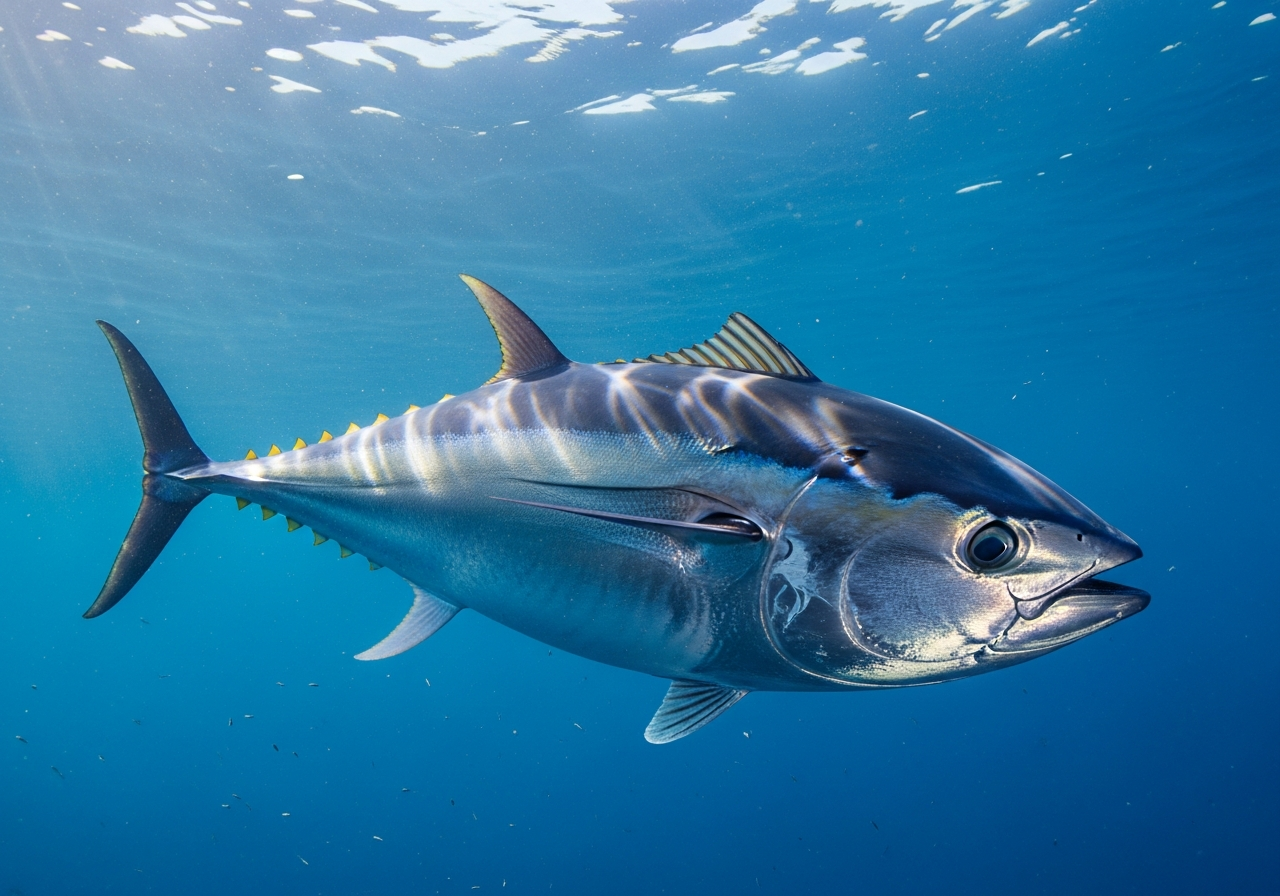
The Atlantic bluefin tuna (Thunnus thynnus) is a powerful, warm-blooded fish built for speed, reaching about 3 m (10 ft) long and up to 450 kg (990 lb). It swims across the open Atlantic and Mediterranean at bursts of up to 70 km/h (43 mph), hunting fish and squid. Bluefin are among the longest-lived tuna, surviving 35 to 50 years. The IUCN lists the species as Least Concern.
Top questions about the Atlantic Bluefin Tuna
Atlantic Bluefin Tuna facts at a glance
- Weight 450 kg
- Length 3 m
- Top speed 70 km/h
- Lifespan 45 years
| Scientific name | Thunnus thynnus |
|---|---|
| Diet | Carnivore (fish and squid) |
| Habitat | Open Atlantic Ocean and Mediterranean Sea |
| Lifespan | 35–50 years |
| Length | 2–3 m (6.5–10 ft) |
| Top speed | Up to 70 km/h (43 mph) |
| Conservation status | Least Concern (IUCN) |
| Kingdom | Animalia |
|---|---|
| Phylum | Chordata |
| Class | Actinopterygii |
| Order | Scombriformes |
| Family | Scombridae |
| Genus | Thunnus |
Where it lives
The atlantic bluefin tuna (Thunnus thynnus) is native to Open waters of the Atlantic Ocean and Mediterranean Sea, migrating between cold feeding grounds and warm spawning areas. — recorded across Oceans in this guide’s range summary.
For occurrence records, see GBIF species search and sources below.
How big is a atlantic bluefin tuna?
An adult atlantic bluefin tuna measures 3 m long — about 1.7× the height of an average adult person (1.73 m) — and weighs around 450 kg, about 6.4× an average adult’s body weight (70 kg).
Length vs an average adult’s height (to scale)
What is a group of atlantic bluefin tunas called?
Group name (collective noun)
A group of Atlantic Bluefin Tunas is called a school. It is also known as a shoal or a fever.
Baby name
A baby Atlantic Bluefin Tuna is called a fry.
Explore more animal collective nouns and baby animal names .
Size and body
The Atlantic bluefin is the largest of all tuna, typically 2 to 3 m (6.5 to 10 ft) long and weighing up to around 450 kg (990 lb). Its torpedo-shaped body is metallic blue above and silvery below, tapering to a stiff, crescent-shaped tail built for thrust. Fins fold into grooves along the body to cut drag, and a row of small finlets runs down the tail to smooth the flow of water. Every part of its shape is tuned for fast, sustained swimming.
A warm-blooded fish
Unlike almost all other fish, bluefin tuna are partly warm-blooded, keeping their muscles, eyes, and brain warmer than the surrounding sea. A special network of blood vessels acts as a heat exchanger, trapping warmth generated by their swimming muscles. This gives them the power to hunt efficiently in cold northern waters that would slow a cold-blooded fish. It is one of the key adaptations behind their remarkable speed and endurance.
Speed and swimming
Bluefin tuna are among the fastest fish in the ocean, capable of swimming in bursts of up to 70 km/h (43 mph). They swim almost constantly, driving themselves forward with a stiff, powerful tail while the rest of the body stays rigid. This continuous motion also pushes water over their gills, so they must keep moving to breathe. Their stamina lets them migrate thousands of kilometres across the Atlantic each year.
Hunting and diet
Bluefin are fast, opportunistic predators that hunt schooling fish such as herring, mackerel, and anchovies, along with squid and crustaceans. They often hunt in groups, using their speed to chase down and pick off prey from tightly packed shoals. Young bluefin feed lower down the food chain, while large adults take bigger, faster fish. Their excellent eyesight helps them track prey in the open water.
Migration and lifespan
Atlantic bluefin are long-distance travellers that cross the ocean between feeding grounds and warm spawning areas such as the Gulf of Mexico and the Mediterranean Sea. They are also long-lived for a fish, reaching ages of 35 to 50 years. Individuals may repeat the same vast migratory loops year after year, guided partly by water temperature. Tagging studies have tracked single fish swimming back and forth across the entire Atlantic.
Fishing and conservation
The Atlantic bluefin is one of the most valuable fish in the world, prized for sushi and sashimi, and heavy fishing once pushed some populations to worrying lows. Tighter catch quotas and international management have since allowed numbers to recover, and the IUCN now lists the species as Least Concern. Careful monitoring remains important, because demand is high and the fish is slow to mature. Well-managed fisheries are central to keeping the population stable.
Dig deeper into the Atlantic Bluefin Tuna
- Are Atlantic Bluefin Tunas Dangerous?
Are atlantic bluefin tunas dangerous? Realistic risk, when incidents rise, and safety basics.
- Atlantic Bluefin Tuna: Key Facts
Atlantic Bluefin Tunas (Thunnus thynnus) are fish found across multiple regions. The warm-blooded ocean speedster.
- How Long Do Atlantic Bluefin Tunas Live?
Atlantic Bluefin Tuna lifespan is typically 35–50 years. What shortens or extends life, life stages, and status (Least Concern).
- What Do Atlantic Bluefin Tunas Eat?
What atlantic bluefin tunas eat: Carnivore (fish and squid), foraging style, and seasonal shifts in Open Atlantic Ocean and Mediterranean Sea.
- Where Do Atlantic Bluefin Tunas Live?
Where atlantic bluefin tunas live: Open Atlantic Ocean and Mediterranean Sea, native range cues, and human overlap. Status Least Concern.
Explore the Atlantic Bluefin Tuna
Related Fishs
Range & geography
Did you know? Atlantic Bluefin Tuna facts
- The Atlantic bluefin tuna is one of the largest and fastest bony fish, reaching about 3 m (10 ft) long and weighing over 450 kg (1,000 lb).
- Atlantic bluefin tuna can grow to about 3 m (10 ft) long and weigh more than 450 kg (1,000 lb), making them one of the largest bony fish in the ocean.
- Bluefin tuna are among the fastest fish, capable of bursts up to about 70 km/h (43 mph) thanks to their streamlined bodies and powerful crescent-shaped tails.
- Bluefin tuna are partly warm-blooded, keeping their muscles, eyes, and brain warmer than the surrounding water. This boosts their speed, vision, and stamina in cold seas.
- They are carnivores that feed mainly on schooling fish such as herring, mackerel, and sardines, plus squid and crustaceans, often hunting cooperatively.
- Conservation: Least Concern (IUCN).
Diet & feeding
Atlantic Bluefin Tuna feeds primarily as a carnivore (fish and squid). Unlike most fish, the bluefin tuna is partly warm-blooded, keeping its muscles, brain, and eyes warmer than the surrounding seawater. This adaptation lets it stay powerful and alert in cold water and chase prey at high speed. Its torpedo-shaped body
Adaptations
- Unlike most fish, the bluefin tuna is partly warm-blooded, keeping its muscles, brain, and eyes warmer than the surrounding seawater. This adaptation lets it stay powerful and alert in cold water and chase prey at high speed. Its torpedo-shaped body, retractable fins, and crescent tail are built for sustained, efficient swimming across entire ocean basins.
- Bluefin tuna are fast-moving carnivores that feed on schooling fish such as herring, mackerel, and sardines, along with squid and crustaceans. They often hunt in groups, herding prey into tight balls before slashing through them at speed. Their high metabolism demands large amounts of food to fuel their constant swimming.
Behaviour & ecology
- Unlike most fish, the bluefin tuna is partly warm-blooded, keeping its muscles, brain, and eyes warmer than the surrounding seawater. This adaptation lets it stay powerful and alert in cold water and chase prey at high speed. Its torpedo-shaped body, retractable fins, and crescent tail are built for sustained, efficient swimming across entire ocean basins.
- Bluefin tuna are fast-moving carnivores that feed on schooling fish such as herring, mackerel, and sardines, along with squid and crustaceans. They often hunt in groups, herding prey into tight balls before slashing through them at speed. Their high metabolism demands large amounts of food to fuel their constant swimming.
- Atlantic bluefin live throughout the North Atlantic and the Mediterranean Sea, ranging from cold subarctic feeding grounds to warmer spawning areas. They undertake long trans-Atlantic migrations and return to specific regions, such as the Gulf of Mexico and Mediterranean, to spawn. They move between surface waters and depths of several hundred meters.
Communication
- Lateral-line and visual cues coordinate schooling, courtship, or territorial behaviour.
- Some species produce low-frequency sounds or drumming for spawning or defence.
Habitat & range
Open Atlantic Ocean and Mediterranean Sea
Ecological role
Atlantic Bluefin Tuna acts as a predator that helps regulate prey populations and maintain balance in open atlantic ocean and mediterranean sea.
Conservation status of the Atlantic Bluefin Tuna
The atlantic bluefin tuna (Thunnus thynnus) is listed as Least Concern on the IUCN Red List. Least Concern (LC) is the IUCN's lowest-risk category, assigned to widespread, abundant species that have been evaluated and found not to be threatened. It does not mean a species faces no pressures — only that it is not currently at risk of extinction.
The atlantic bluefin tuna (Thunnus thynnus) is assessed on the IUCN Red List. Look up on the IUCN Red List .
Frequently asked questions about the Atlantic Bluefin Tuna
How big do Atlantic bluefin tuna get?
Atlantic bluefin tuna typically grow 2 to 3 m (6.5 to 10 ft) long and can weigh up to around 450 kg (990 lb), making them the largest of all tuna species.
How fast can a bluefin tuna swim?
Bluefin tuna can swim in bursts of up to 70 km/h (43 mph). Their torpedo-shaped bodies and crescent-shaped tails make them one of the fastest fish in the ocean.
Are bluefin tuna warm-blooded?
Partly, yes. Bluefin tuna keep their muscles, eyes, and brain warmer than the surrounding water using a built-in heat exchanger, which helps them hunt in cold seas.
What do bluefin tuna eat?
Bluefin tuna are carnivores that hunt schooling fish such as herring, mackerel, and anchovies, as well as squid and crustaceans. They often hunt cooperatively at high speed.
How long do bluefin tuna live?
Atlantic bluefin tuna are long-lived, reaching ages of 35 to 50 years. Because they mature slowly, populations can take time to recover from heavy fishing.
Are bluefin tuna endangered?
The IUCN currently lists the Atlantic bluefin tuna as Least Concern after populations recovered under tighter catch quotas. Continued management is still important because of high fishing demand.
What is a group of atlantic bluefin tunas called?
A group of Atlantic Bluefin Tunas is called a school. It is also known as a shoal or a fever.
What is a baby atlantic bluefin tuna called?
A baby Atlantic Bluefin Tuna is called a fry.
Sources & references
This guide is compiled and reviewed against established zoological and conservation references. Key sources for the Atlantic Bluefin Tuna:
-
IUCN Red List of Threatened Species
Conservation status (Least Concern) reflects the IUCN Red List category for Thunnus thynnus.
-
iNaturalist — observations & photos
Search citizen-science observations and community IDs for Thunnus thynnus. Useful for range checks and recent sightings — not a substitute for formal Red List status.
-
GBIF — occurrence data
Global Biodiversity Information Facility species search for Thunnus thynnus. Explore published occurrence records used in range research.
- IUCN Red List — Thunnus thynnus.
Conservation status (Least Concern) and population trends.
- Animal Diversity Web — Thunnus thynnus. University of Michigan Museum of Zoology.
Life history, morphology, and range.
- Wikipedia — Atlantic Bluefin Tuna.
General taxonomy and overview (cross-check primary sources).
-
Global Animal Guide editorial standards
How we research, source, review, and update every guide for accuracy.