Quick answer
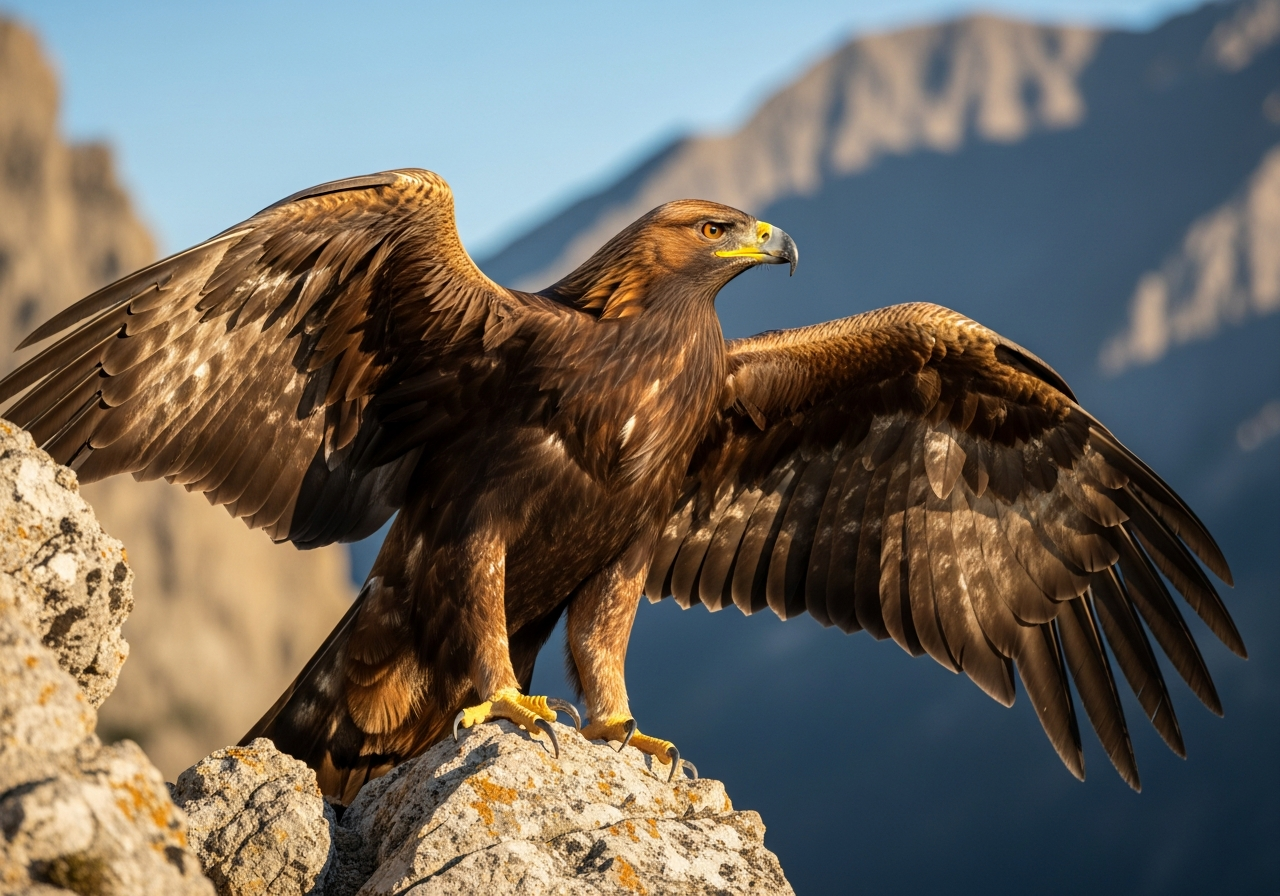
The golden eagle (Aquila chrysaetos) is one of the largest and fastest birds of prey, found across the mountains, open hills, and tundra of the Northern Hemisphere. It weighs around 4.5 kg with a wingspan of 1.8 to 2.3 m, and in a hunting dive it can exceed 240 km/h (150 mph). This powerful aerial hunter takes hares, marmots, and birds, lives 20 to 30 years, and is listed as Least Concern.
Top questions about the Golden Eagle
Golden Eagle facts at a glance
- Weight 4.5 kg
- Length 90 cm
- Top speed 240 km/h
- Lifespan 25 years
| Scientific name | Aquila chrysaetos |
|---|---|
| Diet | Carnivore (hares, marmots, birds, carrion) |
| Habitat | Mountains, open hills, and tundra |
| Lifespan | 20–30 years in the wild |
| Wingspan | 1.8–2.3 m (6–7.5 ft) |
| Top speed | Over 240 km/h (150 mph) in a dive |
| Conservation status | Least Concern (IUCN) |
| Kingdom | Animalia |
|---|---|
| Phylum | Chordata |
| Class | Aves |
| Order | Accipitriformes |
| Family | Accipitridae |
| Genus | Aquila |
Where it lives
The golden eagle (Aquila chrysaetos) is native to Mountains and open country across North America, Europe, North Africa, and much of Asia. — recorded across North America, Europe, Asia, Africa in this guide’s range summary.
For occurrence records, see GBIF species search and sources below.
How big is a golden eagle?
An adult golden eagle measures 90 cm long — about 52% of the height of an average adult person (1.73 m) — and weighs around 4.5 kg, about 6% of an average adult’s body weight (70 kg).
Length vs an average adult’s height (to scale)
What is a group of golden eagles called?
Group name (collective noun)
A group of Golden Eagles is called a convocation.
Baby name
A baby Golden Eagle is called an eaglet. It may also be called a chick.
Explore more animal collective nouns and baby animal names .
Appearance and identification
The golden eagle is a large, dark-brown raptor named for the golden feathers that gleam on the nape and crown. Adults weigh around 4.5 kg and span 1.8 to 2.3 m (6 to 7.5 ft) from wingtip to wingtip, with females noticeably larger than males. In flight it holds its long, broad wings in a shallow V and soars with only occasional wingbeats. Young birds show white patches at the base of the tail and in the wings that fade as they mature.
Hunting and flight
The golden eagle is a superb flier that hunts on the wing, soaring on rising air and then folding its wings into a steep, high-speed stoop. In such a dive it can exceed 240 km/h (150 mph), striking prey with long, powerful talons. It is a carnivore that takes hares, rabbits, marmots, ground squirrels, and birds up to the size of a goose, and readily feeds on carrion in winter. Pairs sometimes hunt cooperatively, one flushing prey while the other makes the kill.
Habitat and range
Golden eagles range widely across the Northern Hemisphere, breeding in North America, Europe, North Africa, and much of Asia. They favour open, rugged country such as mountains, moorland, hills, and tundra where they can spot prey from the air. Large home ranges and cliff or tree nest sites are essential to a breeding pair. In Britain the species survives mainly in the Scottish Highlands and islands.
Nesting and reproduction
Golden eagles pair for life and build huge stick nests, called eyries, on cliff ledges or in tall trees, reusing and enlarging them over many years. The female usually lays one to three eggs, and the pair defends a large territory throughout the breeding season. Where more than one chick hatches, the older and stronger often outcompetes its sibling. Young birds fledge after around ten weeks but depend on their parents for some time before dispersing.
Lifespan and behaviour
Golden eagles are long-lived, typically reaching 20 to 30 years in the wild. They are territorial and largely solitary outside the breeding pair, patrolling extensive ranges in search of food. Their eyesight is exceptionally sharp, letting them detect prey from great distances as they soar. Revered in many cultures, the golden eagle has long been a symbol of power and remains an emblem of wild, mountainous country.
Conservation status
The golden eagle is listed as Least Concern by the IUCN and remains widespread across its huge global range. Even so, it faces regional threats from illegal persecution, poisoning, collisions with power lines and wind turbines, and disturbance at nest sites. In some countries, including Britain, populations are recovering thanks to legal protection and reduced persecution. Safeguarding large tracts of open upland habitat is important for its long-term future.
Dig deeper into the Golden Eagle
- Are Golden Eagles Dangerous?
Are golden eagles dangerous? Realistic risk, when incidents rise, and safety basics.
- How Long Do Golden Eagles Live?
Golden Eagle lifespan is typically 20–30 years in the wild. What shortens or extends life, life stages, and status (Least Concern).
- What Do Golden Eagles Eat?
What golden eagles eat: Carnivore (hares, marmots, birds, carrion), foraging style, and seasonal shifts in Mountains, open hills, and tundra.
- Where Do Golden Eagles Live?
Where golden eagles live: Mountains, open hills, and tundra, native range cues, and human overlap. Status Least Concern.
Explore the Golden Eagle
Related Birds
Collections
Range & geography
Did you know? Golden Eagle facts
- The golden eagle is a powerful bird of prey found across the Northern Hemisphere, named for the golden-brown feathers on its head and neck.
- Golden eagles cruise at around 45 to 50 km/h (28 to 32 mph) but can reach more than 240 km/h (150 mph) when diving on prey, making them among the fastest animals on Earth.
- They are carnivores that mainly hunt medium-sized mammals such as hares, rabbits, marmots, and ground squirrels. They also take birds and reptiles and will feed on carrion, especially in winter.
- Golden eagles have a wingspan of roughly 1.8 to 2.3 m (6 to 7.5 ft) and weigh around 3 to 6 kg (7 to 13 lb), with females noticeably larger than males.
- Adult bald eagles have a white head and tail and eat a lot of fish, while golden eagles are all brown with golden nape feathers and hunt mainly mammals. Golden eagles also have feathered legs down to the toes.
- Conservation: Least Concern (IUCN).
Diet & feeding
Golden Eagle feeds primarily as a carnivore (hares, marmots, birds, carrion). Golden eagles are formidable hunters that use surprise, speed, and immense gripping strength to take prey as large as foxes, young deer, and cranes, though most meals are hares, rabbits, and ground squirrels. They patrol vast territories, soa
Adaptations
- Golden eagles are formidable hunters that use surprise, speed, and immense gripping strength to take prey as large as foxes, young deer, and cranes, though most meals are hares, rabbits, and ground squirrels. They patrol vast territories, soaring on rising air and then folding their wings into a steep dive to strike prey with their talons.
- Adults are dark brown with the lustrous golden feathers on the head and nape that give the species its name. They are among the largest eagles, with long, broad wings and a fairly long tail suited to soaring and maneuvering over rugged terrain. Young birds show distinctive white patches in the wings and tail that fade as they mature.
Behaviour & ecology
- Golden eagles are formidable hunters that use surprise, speed, and immense gripping strength to take prey as large as foxes, young deer, and cranes, though most meals are hares, rabbits, and ground squirrels. They patrol vast territories, soaring on rising air and then folding their wings into a steep dive to strike prey with their talons.
- Adults are dark brown with the lustrous golden feathers on the head and nape that give the species its name. They are among the largest eagles, with long, broad wings and a fairly long tail suited to soaring and maneuvering over rugged terrain. Young birds show distinctive white patches in the wings and tail that fade as they mature.
- The golden eagle is one of the most widespread eagles in the world, living across North America, Europe, North Africa, and much of Asia. It favors open and mountainous country, including highlands, cliffs, moorland, and tundra, where it can find updrafts for soaring and open ground for hunting.
Communication
- Golden Eagle uses calls and visual displays to communicate territory, alarm, and breeding status.
- Vocal repertoires vary by species and are often learned or refined during development.
Habitat & range
Mountains, open hills, and tundra
Ecological role
Golden Eagle acts as a predator that helps regulate prey populations and maintain balance in mountains, open hills, and tundra.
Conservation status of the Golden Eagle
The golden eagle (Aquila chrysaetos) is listed as Least Concern on the IUCN Red List. Least Concern (LC) is the IUCN's lowest-risk category, assigned to widespread, abundant species that have been evaluated and found not to be threatened. It does not mean a species faces no pressures — only that it is not currently at risk of extinction.
The golden eagle (Aquila chrysaetos) is assessed on the IUCN Red List. Look up on the IUCN Red List .
Frequently asked questions about the Golden Eagle
How fast can a golden eagle fly?
In a hunting dive, or stoop, a golden eagle can exceed 240 km/h (150 mph). In level flight it is much slower, cruising and soaring on rising air to conserve energy.
What do golden eagles eat?
They are carnivores that hunt hares, rabbits, marmots, ground squirrels, and birds up to the size of a goose. In winter they also feed readily on carrion when live prey is scarce.
How big is a golden eagle?
Adults weigh around 4.5 kg and have a wingspan of 1.8 to 2.3 m (6 to 7.5 ft). Females are noticeably larger than males, as in most birds of prey.
Where do golden eagles live?
They range across the Northern Hemisphere in North America, Europe, North Africa, and Asia, favouring mountains, open hills, and tundra. In Britain they survive mainly in the Scottish Highlands and islands.
How long do golden eagles live?
In the wild golden eagles typically live 20 to 30 years. They pair for life and can raise young over many breeding seasons in the same territory.
Are golden eagles endangered?
No. The golden eagle is listed as Least Concern by the IUCN and is widespread globally. Regional threats include illegal persecution, poisoning, and collisions with power lines and wind turbines.
What is a group of golden eagles called?
A group of Golden Eagles is called a convocation.
What is a baby golden eagle called?
A baby Golden Eagle is called an eaglet. It may also be called a chick.
Sources & references
This guide is compiled and reviewed against established zoological and conservation references. Key sources for the Golden Eagle:
-
IUCN Red List of Threatened Species
Conservation status (Least Concern) reflects the IUCN Red List category for Aquila chrysaetos.
-
iNaturalist — observations & photos
Search citizen-science observations and community IDs for Aquila chrysaetos. Useful for range checks and recent sightings — not a substitute for formal Red List status.
-
GBIF — occurrence data
Global Biodiversity Information Facility species search for Aquila chrysaetos. Explore published occurrence records used in range research.
-
eBird — bird observations
Cornell Lab eBird target search for Golden Eagle. Check recent checklists and seasonal abundance where birders report this species.
- IUCN Red List — Aquila chrysaetos.
Conservation status (Least Concern) and population trends.
- Animal Diversity Web — Aquila chrysaetos. University of Michigan Museum of Zoology.
Life history, morphology, and range.
- Wikipedia — Golden Eagle.
General taxonomy and overview (cross-check primary sources).
-
Global Animal Guide editorial standards
How we research, source, review, and update every guide for accuracy.