Image sourcing: see credits & licences
Quick answer
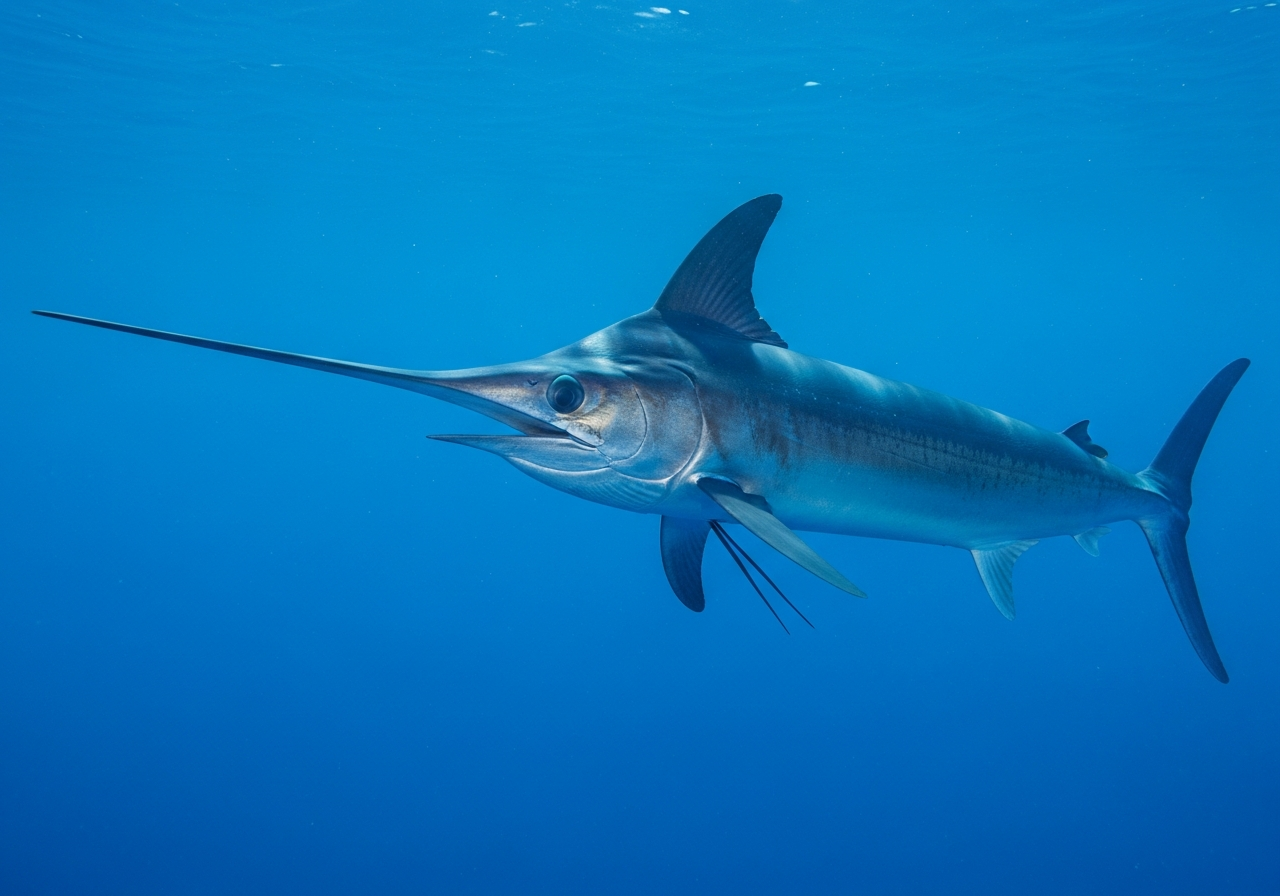
The swordfish (Xiphias gladius) is a large, fast predatory fish of temperate and tropical open oceans, named for the long flattened bill that extends from its upper jaw. It can reach 3 m in length including the sword, weigh up to about 450 kg, and swim in bursts of up to 80 km/h. Swordfish hunt fish and squid in open water and typically live 9 to 15 years. The species is listed as Least Concern.
Top questions about the Swordfish
Swordfish facts at a glance
- Weight 450 kg
- Length 3 m
- Top speed 80 km/h
- Lifespan 12 years
| Scientific name | Xiphias gladius |
|---|---|
| Diet | Carnivore (fish and squid) |
| Habitat | Temperate and tropical open oceans |
| Lifespan | 9–15 years |
| Length | Up to 3 m (10 ft), bill included |
| Top speed | Up to 80 km/h (50 mph) |
| Conservation status | Least Concern (IUCN) |
| Kingdom | Animalia |
|---|---|
| Phylum | Chordata |
| Class | Actinopterygii |
| Order | Istiophoriformes |
| Family | Xiphiidae |
| Genus | Xiphias |
Where it lives
The swordfish (Xiphias gladius) is native to Temperate and tropical oceans worldwide, hunting from the surface down to deep water. — recorded across Oceans in this guide’s range summary.
For occurrence records, see GBIF species search and sources below.
How big is a swordfish?
An adult swordfish measures 3 m long — about 1.7× the height of an average adult person (1.73 m) — and weighs around 450 kg, about 6.4× an average adult’s body weight (70 kg).
Length vs an average adult’s height (to scale)
What is a baby swordfish called?
Baby name
A baby Swordfish is called a fry. It may also be called a larva.
Explore more animal collective nouns and baby animal names .
The sword and how it is used
The swordfish's most famous feature is the long, flat, sword-like bill formed from an extension of its upper jaw. Rather than spearing prey directly, the fish often slashes sideways through schools of fish and squid, stunning or injuring several at once before eating them. The bill also cuts drag as the fish accelerates. Unlike some billfish, adult swordfish have no teeth and no scales, relying on the sword and their speed to feed.
Built for speed in open water
Swordfish are among the fastest swimmers in the ocean, capable of bursts up to 80 km/h. Their streamlined, torpedo-shaped bodies, stiff crescent-shaped tails, and reduced fins let them slice through the water with minimal resistance. Specialised muscle and a heat-exchange system near the eyes and brain keep those organs warmer than the surrounding water, sharpening their vision and reactions in cold depths. This combination makes them formidable hunters across a wide range of ocean conditions.
Hunting and diet
Swordfish are carnivores that hunt fish and squid throughout the water column. They make daily vertical journeys, descending to cold, dark depths of several hundred metres during the day and rising toward the surface at night to feed. Their warmed eyes give them an edge in spotting prey in dim light far below the surface. A single swordfish can cover great distances in pursuit of shoaling prey.
Range and habitat
Swordfish live in temperate and tropical open oceans around the world, from the Atlantic and Pacific to the Indian Ocean and Mediterranean. They are highly migratory, moving toward warmer waters to spawn and cooler, productive waters to feed. Adults spend much of their time far offshore rather than near coasts. They tolerate a broad range of water temperatures thanks to their internal heat-exchange system.
Growth, size and lifespan
Swordfish grow quickly and can reach 3 m in length including the bill, with the largest individuals weighing up to about 450 kg. Females grow larger than males and tend to live longer. Their typical lifespan is 9 to 15 years. Rapid early growth helps young swordfish reach a size where few predators can threaten them.
Fishing and conservation
Swordfish are a major commercial and sport fish, caught by longline and harpoon fisheries across the world's oceans. Some regional stocks were heavily depleted in the past, but management measures have helped several populations recover. The IUCN currently lists the species as Least Concern. Continued monitoring of catch limits helps keep the fishery sustainable.
Dig deeper into the Swordfish
- Are Swordfish Dangerous?
Are swordfish dangerous? Realistic risk, when incidents rise, and safety basics.
- How Long Do Swordfish Live?
Swordfish lifespan is typically 9–15 years. What shortens or extends life, life stages, and status (Least Concern).
- Swordfish: Key Facts
Swordfish (Xiphias gladius) are fish found across multiple regions. The ocean hunter armed with a sword.
- What Do Swordfish Eat?
What swordfish eat: Carnivore (fish and squid), foraging style, and seasonal shifts in Temperate and tropical open oceans.
- Where Do Swordfish Live?
Where swordfish live: Temperate and tropical open oceans, native range cues, and human overlap. Status Least Concern.
Explore the Swordfish
Related Fishs
Range & geography
Did you know? Swordfish facts
- The swordfish is a large, fast predatory fish named for its long, flat, sword-like bill, which it uses to slash at prey.
- The long, flat bill is used to slash through schools of fish, stunning or injuring prey that the swordfish then eats. It may also help the fish cut through water more efficiently.
- Swordfish are among the fastest fish in the sea, with estimates of burst speeds up to about 80 km/h (50 mph) thanks to their streamlined, powerful bodies.
- Swordfish are carnivores that feed mainly on squid and fish such as mackerel and herring, often diving deep during the day to hunt and rising toward the surface at night.
- Swordfish can reach about 3 m (10 ft) in length, including the bill, and weigh over 450 kg (1,000 lb), with females generally growing larger than males.
- Conservation: Least Concern (IUCN).
Diet & feeding
Swordfish feeds primarily as a carnivore (fish and squid). The swordfish's defining feature is its long, flattened upper jaw, which forms a smooth, sharp bill used to slash through schools of fish and stun prey. Unlike marlin, its bill is flat rather than round, and it lacks scales and teeth as an adult. Swordfish are
Adaptations
- The swordfish's defining feature is its long, flattened upper jaw, which forms a smooth, sharp bill used to slash through schools of fish and stun prey. Unlike marlin, its bill is flat rather than round, and it lacks scales and teeth as an adult. Swordfish are mostly solitary and can warm their eyes and brain, sharpening their vision when diving into cold, deep water.
- Swordfish are carnivores that feed on squid and a wide range of fish, from mackerel and herring to deepwater species. They often dive hundreds of meters during the day to hunt, then move toward the surface at night following their prey. The sword is used to injure or kill prey, which is then swallowed whole.
Behaviour & ecology
- The swordfish's defining feature is its long, flattened upper jaw, which forms a smooth, sharp bill used to slash through schools of fish and stun prey. Unlike marlin, its bill is flat rather than round, and it lacks scales and teeth as an adult. Swordfish are mostly solitary and can warm their eyes and brain, sharpening their vision when diving into cold, deep water.
- Swordfish are carnivores that feed on squid and a wide range of fish, from mackerel and herring to deepwater species. They often dive hundreds of meters during the day to hunt, then move toward the surface at night following their prey. The sword is used to injure or kill prey, which is then swallowed whole.
- Swordfish live in temperate and tropical oceans around the world, from the surface down to depths of several hundred meters. They migrate toward cooler, productive waters to feed in summer and warmer waters to spawn. They are highly mobile and can cross large stretches of open ocean.
Communication
- Lateral-line and visual cues coordinate schooling, courtship, or territorial behaviour.
- Some species produce low-frequency sounds or drumming for spawning or defence.
Habitat & range
Temperate and tropical open oceans
Ecological role
Swordfish acts as a predator that helps regulate prey populations and maintain balance in temperate and tropical open oceans.
Conservation status of the Swordfish
The swordfish (Xiphias gladius) is listed as Least Concern on the IUCN Red List. Least Concern (LC) is the IUCN's lowest-risk category, assigned to widespread, abundant species that have been evaluated and found not to be threatened. It does not mean a species faces no pressures — only that it is not currently at risk of extinction.
The swordfish (Xiphias gladius) is assessed on the IUCN Red List. Look up on the IUCN Red List .
Frequently asked questions about the Swordfish
How fast can a swordfish swim?
Swordfish are among the fastest fish in the sea and can swim in bursts of up to 80 km/h (about 50 mph). Their streamlined bodies and stiff, crescent-shaped tails let them accelerate rapidly after prey.
How big do swordfish get?
Swordfish can reach about 3 m in length including the sword and weigh up to roughly 450 kg. Females typically grow larger than males.
What do swordfish eat?
Swordfish are carnivores that feed mainly on fish and squid. They often slash through schools of prey with their long bill to stun several targets before eating them.
What is a swordfish's sword used for?
The sword is an extension of the upper jaw used mainly for hunting. The swordfish slashes it sideways through groups of fish and squid to injure or stun them, and it also helps cut drag while swimming at speed.
How long do swordfish live?
Swordfish typically live 9 to 15 years. They grow quickly when young, and females generally live longer than males.
Are swordfish endangered?
No. The swordfish is listed as Least Concern by the IUCN. Some regional stocks were overfished in the past, but fisheries management has helped several populations recover.
What is a baby swordfish called?
A baby Swordfish is called a fry. It may also be called a larva.
Sources & references
This guide is compiled and reviewed against established zoological and conservation references. Key sources for the Swordfish:
-
IUCN Red List of Threatened Species
Conservation status (Least Concern) reflects the IUCN Red List category for Xiphias gladius.
-
iNaturalist — observations & photos
Search citizen-science observations and community IDs for Xiphias gladius. Useful for range checks and recent sightings — not a substitute for formal Red List status.
-
GBIF — occurrence data
Global Biodiversity Information Facility species search for Xiphias gladius. Explore published occurrence records used in range research.
- IUCN Red List — Xiphias gladius.
Conservation status (Least Concern) and population trends.
- Animal Diversity Web — Xiphias gladius. University of Michigan Museum of Zoology.
Life history, morphology, and range.
- Wikipedia — Swordfish.
General taxonomy and overview (cross-check primary sources).
-
Global Animal Guide editorial standards
How we research, source, review, and update every guide for accuracy.