Quick answer
Fleas are tiny, wingless insects that live as parasites on the bodies of mammals and birds, feeding on their blood. They are renowned for their jumping ability, able to leap many times their own body length thanks to powerful hind legs and a spring-like protein. Fleas can be a nuisance to pets and people and can transmit disease, and they are found nearly worldwide.
Top questions about the Flea
Flea facts at a glance
- Weight 0 g
- Length 0 cm
- Top speed 5 km/h
- Lifespan 1 years
| Scientific name | Order Siphonaptera |
|---|---|
| Diet | Hematophagous (blood of mammals and birds) |
| Habitat | On the bodies of host animals worldwide |
| Lifespan | Several weeks to a few months |
| Length | 1.5–3 mm (about 0.1 in) |
| Jump | Up to many times its body length |
| Conservation status | Varies by species |
| Kingdom | Animalia |
|---|---|
| Phylum | Arthropoda |
| Class | Insecta |
| Order | Siphonaptera |
Where it lives
The flea (Siphonaptera) is native to On the bodies of mammals and birds worldwide; wingless parasites famous for their jumping. — recorded across Africa, Asia, Europe, North America, South America, Oceania in this guide’s range summary.
For occurrence records, see GBIF species search and sources below.
How big is a flea?
An adult flea measures 0 cm long — a small fraction of the height of an average adult person (1.73 m) — and weighs around 0 g, a small fraction of an average adult’s body weight (70 kg).
Length vs an average adult’s height (to scale)
What is a group of fleas called?
Group name (collective noun)
A group of Fleas is called a swarm. It is also known as an infestation.
Baby name
A baby Flea is called a larva.
Explore more animal collective nouns and baby animal names .
Built for jumping
Fleas are famous for their extraordinary jumps, able to leap distances and heights many times their own body length. The power comes from a rubber-like protein called resilin that stores energy and releases it like a spring. This lets a flea launch onto a passing host with explosive acceleration.
A parasitic lifestyle
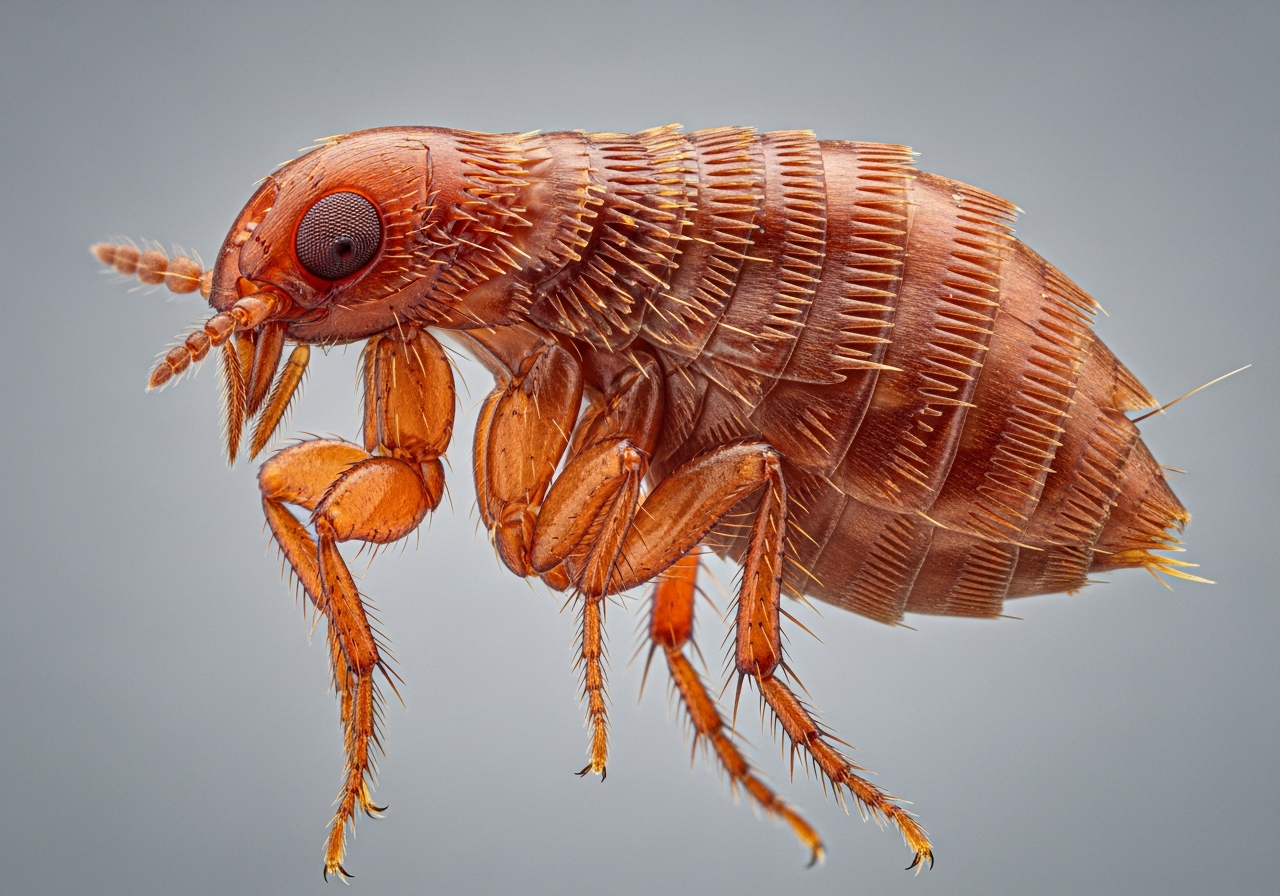
Fleas are external parasites that feed on the blood of mammals and birds, with each species often favoring particular hosts. Their bodies are flattened from side to side, helping them slip easily through fur and feathers, and backward-pointing bristles make them hard to remove. Mouthparts adapted for piercing skin let them feed on blood.
Life cycle
A flea's life cycle moves through egg, larva, pupa, and adult, much of it taking place off the host in bedding, carpets, or nests. Eggs laid on a host often fall into the surrounding environment, where the larvae feed on debris before pupating. Adults emerge ready to jump onto a host and feed, sometimes after waiting for the right cue such as warmth or vibration.
Fleas and disease
Beyond the irritation of their bites, fleas can transmit diseases and parasites. Historically, certain fleas spread the bacteria responsible for plague, and fleas can also carry tapeworms and other pathogens between animals. Controlling fleas on pets and in the home helps protect both animals and people.
Dig deeper into the Flea
- Flea: Key Facts
Fleas are tiny, wingless insects that live as parasites on the bodies of mammals and birds, feeding on their blood.
- What Do Fleas Eat?
What fleas eat: Hematophagous (blood of mammals and birds), foraging style, and seasonal shifts in On the bodies of host animals worldwide.
- Where Do Fleas Live?
Where fleas live: On the bodies of host animals worldwide, native range cues, and human overlap. Status Least Concern.
Explore the Flea
Related Insects
Did you know? Flea facts
- Fleas are tiny, wingless insects that live as parasites on the bodies of mammals and birds, feeding on their blood.
- Fleas can leap many times their own body length, an extraordinary feat for their size. The jump is powered by a spring-like protein called resilin that releases stored energy in an instant.
- Fleas are parasites that feed on the blood of mammals and birds. Different species tend to favor particular hosts, such as cats, dogs, or rodents.
- Adult fleas typically live several weeks to a few months when they have a host to feed on. Much of the life cycle, including the egg, larva, and pupa stages, takes place off the host.
- Yes. Fleas can transmit diseases and parasites, and historically certain fleas spread the bacteria that cause plague. They can also carry tapeworms between animals, which is why flea control matters.
- Conservation: Varies by species.
Diet & feeding
Flea feeds primarily as a hematophagous (blood of mammals and birds). Fleas are external parasites that feed on the blood of mammals and birds, with each species often favoring particular hosts. Their bodies are flattened from side to side, helping them slip easily through fur and feathers, and backward-pointing bristl
Adaptations
- Fleas are famous for their extraordinary jumps, able to leap distances and heights many times their own body length. The power comes from a rubber-like protein called resilin that stores energy and releases it like a spring. This lets a flea launch onto a passing host with explosive acceleration.
- Fleas are external parasites that feed on the blood of mammals and birds, with each species often favoring particular hosts. Their bodies are flattened from side to side, helping them slip easily through fur and feathers, and backward-pointing bristles make them hard to remove. Mouthparts adapted for piercing skin let them feed on blood.
Behaviour & ecology
- Fleas are famous for their extraordinary jumps, able to leap distances and heights many times their own body length. The power comes from a rubber-like protein called resilin that stores energy and releases it like a spring. This lets a flea launch onto a passing host with explosive acceleration.
- Fleas are external parasites that feed on the blood of mammals and birds, with each species often favoring particular hosts. Their bodies are flattened from side to side, helping them slip easily through fur and feathers, and backward-pointing bristles make them hard to remove. Mouthparts adapted for piercing skin let them feed on blood.
- A flea's life cycle moves through egg, larva, pupa, and adult, much of it taking place off the host in bedding, carpets, or nests. Eggs laid on a host often fall into the surrounding environment, where the larvae feed on debris before pupating. Adults emerge ready to jump onto a host and feed, sometimes after waiting for the right cue such as warmth or vibration.
Communication
- Flea uses scent, posture, and vocal signals to mark territory and coordinate social behaviour.
- Communication intensity often peaks during breeding seasons and territorial disputes.
Habitat & range
On the bodies of host animals worldwide
Ecological role
Flea participates in pollination, decomposition, or prey-base support for birds and other insectivores.
Conservation status of the Flea
The flea (Siphonaptera) is listed as Least Concern on the IUCN Red List. Least Concern (LC) is the IUCN's lowest-risk category, assigned to widespread, abundant species that have been evaluated and found not to be threatened. It does not mean a species faces no pressures — only that it is not currently at risk of extinction.
The flea (Siphonaptera) is assessed on the IUCN Red List. Look up on the IUCN Red List .
Frequently asked questions about the Flea
How far can a flea jump?
Fleas can leap many times their own body length, an extraordinary feat for their size. The jump is powered by a spring-like protein called resilin that releases stored energy in an instant.
What do fleas eat?
Fleas are parasites that feed on the blood of mammals and birds. Different species tend to favor particular hosts, such as cats, dogs, or rodents.
How long do fleas live?
Adult fleas typically live several weeks to a few months when they have a host to feed on. Much of the life cycle, including the egg, larva, and pupa stages, takes place off the host.
Can fleas spread disease?
Yes. Fleas can transmit diseases and parasites, and historically certain fleas spread the bacteria that cause plague. They can also carry tapeworms between animals, which is why flea control matters.
Why are fleas so hard to get rid of?
Much of the flea population lives off the host as eggs, larvae, and pupae in bedding and carpets, so treating only the animal misses many fleas. Effective control treats both the pet and its environment.
Do fleas have wings?
No. Fleas are wingless insects. Instead of flying they rely on their powerful hind legs to jump onto hosts and move between them.
What is a group of fleas called?
A group of Fleas is called a swarm. It is also known as an infestation.
What is a baby flea called?
A baby Flea is called a larva.
Sources & references
This guide is compiled and reviewed against established zoological and conservation references. Key sources for the Flea:
-
IUCN Red List of Threatened Species
Conservation status (Least Concern) reflects the IUCN Red List category for Siphonaptera.
-
iNaturalist — observations & photos
Search citizen-science observations and community IDs for Siphonaptera. Useful for range checks and recent sightings — not a substitute for formal Red List status.
-
GBIF — occurrence data
Global Biodiversity Information Facility species search for Siphonaptera. Explore published occurrence records used in range research.
- IUCN Red List — Siphonaptera.
Conservation status (Least Concern) and population trends.
- Wikipedia — Flea.
General taxonomy and overview (cross-check primary sources).
-
Global Animal Guide editorial standards
How we research, source, review, and update every guide for accuracy.