Image sourcing: see credits & licences
Quick answer
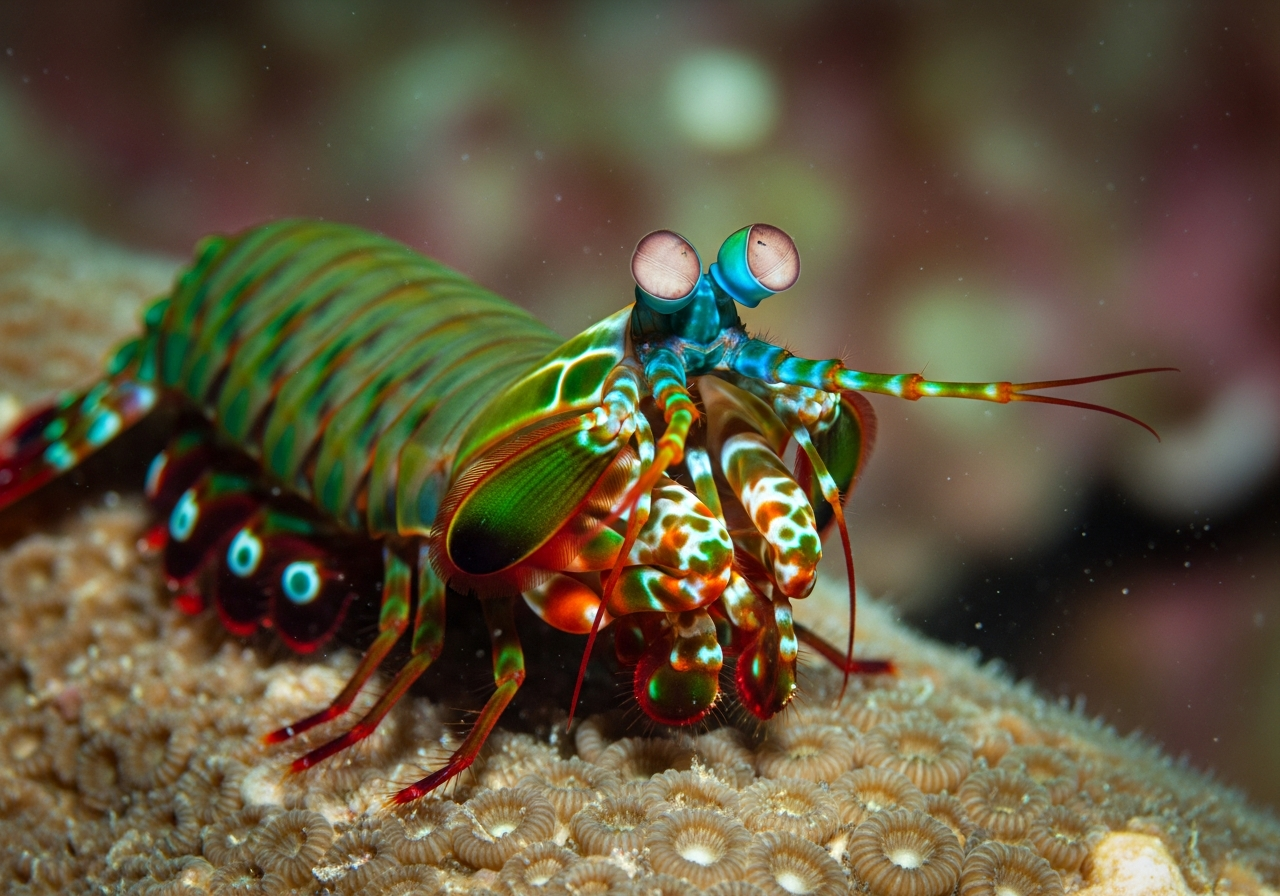
The peacock mantis shrimp (Odontodactylus scyllarus) is a vividly coloured predatory crustacean of tropical Indo-Pacific reefs, famous for the fastest strike in the animal kingdom. Growing up to about 18 cm (7 in), it swims over the reef and burrows in the seabed, smashing snails and crabs with club-like appendages that accelerate at over 80 km/h (50 mph). It has extraordinary eyes and lives three to six years.
Top questions about the Peacock Mantis Shrimp
Peacock Mantis Shrimp facts at a glance
- Weight 60 g
- Length 18 cm
- Top speed 1 km/h
- Lifespan 6 years
| Scientific name | Odontodactylus scyllarus |
|---|---|
| Diet | Carnivore (crabs, snails, mollusks, fish) |
| Habitat | Burrows on tropical Indo-Pacific reefs |
| Lifespan | 3–6 years |
| Length | Up to about 18 cm (7 in) |
| Top speed | Strike reaches over 80 km/h (50 mph) |
| Conservation status | Least Concern (IUCN) |
| Kingdom | Animalia |
|---|---|
| Phylum | Arthropoda |
| Class | Malacostraca |
| Order | Stomatopoda |
| Family | Odontodactylidae |
| Genus | Odontodactylus |
Where it lives
The peacock mantis shrimp (Odontodactylus scyllarus) is native to Burrows on coral reefs of the tropical Indo-Pacific, from East Africa to Guam and northern Australia. — recorded across Oceans in this guide’s range summary.
For occurrence records, see GBIF species search and sources below.
How big is a peacock mantis shrimp?
An adult peacock mantis shrimp measures 18 cm long — about 10% of the height of an average adult person (1.73 m) — and weighs around 60 g, a small fraction of an average adult’s body weight (70 kg).
Length vs an average adult’s height (to scale)
What is a baby peacock mantis shrimp called?
Baby name
A baby Peacock Mantis Shrimp is called a larva.
Explore more animal collective nouns and baby animal names .
The fastest punch in nature
The peacock mantis shrimp belongs to the "smasher" group, armed with a pair of club-shaped appendages folded under the body like a coiled spring. When released, the club accelerates faster than a rifle bullet leaving a barrel, reaching a strike speed of over 80 km/h (50 mph). The blow is so fast that it briefly boils the surrounding water, creating collapsing bubbles that deliver a second shockwave. This lets the animal shatter the shells of snails, crabs and clams that other predators cannot crack.
Movement and burrows
The peacock mantis shrimp swims over the reef with rippling movements of its abdominal legs and crawls along the seabed on its walking legs. It shelters in burrows and crevices in the coral rubble and sand, which it excavates and defends. From the mouth of its burrow it ambushes passing prey, striking with lightning speed before dragging the meal inside. Though only about 18 cm (7 in) long and weighing a mere 60 grams, it is one of the reef's most formidable hunters.
Remarkable eyes and vision
Mantis shrimp have some of the most complex eyes known in the animal kingdom. Each eye sits on a mobile stalk and can move independently, and it contains up to sixteen types of colour receptor, compared with just three in humans. They can also detect ultraviolet and polarised light, which may help them communicate and spot prey. Their vivid green, red and blue body colours are thought to play a role in signalling to rivals and mates.
Diet and hunting
The peacock mantis shrimp is a carnivore that preys on hard-shelled animals such as crabs, snails, molluscs and small fish. It uses its smashing clubs to break open shells that resist most other predators, then feeds on the soft body inside. Prey is detected by sight and ambushed from the burrow entrance with a single explosive strike. This diet of armoured invertebrates makes powerful, durable weapons essential to its survival.
Behaviour and reproduction
Peacock mantis shrimp are typically solitary and aggressively territorial, defending their burrows against intruders. Some pairs form longer bonds, sharing a burrow and cooperating to raise their young. Females lay clutches of eggs that they may carry and tend until they hatch. In captivity these shrimp are notorious among aquarists, as a determined individual can crack aquarium glass with its strike.
Conservation status
The peacock mantis shrimp is listed as Least Concern and is widespread across the tropical Indo-Pacific. It is collected for the aquarium trade because of its dazzling colours, but this has not threatened wild populations overall. The main long-term concern is the health of the coral reefs it depends on for shelter and prey. Living three to six years, it remains a common and iconic reef predator.
Dig deeper into the Peacock Mantis Shrimp
- How Long Do Peacock Mantis Shrimps Live?
Peacock Mantis Shrimp lifespan is typically 3–6 years. What shortens or extends life, life stages, and status (Least Concern).
- Peacock Mantis Shrimp: Key Facts
Peacock Mantis Shrimps (Odontodactylus scyllarus) are invertebrates found across multiple regions. The reef brawler with the fastest punch in nature.
- What Do Peacock Mantis Shrimps Eat?
What peacock mantis shrimps eat: Carnivore (crabs, snails, mollusks, fish), foraging style, and seasonal shifts in Burrows on tropical Indo-Pacific reefs.
- Where Do Peacock Mantis Shrimps Live?
Where peacock mantis shrimps live: Burrows on tropical Indo-Pacific reefs, native range cues, and human overlap. Status Least Concern.
Explore the Peacock Mantis Shrimp
Related Invertebrates
Range & geography
Did you know? Peacock Mantis Shrimp facts
- The peacock mantis shrimp is a brilliantly colored crustacean of tropical Indo-Pacific reefs, famous for one of the fastest and most powerful strikes in the animal kingdom.
- The peacock mantis shrimp's strike is among the fastest movements in nature, accelerating faster than a bullet. It hits hard enough to smash shells and even crack aquarium glass.
- Mantis shrimp have around a dozen types of color receptor, far more than humans, and can detect polarized light. Their stalked eyes move independently and help them hunt and signal on colorful reefs.
- Peacock mantis shrimp are carnivores that eat crabs, snails, clams, and fish. As smashers, they use their club-like limbs to break open hard-shelled prey.
- Not really. Mantis shrimp are crustaceans called stomatopods, a group separate from true shrimp. They get their name from their shrimp-like shape and praying-mantis-style front limbs.
- Conservation: Least Concern (IUCN).
Diet & feeding
Peacock Mantis Shrimp feeds primarily as a carnivore (crabs, snails, mollusks, fish). The peacock mantis shrimp is a smasher that uses club-shaped front limbs to deliver one of the fastest movements known in the animal kingdom. Its strike accelerates faster than a bullet leaving a gun and is so powerful it briefly crea
Adaptations
- The peacock mantis shrimp is a smasher that uses club-shaped front limbs to deliver one of the fastest movements known in the animal kingdom. Its strike accelerates faster than a bullet leaving a gun and is so powerful it briefly creates collapsing bubbles, or cavitation, that produce a second shockwave. This lets it shatter the shells of snails, crabs, and clams, and captive specimens have been known to crack aquarium glass.
- Mantis shrimp have some of the most complex eyes in the animal kingdom, mounted on stalks and able to move independently. Where humans have three types of color receptor, the peacock mantis shrimp has around a dozen, and it can also detect polarized light. Each eye can perceive depth on its own, giving the animal remarkable visual abilities for hunting on busy reefs.
Behaviour & ecology
- The peacock mantis shrimp is a smasher that uses club-shaped front limbs to deliver one of the fastest movements known in the animal kingdom. Its strike accelerates faster than a bullet leaving a gun and is so powerful it briefly creates collapsing bubbles, or cavitation, that produce a second shockwave. This lets it shatter the shells of snails, crabs, and clams, and captive specimens have been known to crack aquarium glass.
- Mantis shrimp have some of the most complex eyes in the animal kingdom, mounted on stalks and able to move independently. Where humans have three types of color receptor, the peacock mantis shrimp has around a dozen, and it can also detect polarized light. Each eye can perceive depth on its own, giving the animal remarkable visual abilities for hunting on busy reefs.
- Peacock mantis shrimp are carnivores that prey on hard-shelled animals such as crabs, snails, and clams, as well as fish. Smashers like this species use their powerful clubs to break open armored prey, while spearing types of mantis shrimp instead impale soft-bodied animals. They are ambush hunters that strike with astonishing speed once prey comes within reach.
Communication
- Peacock Mantis Shrimp uses scent, posture, and vocal signals to mark territory and coordinate social behaviour.
- Communication intensity often peaks during breeding seasons and territorial disputes.
Habitat & range
Burrows on tropical Indo-Pacific reefs
Ecological role
Peacock Mantis Shrimp acts as a predator that helps regulate prey populations and maintain balance in burrows on tropical indo-pacific reefs.
Conservation status of the Peacock Mantis Shrimp
The peacock mantis shrimp (Odontodactylus scyllarus) is listed as Least Concern on the IUCN Red List. Least Concern (LC) is the IUCN's lowest-risk category, assigned to widespread, abundant species that have been evaluated and found not to be threatened. It does not mean a species faces no pressures — only that it is not currently at risk of extinction.
The peacock mantis shrimp (Odontodactylus scyllarus) is assessed on the IUCN Red List. Look up on the IUCN Red List .
Frequently asked questions about the Peacock Mantis Shrimp
How fast is a mantis shrimp punch?
A peacock mantis shrimp's strike accelerates at over 80 km/h (50 mph), making it one of the fastest movements in the animal kingdom. The blow is so rapid that it briefly vaporises water into collapsing bubbles, producing a second shockwave that helps shatter shells.
How big is a peacock mantis shrimp?
The peacock mantis shrimp grows up to about 18 cm (7 in) long and weighs only around 60 grams. Despite its small size, it is one of the most powerful hunters on the reef.
Why do mantis shrimp have such amazing eyes?
Mantis shrimp have up to sixteen types of colour receptor, compared with three in humans, and can see ultraviolet and polarised light. These complex eyes move independently on stalks, helping the shrimp spot prey and communicate with rivals and mates.
What do mantis shrimp eat?
Peacock mantis shrimp are carnivores that hunt hard-shelled animals such as crabs, snails, molluscs and small fish. They smash open shells with their club-like appendages, then eat the soft body inside.
Can a mantis shrimp break aquarium glass?
Yes. A determined peacock mantis shrimp can crack aquarium glass with its powerful strike, which is why aquarists keep them in tanks with thick or reinforced walls. The same blow easily shatters the shells of its prey.
How long do mantis shrimp live?
Peacock mantis shrimp typically live three to six years. They spend much of their lives in burrows on tropical Indo-Pacific reefs, defending their territory and ambushing passing prey.
What is a baby peacock mantis shrimp called?
A baby Peacock Mantis Shrimp is called a larva.
Sources & references
This guide is compiled and reviewed against established zoological and conservation references. Key sources for the Peacock Mantis Shrimp:
-
IUCN Red List of Threatened Species
Conservation status (Least Concern) reflects the IUCN Red List category for Odontodactylus scyllarus.
-
iNaturalist — observations & photos
Search citizen-science observations and community IDs for Odontodactylus scyllarus. Useful for range checks and recent sightings — not a substitute for formal Red List status.
-
GBIF — occurrence data
Global Biodiversity Information Facility species search for Odontodactylus scyllarus. Explore published occurrence records used in range research.
- IUCN Red List — Odontodactylus scyllarus.
Conservation status (Least Concern) and population trends.
- Animal Diversity Web — Odontodactylus scyllarus. University of Michigan Museum of Zoology.
Life history, morphology, and range.
- Wikipedia — Peacock Mantis Shrimp.
General taxonomy and overview (cross-check primary sources).
-
Global Animal Guide editorial standards
How we research, source, review, and update every guide for accuracy.