Quick answer
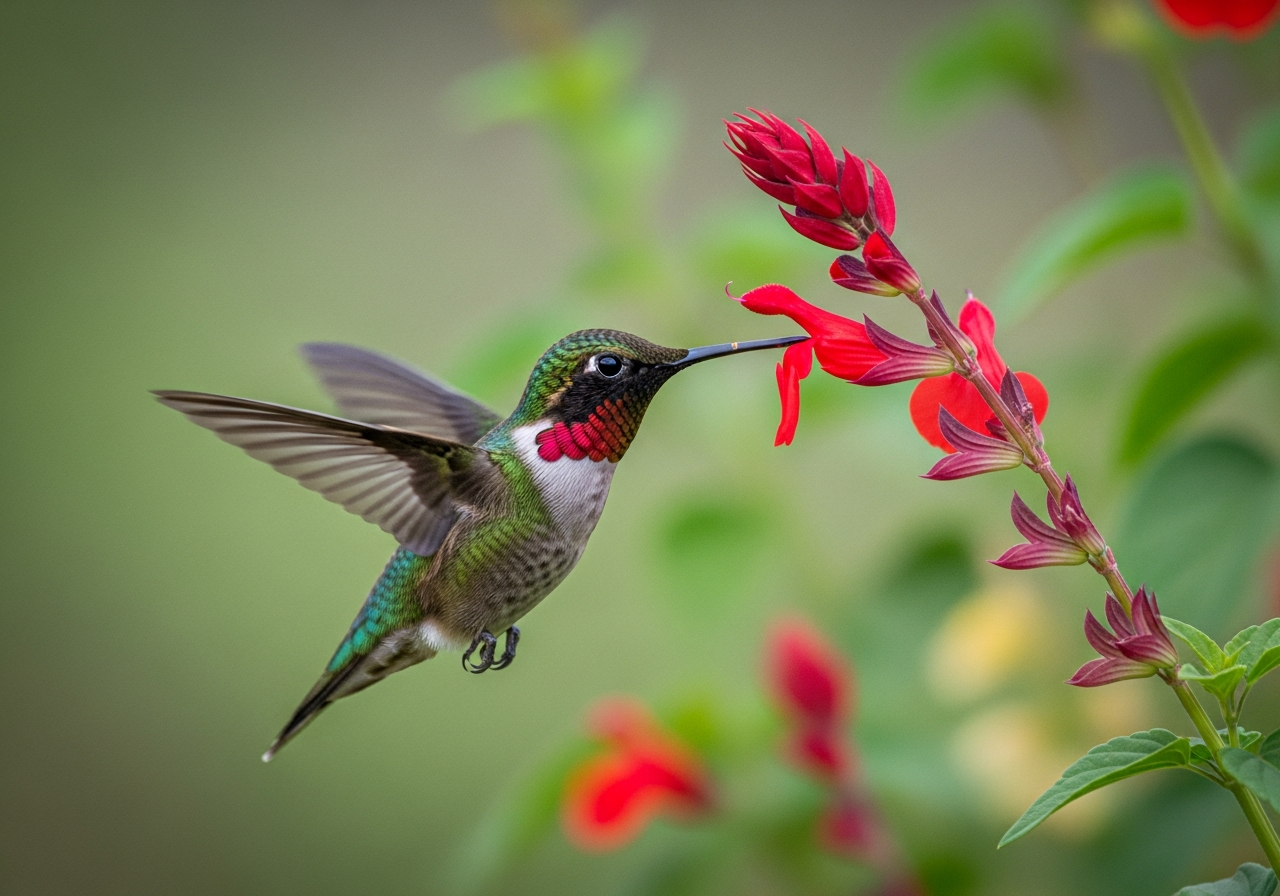
The ruby-throated hummingbird (Archilochus colubris) is a tiny nectar-feeding bird of eastern North America, weighing just 2 to 6 grams, about the same as a penny. It can hover in mid-air and even fly backwards, beating its wings roughly 50 times a second and reaching speeds of 50 km/h (30 mph). Males show a brilliant red throat, and these little birds typically live 3 to 5 years.
Top questions about the Ruby-throated Hummingbird
Ruby-throated Hummingbird facts at a glance
- Weight 3 g
- Length 9 cm
- Top speed 50 km/h
- Lifespan 5 years
| Scientific name | Archilochus colubris |
|---|---|
| Diet | Nectarivore (also small insects) |
| Habitat | Gardens, woodlands, meadows |
| Lifespan | 3–5 years |
| Weight | 2–6 g (about a penny) |
| Top speed | 50 km/h (30 mph) in flight |
| Conservation status | Least Concern (IUCN) |
| Kingdom | Animalia |
|---|---|
| Phylum | Chordata |
| Class | Aves |
| Order | Apodiformes |
| Family | Trochilidae |
Where it lives
The ruby-throated hummingbird (Archilochus colubris) is native to Breeds across eastern North America and migrates to Central America for winter. — recorded across North America in this guide’s range summary.
For occurrence records, see GBIF species search and sources below.
How big is a ruby-throated hummingbird?
An adult ruby-throated hummingbird measures 9 cm long — about 5% of the height of an average adult person (1.73 m) — and weighs around 3 g, a small fraction of an average adult’s body weight (70 kg).
Length vs an average adult’s height (to scale)
What is a group of ruby-throated hummingbirds called?
Group name (collective noun)
A group of Ruby-throated Hummingbirds is called a charm. It is also known as a bouquet or a glittering.
Baby name
A baby Ruby-throated Hummingbird is called a chick.
Explore more animal collective nouns and baby animal names .
Size and appearance
The ruby-throated hummingbird is a featherweight, tipping the scales at just 2 to 6 grams and measuring around 9 cm (3.5 in) long. Both sexes have iridescent green backs, but only the adult male sports the dazzling ruby-red throat patch, called a gorget, that gives the species its name. The colour comes from the way light refracts off the feathers rather than from pigment, so it can appear black until it catches the sun.
Hovering flight
Hummingbirds are the only birds that can hover in place and fly backwards, thanks to a shoulder joint that lets the wings trace a figure-eight. A ruby-throat beats its wings around 50 times per second and can reach 50 km/h (30 mph) in flight, its wings producing the humming sound that gives the family its name. This acrobatic flight is enormously demanding, and their heart can race to well over 1,000 beats a minute.
Feeding on nectar
These birds live mainly on flower nectar, which they lap up with a long, grooved tongue that flicks in and out many times a second. To fuel their frantic metabolism, a hummingbird may visit hundreds of flowers a day and eat around half its body weight in sugar. They also snatch small insects and spiders for protein, and are important pollinators, carrying pollen between the tubular red and orange flowers they favour.
Migration and torpor
Ruby-throated hummingbirds breed across eastern North America and migrate to Central America for the winter, many crossing the Gulf of Mexico in a single non-stop flight of around 800 km (500 miles). To survive cold nights and food shortages, they can enter torpor, a deep sleep-like state in which their heart rate and body temperature drop dramatically to save energy. This ability helps such a tiny animal weather conditions that would otherwise be fatal.
Nesting and young
The female builds a tiny cup nest, about the size of a walnut half, from plant down and spider silk, which stretches as the chicks grow. She lays two pea-sized white eggs and raises the young entirely on her own. The chicks fledge in around three weeks, and the flexible silk-bound nest expands to accommodate them as they develop.
Lifespan and conservation
In the wild, ruby-throated hummingbirds usually live 3 to 5 years, though the rigours of migration and their high-energy lifestyle mean many do not survive their first year. The species is common and listed as Least Concern by the IUCN. Garden feeders and native flowering plants help support them, especially during migration when they need to refuel frequently.
Dig deeper into the Ruby-throated Hummingbird
- How Fast Is A Ruby-throated Hummingbird?
Ruby-throated Hummingbird top speed is about 50 km/h (30 mph) in flight. Sprint vs endurance and what limits pace.
- How Long Do Ruby-throated Hummingbirds Live?
Ruby-throated Hummingbird lifespan is typically 3–5 years. What shortens or extends life, life stages, and status (Least Concern).
- Ruby-throated Hummingbird: Key Facts
Ruby-throated Hummingbirds (Archilochus colubris) are birds found across North America. A tiny hovering bird with a blazing throat.
- What Do Ruby-throated Hummingbirds Eat?
What ruby-throated hummingbirds eat: Nectarivore (also small insects), foraging style, and seasonal shifts in Gardens, woodlands, meadows.
- Where Do Ruby-throated Hummingbirds Live?
Where ruby-throated hummingbirds live: Gardens, woodlands, meadows, native range cues, and human overlap. Status Least Concern.
Explore the Ruby-throated Hummingbird
Related Birds
Range & geography
Did you know? Ruby-throated Hummingbird facts
- Hummingbirds are the only birds that can fly backwards and hover in place.
- Their wings beat up to about 80 times per second.
- A hummingbird's heart can beat over 1,200 times a minute.
- They have the fastest metabolism of any bird and must feed almost constantly.
- At night, some enter torpor, dropping their body temperature to save energy.
- They are vital pollinators for many flowering plants.
Diet & feeding
Hummingbirds feed mainly on flower nectar for energy, supplemented by small insects and spiders for protein, feeding many times an hour.
Adaptations
- A unique figure-of-eight wingstroke allows hovering and backward flight.
- An extremely high metabolism and rapid heartbeat power constant activity.
- A long bill and tongue reach nectar deep inside flowers.
- Nightly torpor conserves energy when food is unavailable.
Behaviour & ecology
- Hummingbirds feed frequently on nectar, defending rich flower patches.
- They are highly territorial around feeders and flowers.
- Males perform fast, looping display flights to attract mates.
- Some species migrate remarkable distances for their tiny size.
Communication
- Hummingbirds use chips, squeaks, and (in some species) song to signal.
- Display dives and the sounds they make advertise to mates and rivals.
- Aggressive posturing defends feeding territory.
Habitat & range
Hummingbirds occur only in the Americas, from tropical forests to mountains and gardens, wherever nectar-rich flowers are available.
Ecological role
As specialised nectar-feeders, hummingbirds are important pollinators, co-evolved with many plants whose flowers are shaped for them.
Conservation status of the Ruby-throated Hummingbird
The ruby-throated hummingbird (Archilochus colubris) is listed as Least Concern on the IUCN Red List. Least Concern (LC) is the IUCN's lowest-risk category, assigned to widespread, abundant species that have been evaluated and found not to be threatened. It does not mean a species faces no pressures — only that it is not currently at risk of extinction.
The ruby-throated hummingbird (Archilochus colubris) is assessed on the IUCN Red List. Look up on the IUCN Red List .
Frequently asked questions about the Ruby-throated Hummingbird
How fast do hummingbirds flap their wings?
A ruby-throated hummingbird beats its wings around 50 times per second in normal flight, and even faster during courtship displays. This rapid wingbeat produces the humming sound that gives the birds their name.
How much does a hummingbird weigh?
The ruby-throated hummingbird weighs just 2 to 6 grams, roughly the same as a penny. It is one of the smallest birds in North America.
What do hummingbirds eat?
They feed mainly on sugary flower nectar, which they lap up with a long tongue, and they also eat small insects and spiders for protein. To fuel their fast metabolism, a hummingbird may visit hundreds of flowers a day.
Can hummingbirds really fly backwards?
Yes. Hummingbirds are the only birds that can truly hover and fly backwards, thanks to a flexible shoulder joint that lets their wings trace a figure-eight pattern. This lets them hold steady at a flower while feeding.
How long do hummingbirds live?
Ruby-throated hummingbirds typically live 3 to 5 years in the wild. Many die in their first year, but survivors can reach the upper end of that range despite their demanding, high-energy lifestyle.
Where do ruby-throated hummingbirds go in winter?
They migrate south to Central America, with many crossing the Gulf of Mexico in a single non-stop flight of around 800 km (500 miles). They return to eastern North America to breed in spring.
What is a group of ruby-throated hummingbirds called?
A group of Ruby-throated Hummingbirds is called a charm. It is also known as a bouquet or a glittering.
What is a baby ruby-throated hummingbird called?
A baby Ruby-throated Hummingbird is called a chick.
Sources & references
This guide is compiled and reviewed against established zoological and conservation references. Key sources for the Ruby-throated Hummingbird:
-
IUCN Red List of Threatened Species
Conservation status (Least Concern) reflects the IUCN Red List category for Archilochus colubris.
-
iNaturalist — observations & photos
Search citizen-science observations and community IDs for Archilochus colubris. Useful for range checks and recent sightings — not a substitute for formal Red List status.
-
GBIF — occurrence data
Global Biodiversity Information Facility species search for Archilochus colubris. Explore published occurrence records used in range research.
-
eBird — bird observations
Cornell Lab eBird target search for Ruby-throated Hummingbird. Check recent checklists and seasonal abundance where birders report this species.
- BirdLife International — hummingbird assessments. IUCN Red List of Threatened Species.
Status varies by species.
- Billerman, S. M. et al. (eds.). Birds of the World. Cornell Lab of Ornithology.
Flight, metabolism, and ecology.
- Animal Diversity Web — Trochilidae (hummingbirds). University of Michigan Museum of Zoology.
Life history, morphology, and range.
-
Global Animal Guide editorial standards
How we research, source, review, and update every guide for accuracy.