Quick answer
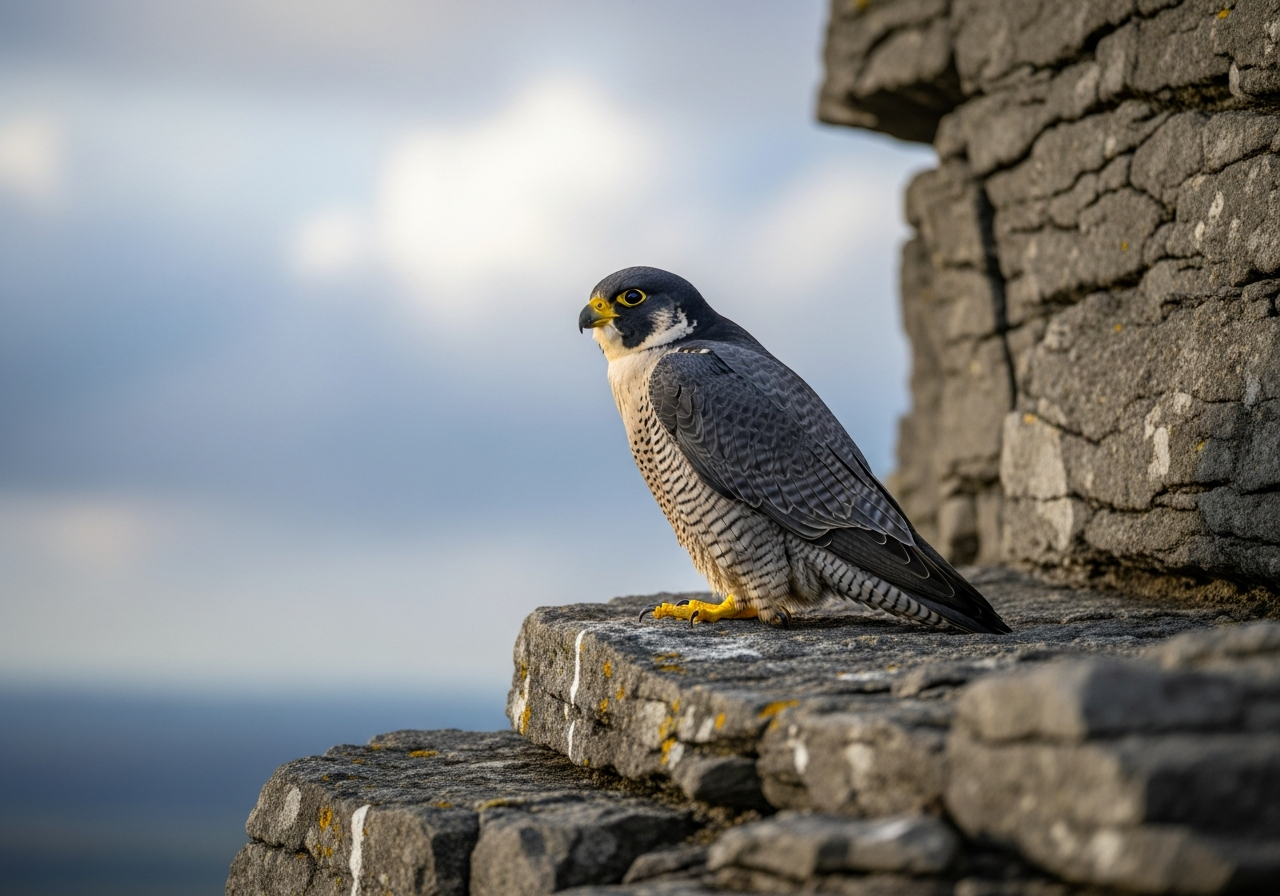
The peregrine falcon (Falco peregrinus) is a crow-sized bird of prey found on every continent except Antarctica, making it one of the most widespread birds in the world. It hunts other birds in mid-air and is the fastest animal on the planet, reaching over 380 km/h (240 mph) in a hunting dive. Adults weigh around 0.9 kg and live up to 15 years in the wild. The species is listed as Least Concern by the IUCN.
Top questions about the Peregrine Falcon
Peregrine Falcon facts at a glance
- Weight 900 g
- Length 50 cm
- Top speed 389 km/h
- Lifespan 15 years
| Scientific name | Falco peregrinus |
|---|---|
| Diet | Carnivore (mainly birds) |
| Habitat | Cliffs, coasts, open country, and cities |
| Lifespan | Up to 15 years in the wild |
| Wingspan | 0.9–1.1 m (3–3.6 ft) |
| Top speed | Over 380 km/h (240 mph) in a dive |
| Conservation status | Least Concern (IUCN) |
| Kingdom | Animalia |
|---|---|
| Phylum | Chordata |
| Class | Aves |
| Order | Falconiformes |
| Family | Falconidae |
| Genus | Falco |
Where it lives
The peregrine falcon (Falco peregrinus) is native to Found on every continent except Antarctica, from Arctic cliffs to tropical coasts and modern cities. — recorded across North America, South America, Europe, Asia, Africa, Oceania in this guide’s range summary.
For occurrence records, see GBIF species search and sources below.
How big is a peregrine falcon?
An adult peregrine falcon measures 50 cm long — about 29% of the height of an average adult person (1.73 m) — and weighs around 900 g, about 1% of an average adult’s body weight (70 kg).
Length vs an average adult’s height (to scale)
What is a group of peregrine falcons called?
Group name (collective noun)
A group of Peregrine Falcons is called a cast.
Baby name
A baby Peregrine Falcon is called an eyas. It may also be called a chick.
Explore more animal collective nouns and baby animal names .
The fastest animal alive
No creature moves faster than a peregrine falcon in its hunting dive, known as a stoop. Folding its wings tight against its body, the bird drops from height and can exceed 380 km/h (240 mph), far outpacing any cheetah or racing car. Special baffles in its nostrils are thought to keep the rushing air from damaging its lungs, and a third eyelid clears debris from its eyes mid-plunge. In level flapping flight it is far slower, so the record speed belongs entirely to the vertical dive.
Hunting and diet
Peregrines are specialist bird-hunters, taking pigeons, ducks, starlings, and shorebirds almost exclusively on the wing. The falcon climbs high above its quarry, then stoops at tremendous speed and strikes with clenched talons, the impact alone often killing or stunning the target. It then follows the falling bird down to finish the kill or catches it in the air. This aerial ambush is why open country, coastlines, and cliff edges suit the peregrine so well.
Where peregrines live
The peregrine is one of the most widely distributed birds on Earth, breeding on every continent except Antarctica and on many oceanic islands. Traditional nest sites are ledges on sea cliffs and rocky crags, but the species has adapted remarkably to human landscapes. Tall buildings, bridges, cathedrals, and power stations now serve as artificial cliffs, and city pigeons provide an abundant food supply. This flexibility has helped urban peregrine populations thrive across Britain and beyond.
Nesting and young
Peregrines do not build a true nest; instead the female scrapes a shallow hollow on a cliff ledge or building and lays three to four reddish-brown eggs. Both parents share incubation over roughly a month, and the chicks, called eyases, hatch covered in white down. The young fledge at around six weeks but depend on their parents for weeks afterwards as they learn to hunt. Peregrines often mate for life and return to the same nesting site year after year.
Recovery from near extinction
In the mid-20th century, peregrine populations crashed across Europe and North America as the pesticide DDT thinned their eggshells, causing them to break during incubation. After DDT was banned and captive-bred birds were released into the wild, numbers rebounded strongly. Today the peregrine is listed as Least Concern by the IUCN and is widely regarded as one of conservation's great success stories. Its comeback into city centres has made it one of the most watchable birds of prey.
Dig deeper into the Peregrine Falcon
- How Fast Is A Peregrine Falcon?
Peregrine Falcon top speed is about Over 380 km/h (240 mph) in a dive. Sprint vs endurance and what limits pace.
- How Long Do Peregrine Falcons Live?
Peregrine Falcon lifespan is typically Up to 15 years in the wild. What shortens or extends life, life stages, and status (Least Concern).
- Peregrine Falcon: Key Facts
Peregrine Falcons (Falco peregrinus) are birds found across North America, South America, Europe, Asia, Africa, Oceania. The fastest animal on the planet.
- What Do Peregrine Falcons Eat?
What peregrine falcons eat: Carnivore (mainly birds), foraging style, and seasonal shifts in Cliffs, coasts, open country, and cities.
- Where Do Peregrine Falcons Live?
Where peregrine falcons live: Cliffs, coasts, open country, and cities, native range cues, and human overlap. Status Least Concern.
Explore the Peregrine Falcon
Related Birds
Collections
Did you know? Peregrine Falcon facts
- The peregrine falcon is the fastest animal on Earth, exceeding 320 km/h in a dive.
- It strikes prey in mid-air with a high-speed 'stoop' from above.
- Peregrines live on every continent except Antarctica.
- They have adapted to cities, nesting on skyscrapers and hunting pigeons.
- Bony nostril baffles let them breathe at extreme diving speeds.
- Like the bald eagle, peregrines recovered after DDT was banned.
Diet & feeding
Peregrines feed mainly on medium-sized birds caught in flight — pigeons, doves, waterfowl, and shorebirds — taken with a high-speed aerial strike.
Adaptations
- A streamlined body and pointed wings enable record-breaking diving speed.
- Bony tubercles in the nostrils manage airflow during high-speed stoops.
- A specialised third eyelid protects and cleans the eyes at speed.
- Exceptional vision locks onto prey from a great height.
Behaviour & ecology
- Peregrines hunt by climbing high, then stooping to strike birds in mid-air.
- They nest on cliffs and, increasingly, tall city buildings.
- Pairs perform dramatic aerial courtship flights.
- They defend nesting territories vigorously.
Communication
- Peregrines use sharp 'kak-kak' calls around the nest and in disputes.
- Aerial displays advertise pairing and territory.
- Calls coordinate the pair during hunting and nesting.
Habitat & range
Peregrine falcons occur worldwide across open country, coasts, mountains, and increasingly cities, needing high nesting ledges and open airspace to hunt.
Ecological role
As a fast aerial predator of birds, the peregrine helps regulate populations of pigeons, waterfowl, and other birds and indicates the health of open ecosystems.
Conservation status of the Peregrine Falcon
The peregrine falcon (Falco peregrinus) is listed as Least Concern on the IUCN Red List. Least Concern (LC) is the IUCN's lowest-risk category, assigned to widespread, abundant species that have been evaluated and found not to be threatened. It does not mean a species faces no pressures — only that it is not currently at risk of extinction.
The peregrine falcon (Falco peregrinus) is assessed on the IUCN Red List. Look up on the IUCN Red List .
Frequently asked questions about the Peregrine Falcon
How fast can a peregrine falcon fly?
In its hunting dive, or stoop, a peregrine falcon can exceed 380 km/h (240 mph), making it the fastest animal on the planet. In ordinary flapping flight it is much slower; the record speed applies only to the near-vertical plunge onto prey.
What do peregrine falcons eat?
Peregrines are carnivores that feed almost entirely on other birds, such as pigeons, ducks, starlings, and waders, which they catch in mid-air. They occasionally take bats or small mammals, but birds caught on the wing make up the bulk of their diet.
Where do peregrine falcons live?
Peregrine falcons are found on every continent except Antarctica, from Arctic tundra to tropical coasts. They nest on sea cliffs and rocky crags, and increasingly on tall buildings, bridges, and cathedrals in towns and cities.
How long do peregrine falcons live?
Wild peregrine falcons can live up to about 15 years, though many die young in their first year. Birds that survive to adulthood and hold a good territory can breed for a decade or more.
Are peregrine falcons endangered?
No. The peregrine falcon is listed as Least Concern by the IUCN. Populations collapsed in the mid-1900s because of the pesticide DDT, but after it was banned the species recovered strongly and is now widespread again.
How big is a peregrine falcon?
The peregrine is a crow-sized raptor about 0.5 m long, weighing around 0.9 kg, with a wingspan of roughly 0.9 to 1.1 m (3 to 3.6 ft). As with most birds of prey, females are noticeably larger than males.
What is a group of peregrine falcons called?
A group of Peregrine Falcons is called a cast.
What is a baby peregrine falcon called?
A baby Peregrine Falcon is called an eyas. It may also be called a chick.
Sources & references
This guide is compiled and reviewed against established zoological and conservation references. Key sources for the Peregrine Falcon:
-
IUCN Red List of Threatened Species
Conservation status (Least Concern) reflects the IUCN Red List category for Falco peregrinus.
-
iNaturalist — observations & photos
Search citizen-science observations and community IDs for Falco peregrinus. Useful for range checks and recent sightings — not a substitute for formal Red List status.
-
GBIF — occurrence data
Global Biodiversity Information Facility species search for Falco peregrinus. Explore published occurrence records used in range research.
-
eBird — bird observations
Cornell Lab eBird target search for Peregrine Falcon. Check recent checklists and seasonal abundance where birders report this species.
- BirdLife International (2021). Falco peregrinus. IUCN Red List of Threatened Species.
Status (Least Concern) and recovery.
- Billerman, S. M. et al. (eds.). Birds of the World. Cornell Lab of Ornithology.
Speed, hunting, and biology.
- Animal Diversity Web — Falco peregrinus. University of Michigan Museum of Zoology.
Life history, morphology, and range.
-
Global Animal Guide editorial standards
How we research, source, review, and update every guide for accuracy.