Kiwi
Apteryx australis
Quick answer
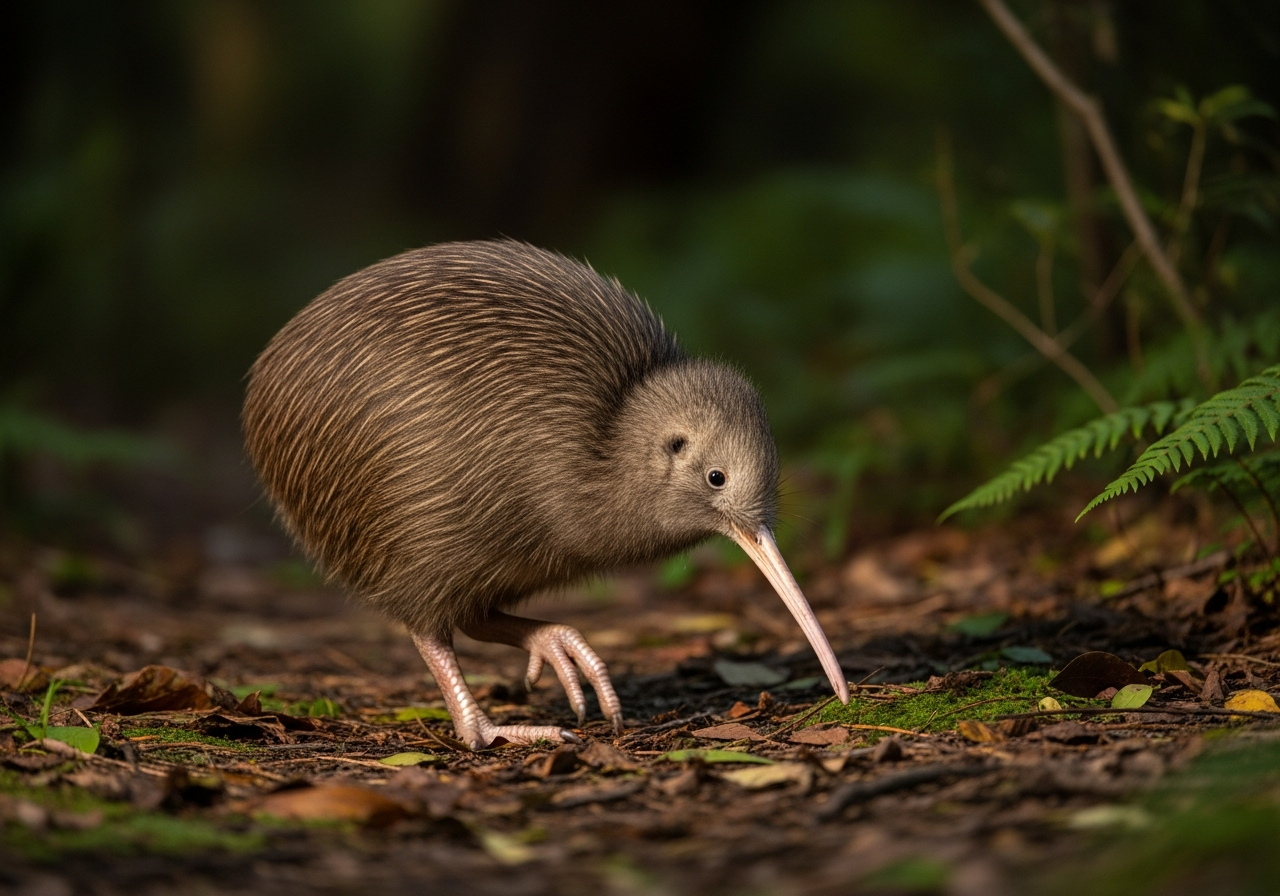
The kiwi is a chicken-sized, flightless bird found only in New Zealand. It is nocturnal, has nostrils at the very tip of its long bill (unique among birds), uses smell to find worms and insects underground, and lays one of the largest eggs relative to body size of any bird — up to about 20% of the female's weight.
Kiwi facts at a glance
| Scientific name | Apteryx australis (Brown Kiwi) |
|---|---|
| Diet | Omnivore (earthworms, insects, berries) |
| Habitat | Native forest, scrubland, and farmland with cover |
| Lifespan | 25–50 years in the wild |
| Weight | 1.3–3.5 kg (3–8 lb) |
| Conservation status | Vulnerable (IUCN; varies by species) |
| Found | New Zealand only |
| Kingdom | Animalia |
|---|---|
| Phylum | Chordata |
| Class | Aves |
| Order | Apterygiformes |
| Family | Apterygidae |
| Genus | Apteryx |
Where it lives
New Zealand only — native to both main islands and several offshore islands; found nowhere else on Earth.
What is a group of kiwis called?
Group name (collective noun)
A group of Kiwis is called a tribe.
Baby name
A baby Kiwi is called a chick.
Explore more animal collective nouns and baby animal names .
What makes the kiwi unique?
The kiwi is one of the most unusual birds alive. Its nostrils are at the tip of its long bill rather than at the base — a feature unique among living birds — giving it a strong sense of smell to detect earthworms, insects, and seeds buried in the soil. Its feathers are loose and hair-like, it has tiny vestigial wings hidden under its plumage, and it has no tail. Its bones are dense and partially filled with marrow like a mammal's, rather than hollow like most birds'. In almost every behavioural and anatomical respect, the kiwi has evolved to fill a ground-mammal niche rather than a typical avian one.
Diet and foraging
Kiwis are nocturnal and feed mainly by probing the ground with their long bill, using smell and touch to locate earthworms, grubs, fallen fruit, and small invertebrates. The bill tip is equipped with sensory pits that detect vibrations and chemical signals underground. Kiwis are one of the very few birds that depend primarily on smell rather than sight to find food — a trait that mirrors how shrews and moles hunt.
The remarkable egg
The female kiwi lays one of the proportionally largest eggs of any bird in the world. A single egg can weigh up to 20% of the female's total body weight — equivalent, in human proportional terms, to giving birth to a six-year-old child. The male incubates the egg for around 75 to 85 days, one of the longest incubation periods of any bird. The chick hatches fully feathered with its eyes open and is largely independent within a week.
Threats and conservation
Kiwi populations have declined dramatically since introduced predators arrived in New Zealand. Stoats are the primary threat to chicks, killing up to 95% of kiwi chicks in unmanaged areas. Rats, cats, ferrets, and dogs also take adults. New Zealand's Department of Conservation runs intensive predator control programmes and egg incubation schemes to protect them. The kiwi is the national bird and symbol of New Zealand, and the source of the nickname 'Kiwis' for New Zealanders.
Frequently asked questions about the Kiwi
Can kiwis fly?
No. Kiwis are completely flightless. Their wings are tiny vestigial structures hidden under their plumage, their breast bone has no keel for flight muscles, and their bones are too dense for flight.
How big is a kiwi egg?
A kiwi egg is enormous relative to the bird — typically 15–20% of the female's body weight, making it one of the proportionally largest eggs of any bird. It is rich in yolk, nourishing the chick through a long incubation of 75 to 85 days.
Are kiwis endangered?
All five kiwi species are threatened to varying degrees. They range from Vulnerable to Endangered on the IUCN Red List. In unmanaged forest without predator control, kiwi populations decline at around 2% per year. Intensive conservation efforts have stabilised and grown some populations.
Why is the kiwi New Zealand's national symbol?
The kiwi has been a national symbol since the late 19th century. Its status as a unique, found-nowhere-else-on-Earth species made it a natural emblem of New Zealand's distinct natural heritage. It appears on coins, military badges, and is the origin of the term 'Kiwi' for New Zealanders.
What do kiwis eat?
Kiwis eat mainly earthworms, which can dominate their diet, along with grubs, spiders, fallen fruit, berries, and small invertebrates. They probe the soil with their sensitive bill tip to detect food by smell and vibration in the dark.
What is a group of kiwis called?
A group of Kiwis is called a tribe.
What is a baby kiwi called?
A baby Kiwi is called a chick.
Sources & references
This guide is compiled and reviewed against established zoological and conservation references. Key sources for the Kiwi:
-
IUCN Red List of Threatened Species
Conservation status (Vulnerable) reflects the IUCN Red List category for Apteryx australis.
-
Global Animal Guide editorial standards
How we research, source, review, and update every guide for accuracy.