Image sourcing: see credits & licences
Quick answer
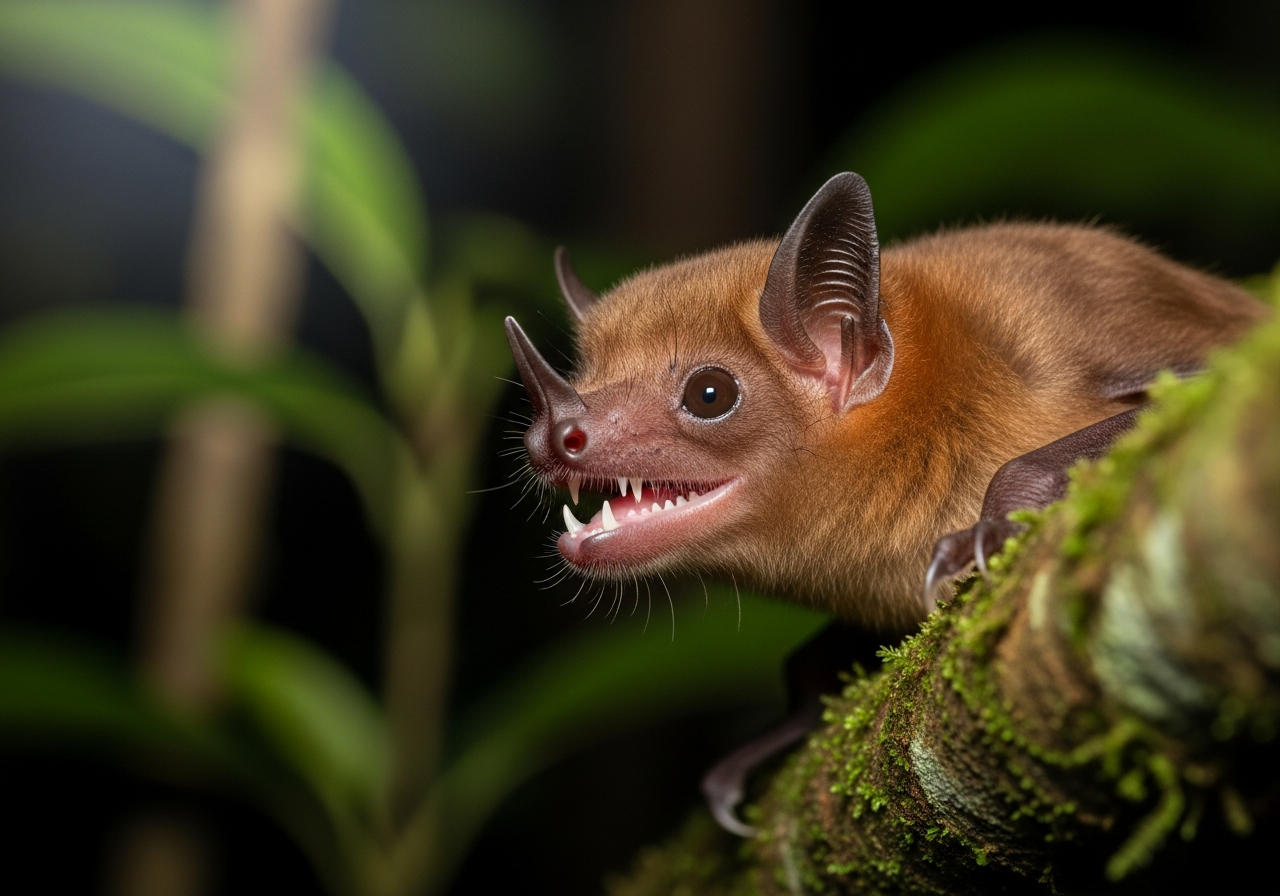
The vampire bat is a small Latin American bat and the only mammal that feeds entirely on blood. It makes a painless bite, laps blood kept flowing by anticoagulant saliva, and shares food with roost-mates that miss a meal. Common vampire bats usually live around 9 to 12 years.
Top questions about the Vampire Bat
Vampire Bat facts at a glance
- Weight 40 g
- Length 9 cm
- Top speed 40 km/h
- Lifespan 12 years
| Scientific name | Desmodus rotundus |
|---|---|
| Diet | Sanguivore (blood) |
| Habitat | Caves and tree hollows in the tropics |
| Lifespan | 9–12 years in the wild |
| Weight | 25–40 g (0.9–1.4 oz) |
| Top speed | Agile flier; can also run on the ground |
| Conservation status | Least Concern (IUCN) |
| Kingdom | Animalia |
|---|---|
| Phylum | Chordata |
| Class | Mammalia |
| Order | Chiroptera |
| Family | Phyllostomidae |
| Genus | Desmodus |
Where it lives
The vampire bat (Desmodus rotundus) is native to Tropics and subtropics of Latin America, from Mexico through Central America to South America. — recorded across South America, North America in this guide’s range summary.
For occurrence records, see GBIF species search and sources below.
How big is a vampire bat?
An adult vampire bat measures 9 cm long — about 5% of the height of an average adult person (1.73 m) — and weighs around 40 g, a small fraction of an average adult’s body weight (70 kg).
Length vs an average adult’s height (to scale)
What is a group of vampire bats called?
Group name (collective noun)
A group of Vampire Bats is called a colony. It is also known as a cloud or a cauldron.
Baby name
A baby Vampire Bat is called a pup.
Explore more animal collective nouns and baby animal names .
A diet of blood
Vampire bats feed only on blood, usually from sleeping livestock and other large animals. Heat sensors on the nose help them find a spot where blood flows close to the skin, and razor-sharp teeth make a small, painless cut. Their saliva contains an anticoagulant that keeps the wound bleeding while they lap, not suck.
Built to move
Unusually for bats, vampire bats are agile on the ground and can run, hop, and leap, which helps them approach prey and take off again afterward. They roost by day in dark caves, hollow trees, and old buildings, often in large colonies.
Vampire bats and people
Vampire bats are not endangered, but they matter to human health because they can transmit rabies to livestock and, rarely, to people. Vaccinating animals and people at risk is more effective than killing bats, which can actually spread the disease further.
Dig deeper into the Vampire Bat
- How Fast Is A Vampire Bat
Dig deeper into vampire bat — how fast is a vampire bat.
- How Long do Vampire Bat Live?
Dig deeper into vampire bat — how long do vampire bat live.
- Vampire Bat: Key Facts
Key facts about the vampire bat — size, diet, habitat, lifespan, and conservation status.
- What do Vampire Bat Eat
Dig deeper into vampire bat — what do vampire bat eat.
- Where do Vampire Bat Live?
Dig deeper into vampire bat — where do vampire bat live.
Explore the Vampire Bat
Collections
Range & geography
Did you know? Vampire Bat facts
- The vampire bat is a small Latin American bat and the only mammal that feeds entirely on blood.
- Yes. Vampire bats are the only mammals that feed entirely on blood, usually from sleeping livestock. They lap the blood from a small cut rather than sucking it.
- The bite itself is tiny and painless, but vampire bats can carry rabies, so any bite from a wild bat should be taken seriously and checked by a doctor.
- Yes. Vampire bats regurgitate blood to feed roost-mates that did not eat, and they form lasting bonds with the individuals who help them.
- Vampire bats live in the tropics and subtropics of Latin America, roosting in caves, hollow trees, and old buildings, often in colonies.
- Conservation: Least Concern (IUCN).
Diet & feeding
Vampire Bat feeds primarily as a sanguivore (blood). Vampire bats feed only on blood, usually from sleeping livestock and other large animals. Heat sensors on the nose help them find a spot where blood flows close to the skin, and razor-sharp teeth make a small, painless cut. Their saliva contains an anticoagulant that
Adaptations
- Vampire bats feed only on blood, usually from sleeping livestock and other large animals. Heat sensors on the nose help them find a spot where blood flows close to the skin, and razor-sharp teeth make a small, painless cut. Their saliva contains an anticoagulant that keeps the wound bleeding while they lap, not suck.
- Vampire bats are remarkably social. A bat that fails to feed will starve within a couple of nights, so well-fed roost-mates regurgitate blood to share with hungry companions. They form long-term bonds and remember which individuals have helped them before.
Behaviour & ecology
- Vampire bats feed only on blood, usually from sleeping livestock and other large animals. Heat sensors on the nose help them find a spot where blood flows close to the skin, and razor-sharp teeth make a small, painless cut. Their saliva contains an anticoagulant that keeps the wound bleeding while they lap, not suck.
- Vampire bats are remarkably social. A bat that fails to feed will starve within a couple of nights, so well-fed roost-mates regurgitate blood to share with hungry companions. They form long-term bonds and remember which individuals have helped them before.
- Unusually for bats, vampire bats are agile on the ground and can run, hop, and leap, which helps them approach prey and take off again afterward. They roost by day in dark caves, hollow trees, and old buildings, often in large colonies.
Communication
- Vampire Bat uses scent, posture, and vocal signals to mark territory and coordinate social behaviour.
- Communication intensity often peaks during breeding seasons and territorial disputes.
Habitat & range
Caves and tree hollows in the tropics
Ecological role
Vampire Bat plays a recognised ecological role in caves and tree hollows in the tropics.
Conservation status of the Vampire Bat
The vampire bat (Desmodus rotundus) is listed as Least Concern on the IUCN Red List. Least Concern (LC) is the IUCN's lowest-risk category, assigned to widespread, abundant species that have been evaluated and found not to be threatened. It does not mean a species faces no pressures — only that it is not currently at risk of extinction.
The vampire bat (Desmodus rotundus) is assessed on the IUCN Red List. Look up on the IUCN Red List .
Frequently asked questions about the Vampire Bat
Do vampire bats really drink blood?
Yes. Vampire bats are the only mammals that feed entirely on blood, usually from sleeping livestock. They lap the blood from a small cut rather than sucking it.
Is a vampire bat's bite dangerous?
The bite itself is tiny and painless, but vampire bats can carry rabies, so any bite from a wild bat should be taken seriously and checked by a doctor.
Do vampire bats share food?
Yes. Vampire bats regurgitate blood to feed roost-mates that did not eat, and they form lasting bonds with the individuals who help them.
Where do vampire bats live?
Vampire bats live in the tropics and subtropics of Latin America, roosting in caves, hollow trees, and old buildings, often in colonies.
How much blood does a vampire bat drink?
A vampire bat drinks about a tablespoon of blood per night, roughly half its body weight, over a feeding session lasting many minutes.
What is a group of vampire bats called?
A group of Vampire Bats is called a colony. It is also known as a cloud or a cauldron.
What is a baby vampire bat called?
A baby Vampire Bat is called a pup.
Sources & references
This guide is compiled and reviewed against established zoological and conservation references. Key sources for the Vampire Bat:
-
IUCN Red List of Threatened Species
Conservation status (Least Concern) reflects the IUCN Red List category for Desmodus rotundus.
-
iNaturalist — observations & photos
Search citizen-science observations and community IDs for Desmodus rotundus. Useful for range checks and recent sightings — not a substitute for formal Red List status.
-
GBIF — occurrence data
Global Biodiversity Information Facility species search for Desmodus rotundus. Explore published occurrence records used in range research.
- IUCN Red List — Desmodus rotundus.
Conservation status (Least Concern) and population trends.
- Animal Diversity Web — Desmodus rotundus. University of Michigan Museum of Zoology.
Life history, morphology, and range.
- Wikipedia — Vampire Bat.
General taxonomy and overview (cross-check primary sources).
-
Global Animal Guide editorial standards
How we research, source, review, and update every guide for accuracy.