Animal Camouflage: How Creatures Hide in Plain Sight
From chameleons to cuttlefish, snow leopards to stick insects — how camouflage works, the main types, and why some animals change colour while others stay still.
Global Animal Guide · June 23, 2026
Quick answer
Camouflage helps animals avoid predators or ambush prey by matching their surroundings. Main types include background matching (blending with habitat), disruptive colouration (patterns that break up the body's outline), mimicry (looking like something else), and active camouflage (rapid colour change in cephalopods). Effectiveness depends on staying still, choosing the right perch, and seasonal coat changes in some mammals.
Why camouflage evolved
If you cannot outrun a predator or overpower prey, not being seen is a powerful survival strategy. Camouflage reduces the chance of detection by matching colour, pattern, shape, or behaviour to the environment. Natural selection favours individuals that predators overlook — or that prey walk past.
What makes concealment such a common answer is that it is cheap. Speed costs muscle and fuel; armour costs weight; venom costs a metabolically expensive gland. Looking like a twig costs almost nothing to run once the pattern is built, which is why camouflage has evolved independently in nearly every animal group — insects, fish, reptiles, birds, mammals, and cephalopods have all arrived at it separately.
The crucial thing to understand is that camouflage is not about matching the world in some absolute sense. It is about defeating a particular viewer. A pattern is only ever cryptic to someone, at a certain distance, in certain light, against a certain background — and the animal doing the looking may see colours we cannot.
Main types of camouflage
Background matching — The animal’s colours resemble its usual habitat. A stick insect looks like a twig; a snow leopard’s rosettes mimic broken rock and shadow on mountainsides.
Disruptive colouration — Bold stripes or spots break up the body’s outline so the brain cannot easily assemble a “deer” or “tiger” shape. Zebras in a herd create visual confusion when lions charge.
Countershading — Many fish, sharks, and deer are darker above and lighter below. From above they blend with the dark seafloor or forest floor; from below they match bright surface light.
Mimicry — Some harmless species imitate dangerous ones (hoverflies resembling wasps). Others mimic inedible objects — caterpillars that look like bird droppings, or orchid mantises resembling flowers to lure pollinating insects.
Active camouflage — Octopuses, cuttlefish, and some squid change skin colour and texture in seconds using specialised cells (chromatophores). They can shift pattern for hiding, signalling, or hunting.
These categories overlap constantly. The tiger is doing background matching and disruptive colouration at once — orange reads as dull green to the colour-blind deer it hunts, while the stripes dissolve its outline in tall grass. Most real animals are running two or three of these strategies simultaneously.
How the mechanisms actually work
Disruptive colouration is the least intuitive of the set and the most instructive. Vision does not deliver objects; it delivers edges, which a brain then assembles into shapes. A high-contrast band running off the true edge of the body creates a false edge that the visual system latches onto, and the real outline is lost in the process. This is why disruptive markings so often sit on the body’s silhouette rather than in the middle of it, and why they work best when the animal is against a cluttered background with plenty of competing edges.
Countershading solves a different problem: shadow. Lit from above, any solid body is bright on top and dark underneath, and that gradient betrays it as three-dimensional even if the colour is a perfect match. A back that is darker than the belly cancels the gradient, flattening the animal into something the eye reads as a patch of nothing. The elegant confirmation is that species living upside down have it reversed — some catfish that swim inverted are dark on the belly and pale on the back.
Active camouflage is the strangest of all, because cephalopods are almost certainly colour-blind. An octopus matching a reef has no direct way to see the colours it is reproducing. It appears to work from brightness and contrast, and possibly from light-sensitive proteins in the skin itself — an animal seeing, in some limited sense, with its whole body. Its chromatophores are pigment sacs pulled open by muscle and driven directly by nerves, which is why the change takes milliseconds rather than the days a chameleon-style hormonal shift would need.
Seasonal and behavioural camouflage
The Arctic fox grows a white winter coat and moults to brown-grey in summer. Ptarmigan and snowshoe hares do the same. Owls rely on cryptic plumage plus staying motionless against tree bark. Flatfish settle on the seabed and adjust pigment to match the sand.
Behaviour matters as much as colour: freezing in place, choosing a perch that completes the illusion, or moving only when the predator looks away.
That behavioural half is easy to underrate. A stick insect’s shape is worthless unless it also holds its legs along its body and sways gently, as a twig in wind would. Moths with bark-like wings orient themselves to align their pattern with the grain of the trunk, and get eaten more often when they land the wrong way round. The pattern is the equipment; the behaviour is the skill.
Seasonal coat change is triggered by day length, not by snow — a reliable cue for tens of thousands of years and an increasingly dangerous one now. A snowshoe hare turns white on schedule whether or not the snow has arrived, and in winters that begin late it spends weeks as a conspicuous white animal on brown ground.
Limits of camouflage
Camouflage fails when habitat changes faster than evolution — urban foxes on lawns, polar bears on bare tundra without snow, or reef fish on bleached coral. Movement, scent, and sound still give animals away. Many prey species combine camouflage with eyes on the sides of the head, herding, or alarm calls as backup defences.
There is also an inescapable trade-off with everything else an animal needs to do. Hiding and advertising are opposite tasks, so a cryptic animal cannot easily court, defend a territory, or warn off a rival. Many species resolve it by keeping the two on separate surfaces — a red-eyed tree frog is plain green and invisible at rest, then flashes vivid flanks and eyes to startle a predator that has already found it.
And a predator’s search image is a moving target. Hunters that repeatedly find one prey type get better at spotting it, which quietly punishes the commonest version of a camouflage pattern and rewards the rare one. This is one reason cryptic species so often come in several distinct forms at once: the best defence against a learning enemy is not to be typical.
Camouflage in human terms
Military and hunting gear borrowed these principles centuries ago. Studying animal concealment also inspires robotics, materials science, and understanding how predators and prey drive each other’s evolution in an endless visual arms race.
The debt is direct. Disruptive colouration entered military thinking through the zoologist and painter Abbott Thayer, whose work on countershading fed into the dazzle painting of First World War ships — hulls covered in clashing geometric blocks that made no attempt to hide the vessel and instead wrecked a rangefinder’s estimate of its heading and speed. Modern digital camouflage rests on the same insight the cuttlefish exploits: what matters is the scale of the pattern relative to the viewer’s distance, so a good pattern must work at more than one scale at once.
Sources
Related reading: Barn owl guide · Octopus guide · Fastest animals on Earth
Frequently asked questions
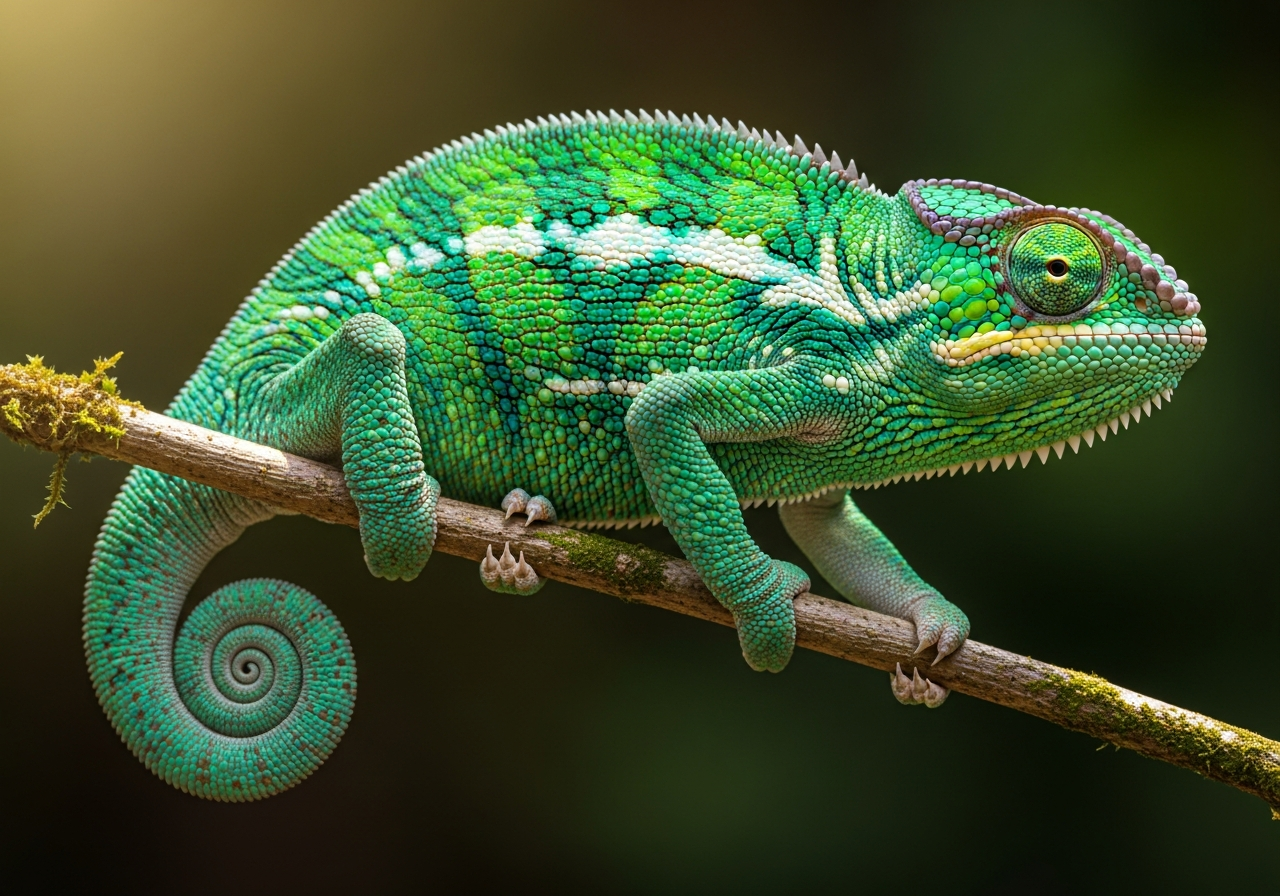
Do chameleons change colour to match any background?
Partly — colour change reflects mood, temperature, and light more than a perfect wallpaper match, though some species do adjust for camouflage.
What is countershading?
Darker backs and lighter bellies flatten the body's 3D appearance in sunlight, making animals harder to spot.
Which animal has the best camouflage?
Many contenders — leaf-tailed geckos, stonefish, owls, and Arctic foxes in winter white are among the most striking examples.
Can predators use camouflage too?
Yes — ambush hunters like leopards, crocodiles, and praying mantises rely on concealment to get close before striking.